
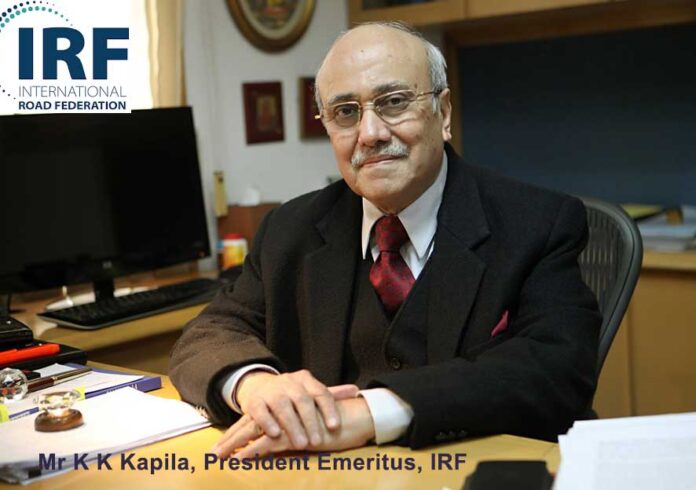
The International Road Federation (IRF), a Geneva-based global road safety organisation, has expressed serious concern over the rising number of road accidents on the Yamuna Expressway, particularly deadly multi-vehicle collisions caused by dense winter fog.
Highlighting the unique concrete road surface of the Yamuna Expressway, IRF President Emeritus Mr K K Kapila said many drivers are unaware that such surfaces require specific tyre conditions and cautious driving practices, especially during low visibility. He emphasised that road safety in foggy conditions demands drastically reduced speeds (around 30 km/h), use of low-beam headlights, maintaining large following distances, avoiding sudden braking or lane changes, and remaining fully alert without distractions. Drivers should rely on indicators, fog lights and lane markers, and if visibility drops to zero, safely pull over until conditions improve.
Mr Kapila noted that driving conditions on expressways such as the Mumbai–Pune and Noida–Agra corridors, as well as newly constructed highways, differ significantly from regular roads. He stressed the urgent need for Intelligent Transport Systems (ITS), strict speed enforcement and advance warnings on weather, road and driving conditions to be provided by road concessionaires.
Advising motorists to prepare vehicles before winter travel, he underlined the importance of checking electrical systems, windscreen washers and wipers, battery, engine oil, brakes and tyres. He also recommended that vehicles be equipped with both front and rear fog lamps during fog season.
Citing multiple studies, Mr Kapila said human error—primarily negligent driving—remains the leading cause of accidents on expressways. Over speeding, wrong overtaking, driver fatigue, drowsiness, monotonous driving and sudden lane changes were identified as major contributors.
He further called for the deployment of Intelligent Traffic Management Systems, including speed cameras and digital warning boards, to enhance enforcement and driver awareness. Such systems, widely used in developed countries, can capture vehicle details, display warnings in real time and relay information to control rooms.
Additional safety measures suggested include setting up trauma care centres, air ambulance services, highway surveillance systems, truck terminals at expressway ends and the use of wire rope crash barrier systems.
Mr Kapila concluded by noting that global bodies such as the World Health Organization and the World Bank remain concerned about rising road fatalities worldwide, despite countries like India committing to the UN Decade of Action for Road Safety. He stressed that a coordinated, holistic and safe-system approach—integrating road design, vehicle safety, speed management and responsible road user behaviour—is essential to achieve the target of halving road deaths by 2030.