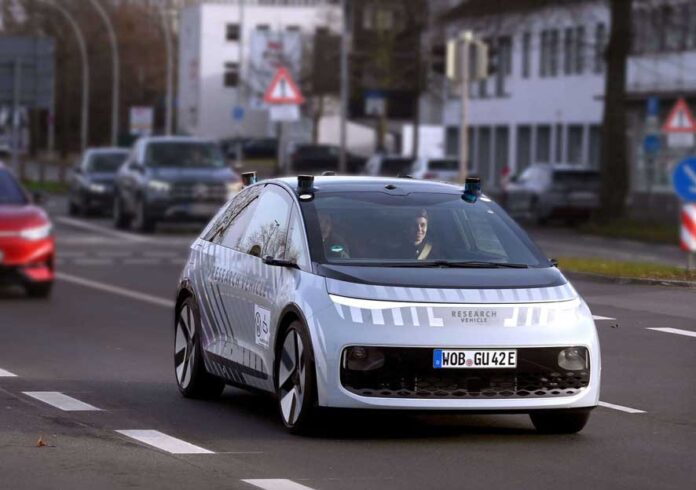
Volkswagen Group has entered a new phase in autonomous mobility research with the launch of real-world testing for its self-driving research vehicle, Gen.Urban, in Wolfsburg, Germany. Following extensive development and closed-track trials, the vehicle is now capable of navigating live urban traffic autonomously, marking a significant milestone in the Group’s future mobility roadmap.
The Gen.Urban project is designed to study how passengers experience travel in a fully autonomous vehicle without traditional controls such as a steering wheel or pedals. The research focuses on redefining vehicle interiors and understanding how mobility transforms when occupants are no longer required to drive.
An interdisciplinary team from Volkswagen Group Innovation—bringing together designers, human factors specialists, software engineers, and materials experts—is conducting detailed observations and data analysis. The team is examining passenger behaviour, interaction patterns, and comfort levels to gain insights into how people use their time inside a self-driving vehicle.
Key areas of investigation include how passengers choose to work, relax, or entertain themselves while travelling autonomously, and which digital features and interior layouts best support these activities. Special emphasis is also being placed on inclusive design, ensuring intuitive and safe interaction for children, elderly passengers, and users with varying mobility needs.
The insights generated from the Gen.Urban trials will play a crucial role in shaping future interior architectures, user experience (UX) concepts, and human-machine interfaces across Volkswagen Group’s global brand portfolio. At the core of the research lies a fundamental question that will define the success of autonomous mobility: Do passengers feel comfortable, confident, and at ease when the vehicle takes full control?
Gen.Urban delivers a personalized driving experience even before the journey begins
Even before departure, passengers can customize their preferences – via app or directly in the vehicle – from cabin temperature to ambient lighting. Upon entering, the Gen.Urban greets the passenger, and the seat automatically adjusts to the desired position. In addition, the vehicle’s digital interior can be tailored to individual preferences using artificial intelligence (AI). The wide front display with its information, light, and sound is then adapted to an individual theme.
Gen.Urban is designed without a traditional steering wheel or pedals. The test participant sits in the driver’s seat, while a trained safety driver monitors the vehicle from the passenger seat. If necessary, the safety driver can intervene at any time using a specially developed control panel with a joystick.
The current test phase initially involves Volkswagen Group employees. The test phase is planned for a period of several weeks.
Dr. Nikolai Ardey, Head of Volkswagen Group Innovation, explains: “The technology for autonomous driving is making rapid progress. With our Gen.Urban research vehicle, we want to understand exactly how passengers experience autonomous driving. Because: The key to a positive customer experience is to build trust – through meaningful interaction, a relaxed atmosphere, and intelligent assistance systems that respond precisely to the needs of passengers. Ultimately, technology should fit people, not the other way around. We will benefit from these insights across the entire Group in the long term.”
Test route in Wolfsburg city area with typical traffic scenarios
The starting point of the test route is the visitor parking lot at the HQ building. From there, the nearly ten-kilometer loop runs through Wolfsburg’s city area, passing the Sandkamp factory gate, Saar and Lessing streets, Brandenburger Platz, Breslauer Street, Grauhorststraße, and finally returning via Heinrich-Nordhoff-Street. Traffic light intersections, roundabouts, current construction sites, residential areas, industrial sections, and possibly congested traffic: the route is chosen to correspond to typical challenges of urban traffic. Each test drive lasts approximately 20 minutes.