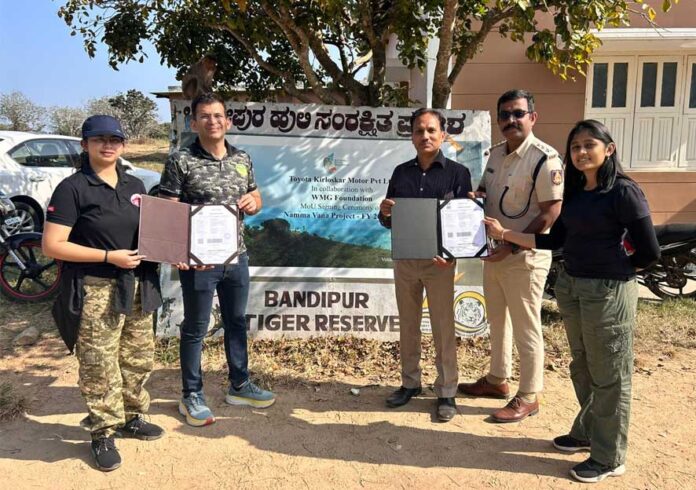
Toyota Kirloskar Motor (TKM) has signed a Memorandum of Understanding (MoU) with the WMG Foundation to support an environmental habitat restoration initiative at the Bandipur Tiger Reserve in Karnataka. The project aims to rejuvenate degraded forest landscapes while addressing ecological imbalance and mitigating human–animal conflict in the region.
The initiative will focus on the systematic removal of the invasive Lantana camara weed, which poses a significant threat to native biodiversity and wildlife movement. By restoring natural habitats, the programme seeks to strengthen ecosystem health and enhance coexistence between wildlife and surrounding communities.
The MoU was formally exchanged by Mr. Roshan R, General Manager – Corporate Social Responsibility, Toyota Kirloskar Motor, in the presence of Ms. Apoorva Angadi V M, Head, WMG Foundation, underscoring the shared commitment of both organisations towards sustainable conservation and environmental stewardship.
Bandipur Tiger Reserve has long been impacted by Lantana camara an invasive species that covers nearly 50–60% of the reserve’s buffer and core areas. This infestation has suppressed native grasses, reduced forage for herbivores, fragmented wildlife corridors, and increased tiger movement towards human settlements.
Aligned with TKM’s core commitment to protecting flora and fauna and safeguarding Mother Earth, the initiative will focus on long-term ecological restoration. Under this program, TKM will support the removal of Lantana camara across the designated forest area, followed by extensive habitat restoration interventions. This enables restoration of native vegetation by allowing native grasses, shrubs, and tree seedlings to regenerate. As natural vegetation revives, forage availability for herbivores such as deer, gaur, and elephants will improve, strengthening the prey base that sustains the tiger population. It will also stabilize tiger territories, reducing their movement outside forest areas and lowering conflict with humans.
To sustain the project, TKM will extend maintenance support over the next two years to prevent the regrowth of Lantana camara and ensure long-term ecological outcomes. This will include scheduled weeding cycles, patch planting in areas with low survival rates, reinforcement of fire lines ahead of the summer season, and ongoing monitoring of wildlife usage within the restored habitat.
Speaking about the initiative, Mr. Sudeep Dalvi, Chief Communication Officer, Senior Vice President and Director, Toyota Kirloskar Motor, said, “Namma Vana Project reflects Toyota’s deep commitment to nurturing ecological resilience and protecting India’s rich biodiversity. Through this project, we aim to restore natural habitats, strengthen wildlife corridors, and reduce human–wildlife conflict in one of Karnataka’s most treasured forest landscapes. This initiative strengthens our belief that sustainable conservation is possible only through collective community actions”
For more than two decades, TKM remained committed to uplifting communities through initiatives spanning Education, Environment, Road Safety, Skill Development, Health & Hygiene, and Disaster Management. Guided by a need-based and sustainability-driven CSR philosophy, TKM’s interventions are designed to promote socio-economic development and long-term community well-being.
Lantana camara, commonly known as common lantana or red sage, is an invasive perennial shrub native to the tropical Americas. It spreads rapidly through bird-dispersed seeds and roots, forming dense thickets that suppress native species. Its aggressive growth alters nutrient cycling and fire regimes, reduces forage availability, and interferes with natural succession in a wide variety of ecosystems, especially open and disturbed habitats.