
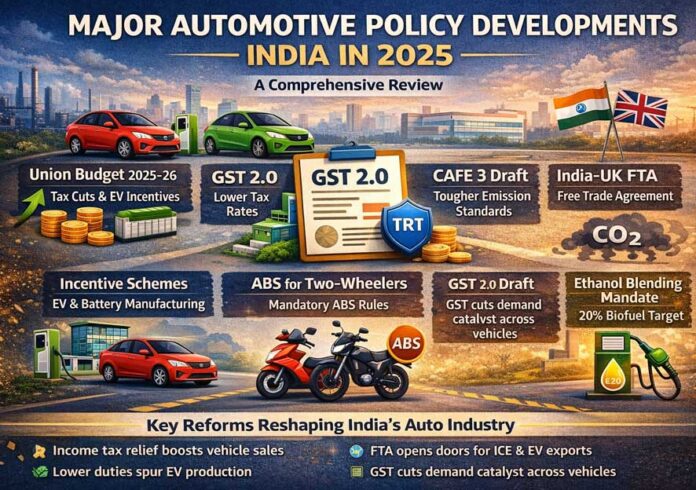
2025 emerged as a defining year for India’s automotive industry, marked by a rapid succession of policy interventions that reshaped market sentiment, investment priorities and product strategies. As India pushed harder on localisation, electrification and safety—while navigating global supply-chain disruptions and geopolitical uncertainties—government incentives and regulatory clarity became decisive levers for growth.
From a reform-driven Union Budget and tighter fuel-efficiency norms to GST 2.0 tax rationalisation, ethanol blending and two-wheeler safety mandates, policy actions in 2025 collectively set the direction for the industry’s next growth cycle.
Union Budget 2025-26: Boosting Demand and Electrification
The year began with a consumer-friendly Union Budget, setting the tone for automotive-related reforms. By exempting individuals earning up to ₹12 lakh annually (₹12.75 lakh for salaried taxpayers after standard deduction) from income tax under the new regime, the government aimed to boost disposable income and revive demand.
Financial analysts estimated that nearly ₹1 lakh crore would flow back into households, with individual savings of up to ₹80,000. Industry observers expected this increase in purchasing power to support entry-level cars and two-wheelers, segments that had been under pressure due to rising ownership costs.
Incentives for EV and Battery Manufacturing
On the supply side, the Budget delivered significant relief to lithium-ion battery and EV component manufacturers. The government fully exempted basic customs duty on 35 additional capital goods used in battery manufacturing and removed duties on waste and scrap of lithium-ion batteries, cobalt powder, lead, zinc and other critical minerals. Earlier, these materials attracted customs duties ranging from 2.5% to 10%.
Motorcycle Import Duty Cuts
The Budget also rationalised import duties on motorcycles:
- Sub-1600 cc motorcycles:
- CBU duty reduced from 50% to 40%
- SKD from 25% to 20%
- CKD from 15% to 10%
- Large motorcycles saw steeper reductions, with CBU duty falling to 30%.
These changes lowered prices of premium and performance motorcycles, a segment gaining traction in India.
Incentive Schemes: Mixed Progress
SPMEPCI and the Elusive Global EV Majors
One of the most anticipated announcements was the Scheme to Promote Manufacturing of Electric Passenger Cars in India (SPMEPCI). Designed to attract global EV players—including Tesla—the scheme allowed limited CBU imports at concessional duty rates in return for firm manufacturing commitments in India.
However, the programme failed to attract applicants. With the application window closing in October 2025 without a single OEM applying, industry experts pointed to ongoing FTA negotiations with Europe and the US as a key deterrent.
PLI ACC Scheme Faces Delays
The PLI Advanced Chemistry Cell (ACC) scheme, launched in 2021 with an outlay of ₹18,100 crore to create 50 GWh of battery capacity by December 2024, also struggled. As of June 2025, only 1.4 GWh had been commissioned. The government reportedly issued notices to all three beneficiaries for missing mandated milestones, signalling stricter enforcement.
India–UK Free Trade Agreement: A Strategic Shift
Signed in July 2025, the India–UK Free Trade Agreement (FTA) opened new opportunities for exports, investment and technology collaboration in the automotive sector.
ICE Vehicles: Gradual Market Opening
Under the agreement, India’s import duties on ICE vehicles—earlier ranging between 66% and 110%—will be gradually reduced to as low as 10% over five years, depending on engine size.
EVs: Export Opportunity for India
The FTA adopts a more protective stance for alternative-fuel vehicles. The UK will eliminate import duties on Indian EVs from year six, offering Indian manufacturers a fresh export avenue while ensuring a calibrated opening of India’s domestic market.
Draft CAFE 3 Norms: Tighter Targets, New Flexibility
One of the most impactful regulatory developments was the release of the draft Corporate Average Fuel Economy (CAFE 3) norms, which will apply from April 2027.
Unlike per-model limits, CAFE norms measure sales-weighted fleet-average CO₂ emissions, forcing OEMs to balance high-emission vehicles with efficient or zero-emission models.
Relief for Small Cars
For India’s price-sensitive small-car segment, the draft offers limited relief. Petrol cars under 4 metres, with engines up to 1,200 cc and weighing up to 909 kg, can claim an additional 3 g CO₂/km reduction, capped at 9 g/km per model annually.
Despite this, fleet-wide limits are expected to tighten sharply—from around 88.4 g CO₂/km in 2027-28, falling progressively thereafter.
Boost for EVs and Range-Extender Hybrids
Battery electric vehicles and range-extender hybrids (REEs) receive a strong push, counting as three vehicles in fleet-average calculations. This multiplier makes REEs an attractive bridge technology for offsetting emissions from larger ICE vehicles.
Emissions Pooling Introduced
Another structural shift is the introduction of emissions pooling, allowing up to three OEMs to combine fleets for compliance. This opens the door to strategic alliances, shared compliance burdens and reduced penalties under tighter norms.
Mandatory ABS for Two-Wheelers
In a major road safety move, the Ministry of Road Transport and Highways proposed mandatory ABS for all two-wheelers from January 1, 2026, along with the requirement to supply two BIS-certified helmets with every vehicle.
The mandate extends ABS to all L2-category two-wheelers, replacing Combined Braking Systems (CBS) even in entry-level models. While the move significantly enhances safety, it also raises concerns about price increases in the commuter segment, which remains highly cost-sensitive.
Ethanol Blending: E20 Rollout and the Flex-Fuel Debate
The rollout of 20% ethanol blending (E20) sparked concerns among owners of older vehicles over mileage loss, engine wear and warranty coverage.
The government responded by citing tests conducted by ARAI, IIP and Indian Oil, which showed no abnormal wear-and-tear and only marginal mileage reduction. SIAM also assured consumers that OEMs would honour warranties for older vehicles using E20.
With surplus ethanol capacity, automakers and sugar manufacturers are now urging the government to prioritise flex-fuel vehicles, seeking tax incentives and a clear price advantage for ethanol over petrol instead of moving directly to higher blends like E25 or E30.
GST 2.0: The Biggest Demand Catalyst of 2025
The most consequential policy shift came in September 2025 with the introduction of GST 2.0, fundamentally reshaping vehicle taxation.
Key GST Changes
- Small cars: GST reduced from 28% to 18%
- Larger cars and SUVs: Flat GST of 40%, replacing cess-based rates
- Two-wheelers up to 350 cc: GST cut from 28% to 18%
These changes simplified pricing, improved affordability and triggered a strong demand revival, clearly visible during the festive season when multiple segments posted record sales.
Conclusion: A Transformational Year for Indian Automotive Policy
From tax reforms and trade agreements to safety mandates and emission regulations, 2025 proved to be one of the most policy-intensive years for India’s automotive sector. While some schemes faced execution challenges, measures like GST 2.0, CAFE 3 norms and safety upgrades have laid the groundwork for a more competitive, efficient and sustainable industry.
As automakers recalibrate strategies for the rest of the decade, the policy decisions of 2025 will likely be remembered as the inflection point that reshaped India’s automotive future.