
Digital Transformation Reshaping Auto Parts Buying
The global automotive aftermarket is undergoing a significant digital shift as changing consumer preferences and rapid technological advances reshape how spare parts are purchased. Where vehicle owners once depended largely on brick-and-mortar retailers and service centres, convenience, price transparency, and home delivery are now accelerating the move toward online platforms.
Auto parts e-commerce is redefining aftermarket procurement by enabling customers to easily search, compare, and purchase replacement components across a wide range of vehicle categories. Supported by advanced digital fitment tools and data-driven catalogues, online marketplaces are improving accuracy, reducing returns, and enhancing the overall buying experience.
Growth in global vehicle parc, extended vehicle lifecycles, and rising maintenance and repair needs continue to drive steady demand for replacement parts. E-commerce platforms are increasingly serving not only individual consumers but also workshops, garages, and fleet operators seeking faster, more efficient sourcing solutions. As digital infrastructure and logistics capabilities expand worldwide, auto parts e-commerce is emerging as a critical pillar of the modern automotive aftermarket ecosystem.
Market Growth Outlook: Strong Revenue Expansion Ahead
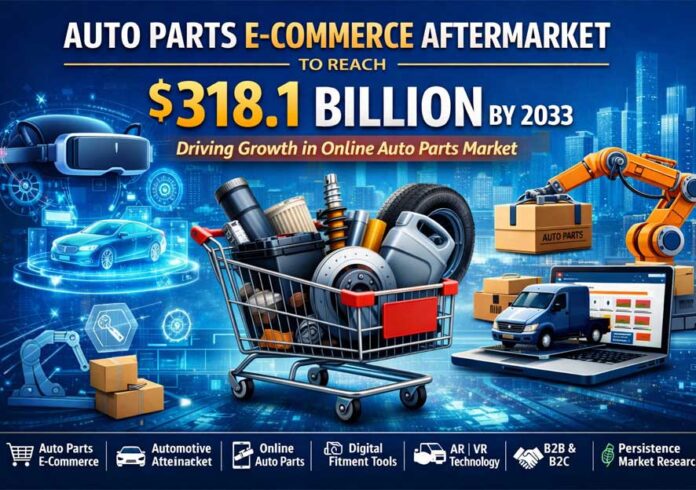
The auto parts e-commerce aftermarket is witnessing remarkable revenue expansion as online retail becomes mainstream in automotive maintenance. According to the latest study by Persistence Market Research, the global auto parts e-commerce aftermarket is likely to be valued at US$121.8 billion in 2026 and is expected to reach US$318.1 billion by 2033. This impressive growth reflects a strong CAGR of 14.7% during the forecast period from 2026 to 2033. The expansion is largely driven by the increasing prevalence of online shopping for vehicle maintenance, rising demand for cost-effective replacement parts, and advancements in digital platforms equipped with AR/VR-based fitment tools.
This strong growth trajectory highlights how digital transformation is reshaping aftermarket supply chains. Online marketplaces are bridging the gap between manufacturers, distributors, and end users by reducing intermediaries and improving inventory visibility. As logistics networks improve and cross-border trade becomes easier, customers can now access genuine parts from global suppliers. This market evolution is making vehicle maintenance more accessible, affordable, and efficient across regions.
Changing Consumer Behavior and Online Buying Preference
Consumer behavior has significantly evolved in the automotive aftermarket landscape. Today’s vehicle owners prefer researching parts online before making a purchase decision. The availability of product reviews, video tutorials, installation guides, and price comparisons has empowered buyers to make informed choices. E-commerce platforms also offer flexible payment options, return policies, and fast delivery, enhancing overall customer satisfaction.
Additionally, younger tech-savvy consumers are more comfortable purchasing auto parts online rather than visiting brick-and-mortar stores. This trend has encouraged aftermarket suppliers to strengthen their digital presence and invest in user-friendly interfaces. Mobile commerce is further accelerating this shift, allowing customers to order parts anytime and anywhere. As trust in online automotive marketplaces grows, digital channels are expected to dominate aftermarket sales in the coming years.
Technology Advancements: AR/VR Fitment and Smart Platforms
Technological innovation is playing a crucial role in overcoming one of the biggest challenges in online auto parts shopping — product fitment accuracy. Advanced e-commerce platforms now integrate AR and VR-based fitment tools that allow users to virtually check whether a part matches their vehicle model. These tools minimize return rates, improve buyer confidence, and enhance the overall purchasing experience.
Artificial intelligence and data analytics are also transforming platform efficiency. AI-powered recommendation engines suggest suitable parts based on vehicle details and browsing behavior. Meanwhile, real-time inventory management ensures better stock availability and faster fulfillment. Blockchain-based supply tracking and digital authentication are further addressing concerns related to counterfeit parts. As technology continues to advance, online aftermarket platforms are becoming more reliable, intelligent, and customer-centric.
Market Segmentation: Diverse Demand Across Categories
The auto parts e-commerce aftermarket caters to a broad mix of customer segments, product categories, and geographic regions, creating multiple growth opportunities for market participants. Differing customer requirements drive the need for tailored digital solutions, while a wide component portfolio supports consistent demand and recurring sales. The market is segmented as follows:
Market Segmentation
By Customer Type: B2B, B2C
By Component Type: Batteries, Cooling Systems, Underbody Components, Automotive Filters, Engine Components, Lighting Components, Electrical Components, Tires
By End User: End Consumers, Workshops, Others
By Region: North America, Europe, Asia Pacific, Latin America, Middle East & Africa
This segmentation highlights strong participation from both individual vehicle owners and professional repair networks. B2C channels continue to expand through direct-to-consumer models offering convenience and competitive pricing, while B2B transactions support bulk sourcing for garages and service centres. High-demand product categories—including batteries, filters, tires, and lighting components—remain key contributors to sustained online sales growth worldwide.
Regional Performance: Digital Aftermarket Expansion Worldwide
North America currently leads the auto parts e-commerce aftermarket due to high vehicle ownership, strong digital infrastructure, and well-established online retail ecosystems. Consumers in the region widely adopt online shopping for maintenance parts, supported by quick delivery networks and trusted platforms. Europe follows closely, driven by strict vehicle inspection regulations and demand for genuine replacement parts across aging vehicle fleets.
Asia Pacific is emerging as the fastest-growing region, supported by rapid urbanization, rising disposable income, and expanding automotive ownership. Countries such as China and India are witnessing a surge in online automotive marketplaces, supported by improving logistics and smartphone penetration. Latin America and the Middle East & Africa are also experiencing gradual adoption, offering future growth potential as internet accessibility and e-commerce trust continue to strengthen.
Supply Chain Transformation and Logistics Efficiency
The rise of online aftermarket platforms has streamlined traditional automotive supply chains. Manufacturers and distributors now reach end-users directly, reducing dependency on physical intermediaries. This shift results in lower costs, improved inventory management, and faster order fulfillment. Warehousing automation and regional distribution centers further support rapid delivery timelines.
Additionally, digital supply networks improve transparency by allowing real-time tracking of shipments and stock availability. This is especially beneficial for workshops that require urgent part replacement to reduce vehicle downtime. Reverse logistics systems also enable smooth returns and replacements, increasing customer confidence. As supply chain digitalization expands, online aftermarket ecosystems will continue to gain operational efficiency and competitive advantage.
Company Insights: Key Players Shaping the Market
The auto parts e-commerce aftermarket is highly competitive, with established automotive suppliers and online retailers expanding their digital footprint. These companies are investing in advanced platforms, global distribution networks, and customer experience enhancements to strengthen market presence.
Key Players Operating in the Market:
✦ DENSO
✦ Valeo
✦ AutoZone & O’Reilly Auto Parts
These players are focusing on digital catalogs, AI-based part selection, strategic partnerships, and global logistics expansion to maintain leadership in the evolving aftermarket environment.
Future Opportunities and Market Outlook
The future of the auto parts e-commerce aftermarket looks highly promising as digital commerce becomes integral to automotive maintenance. Growth opportunities will emerge from subscription-based maintenance services, predictive part replacement using telematics data, and integration with connected vehicle platforms. Personalized customer experiences and voice-assisted ordering features may soon become standard offerings.
Furthermore, electric vehicles are creating new aftermarket demand for specialized components such as battery systems, charging accessories, and electronic modules. As EV adoption rises, online aftermarket platforms will expand their product portfolios to accommodate these evolving requirements. With continuous innovation, improved logistics, and growing digital trust, the auto parts e-commerce aftermarket is well-positioned to sustain strong long-term growth.
Conclusion: A Digitally Driven Aftermarket Era
The auto parts e-commerce aftermarket is transforming the way vehicle maintenance and replacement parts are purchased globally. Driven by convenience, technological innovation, cost efficiency, and expanding digital infrastructure, the market is entering a high-growth phase. With projected revenues rising from US$121.8 billion in 2026 to US$318.1 billion by 2033 at a CAGR of 14.7%, the industry presents lucrative opportunities for manufacturers, suppliers, and digital retailers alike.
As consumer expectations evolve and digital tools become more advanced, online aftermarket platforms will continue to redefine automotive service ecosystems. Businesses that invest in smart technologies, supply chain efficiency, and customer-centric digital experiences will emerge as leaders in this rapidly expanding global marketplace.