As India grapples with worsening air quality, rising fuel import dependence, and ambitious climate commitments, biofuels and advanced clean mobility solutions are emerging as immediate and scalable opportunities to drive environmental gains, enhance rural incomes, and strengthen energy security.
Ahead of the Union Budget 2026–27, the Indian Sugar and Bio-energy Manufacturers Association (ISMA) has urged the Government of India to implement comprehensive GST rationalisation and extend targeted policy support across the biofuels and clean mobility value chain. According to the association, such measures could enable faster emissions reductions, protect farmer livelihoods, lower crude oil imports, and accelerate India’s progress towards its Net Zero goals.
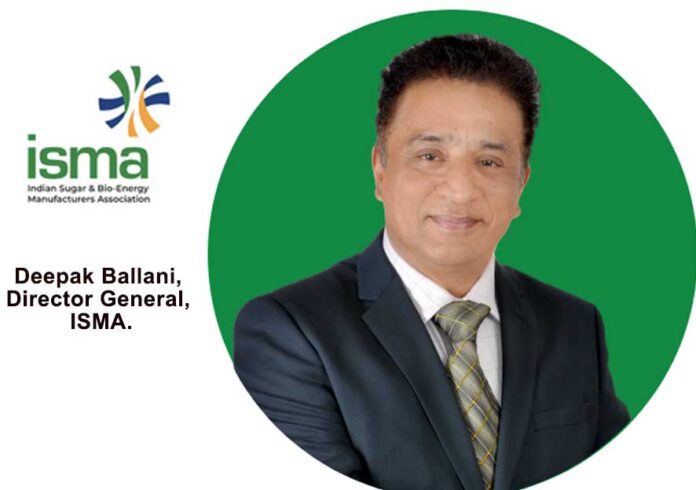
“The Union Budget 2026–27 presents a defining moment to align India’s fiscal policy with its clean energy ambitions. Our 10 point submission is a blueprint to transform the Indian sugar complex from a single-commodity sector into a multi-vertical ‘BioEnergy Hub’ for the world. We are urging the Government to establish a level playing field by rationalizing GST on Flex-Fuel Vehicles and hybrids, positioning them alongside EVs as a mainstream solution. By incentivizing advanced biofuels like SAF, Green Hydrogen, and Isobutanol, we can unlock immediate carbon reduction without waiting for new infrastructure. This policy push is essential to ensure that our farmers remain at the center of India’s journey toward energy independence and Net Zero.” said Deepak Ballani, Director General, ISMA.
ISMA emphasised that its proposals present an unprecedented opportunity to align India’s tax structures and energy policies with clean air goals, rural economic stability and long-term energy security. With surplus ethanol availability, mature production capacity and vehicle technologies already validated in India, the country can secure significant emissions reduction without waiting years for new infrastructure rollout.
1. Align GST on Flex-Fuel Vehicles (FFVs) and Strong Hybrid Electric Vehicles (SHEVs): ISMA has recommended reducing GST on FFV two-wheelers and small cars from 18% to 5%, and on large FFVs from 40%, to achieve cost parity with conventional petrol vehicles, while aligning duties on HEVs and related components with electric vehicles. ISMA has also proposed targeted government procurement and fleet adoption of FFVs, along with demand-side incentives similar to FAME II to reduce acquisition costs and accelerate consumer adoption.
2. Reduce GST on Hydrous Ethanol (E85/E100) to 5%: With ethanol recognised as a carbon-neutral fuel, ISMA has urged reduction of GST on E85/E100 from 18% to 5% to ensure pump prices remain competitive with petrol while compensating for mileage differentials. Notifying distilleries as dispensing entities will also strengthen last-mile availability.
3. Reduce GST on Ethanol Production Machinery to 5%: To accelerate sectoral growth, ISMA has proposed lowering GST on ethanol-related equipment from 18–28% to 5%, following the successful model adopted during India’s early solar expansion.
4. Support Fund of ₹200 crore for Isobutanol Trials: To diversify ethanol utilisation beyond the E20 ceiling, ISMA has sought a ₹200 crore fund to conduct technical validation and commercial-scale trials for isobutanol blending with diesel—critical for decarbonising freight, rail and other diesel-dependent sectors.
5. Launch of the Bharat Biofuels Alliance (BBA): ISMA proposed the establishment of a Bharat Biofuels Alliance—an India-focused platform aligned with the Global Biofuels Alliance—to drive innovation, research, policy development and collaboration across the biofuels value chain. ISMA has offered to host the Secretariat for this effort.
6. Creation of Integrated Bio-Energy Hubs in Sugar Refineries: ISMA has recommended a ₹2,000 crore support fund to convert sugar mills into integrated bio-energy hubs producing 1G/2G ethanol, CBG, SAF, bio-hydrogen, green electricity and bio-based products—positioning rural India as a clean energy powerhouse.
7. National SAF Policy and Tax Rationalisation: To support India’s aviation decarbonisation targets, ISMA has called for a National Sustainable Aviation Fuel (SAF) Policy with a ₹10,000 crore fund, GST reduction on SAF to nil, and lower import duties on critical enzymes. It has also recommended a long-term pricing formula for 2G ethanol to secure investment viability.
8. Targeted Support for Green Bio-Hydrogen: ISMA has proposed a ₹1,500 crore viability gap fund to establish 10 green bio-hydrogen production centres within sugar refineries, along with forward pricing mechanisms to ensure long-term offtake and reduce dependence on grey hydrogen.
9. Incentivise Compressed Biogas (CBG) Within Sugar Refineries: The association has recommended capital support for CBG facilities, simplified environmental clearances and a premium pricing structure delinked from CNG to reflect its environmental benefits—unlocking India’s estimated CBG potential of 62 MMT annually.
10. Reduce GST on Ethanol Cookstoves to 5% and Extend Subsidies for BPL Families: ISMA has urged lowering GST on ethanol cookstoves and extending subsidies to low-income households, given their potential to reduce indoor pollution, cut LPG imports and provide a clean, affordable cooking solution for millions.
| S. No | Subject | Current Status | Proposal |
| 1 | FFVs and HEV | ● 18% GST on FFV 2W & 4W Small Cars ● 40% GST on FFV 4W Large Cars | ● 5% GST on FFV 2W & 4W Small FFVs ● Tax Rationalization on FFV 4W Large Cars to achieve parity with conventional petrol vehicles ● 5% GST on Electrified-FFVs |
| 2 | E100 | ● Fossil Fuel-based transport fuels ● 18% GST on E100 | ● Promote Higher Ethanol Blends (E85 and Hydrous Ethanol) compared to gasoline recognizing its environmental and economic benefit ● Reduction of GST to 5% |
| 3 | Ethanol producing machinery | ● 18-28% GST | ● 5% GST |
| 4 | Isobutanol Blending with Diesel | Overcapacity in Ethanol production vis-a-vis demand creation has necessitated urgent need to evaluate alternative avenues for Ethanol offtake | Support Fund of Rs 200 Crore to establish technical validation and commercial viability for Isobutanol blending with diesel |
| 5 | Bharat Biofuels Alliance | Launch of the Bharat Biofuels Alliance spearheaded by the Hon’ble PM to strengthen India’s contribution to the GBA by building robust national capabilities in research, advocacy, and R&D, prioritizing farmer welfare. | |
| 6 | Bio-Energy Hubs in the sugar bio-refineries | – | ● Support fund of Rs. 2000 Cr to establish bio-energy hubs dispensing Bio-Ethanol, CBG, SAF, Bio-Hydrogen and Bio-Electricity, providing stable green energy for rural India |
| 7 | 2G Ethanol & SAF | ● PM-JIVAN (2024 amendment recognizes advanced fuels and provision for bolt-on facility but places max. cap of Rs 150Cr) ● For SAF inputs (e.g. enzymes): Import duty + Cess + GST= 15-20% of Landed cost | ● Launch of the National SAF Policy allocating a support fund of Rs 10000 Cr ● Overall 0-5% GST on SAF Inputs ● Declaration of long-term pricing formula with current year price as minimum price to attract and ensure viability of investment. |
| 8 | Green Bio-Hydrogen | ● National Mission on Green Hydrogen | ● Targeted Support Fund for Viability Gap Funding of 1500 Crore to set up ten Green Bio-Hydrogen Production Centres “Bolt on” in sugar bio-refineries. ● Specific Forward pricing for offtake of Green/ Bio-Hydrogen |
| 9 | Compressed Bio Gas (CBG) | – | ● Central Financial Assistance and a more facilitative approach to environmental regulations for CBG production from spentwash ● Delinking CBG from CNG pricing and providing premium for CBG’s Environmental Benefit |
| 10 | Ethanol Cookstoves | ● 18% GST on Ethanol | ● 5% GST on ethanol Cooking Fuel ● Subsidy for Ethanol Cookstoves |
In India’s clean mobility and clean energy transition, ethanol and its derivatives present a unique convergence of environmental sustainability, rural prosperity and strategic energy security—a solution ready to scale, if policy enables it.