
Vehicles in India are rapidly evolving from mechanically driven machines into software-defined, data-centric computing platforms. What was once an auxiliary electronic component is now becoming central to vehicle architecture, as features such as ADAS, connected services, over-the-air (OTA) updates and AI-driven functionalities move steadily from premium segments into mass-market models.
In this transformation, in-vehicle storage is emerging as a critical foundational technology decision for original equipment manufacturers (OEMs). The ability to reliably store, process and retrieve vast amounts of data—generated continuously by sensors, cameras, infotainment systems and connectivity modules—will increasingly define vehicle performance, safety, scalability and lifecycle costs.
As automakers design next-generation vehicle platforms for 2026 and beyond, storage can no longer be treated as an optional specification or late-stage add-on. Instead, it must be considered a core architectural element, deeply integrated into system design, software strategy and long-term update pathways.
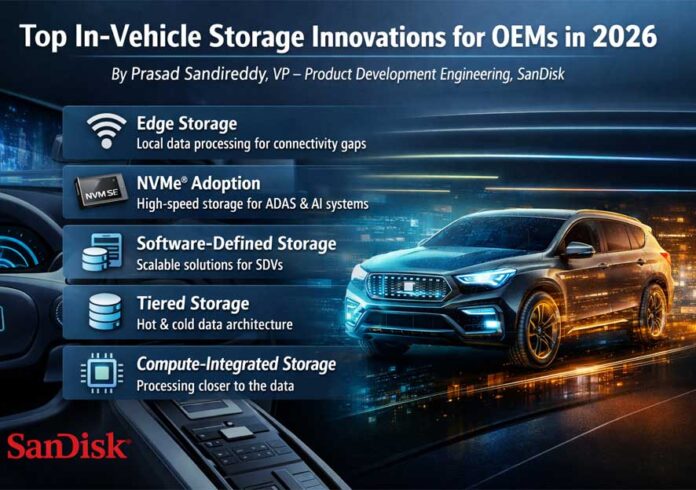
Outlined below are the key in-vehicle storage innovations set to shape future vehicle platforms, not merely as enhancements, but as shared design imperatives for OEMs navigating the shift to connected and intelligent mobility.
Edge Storage Is Becoming Essential for Connected Cars
In 2024, nearly 37% of new passenger vehicles sold in India came with embedded cellular connectivity. That number is expected to rise. However, highways, remote regions, and long intercity routes can suffer from patchy coverage. As a result, relying entirely on the cloud is not practical.
This is where edge storage inside the vehicle becomes critical. It allows key systems to keep running, make local decisions, and respond instantly, even when the network drops. For OEMs building vehicles for Indian driving conditions, robust onboard storage is no longer a nice-to-have, it is a reliability requirement.
NVMe® Is Moving from Premium to Practical
NVMe® storage in automobiles was once thought to be a high-end feature only seen in flagship ADAS systems or high-end infotainment systems. That is rapidly changing. Every hour, massive amounts of data from cameras, radar, LiDAR, and V2X systems are processed by modern cars. Moreover, this data does not arrive in burst, but continuously, and much of it needs to be accessed as quickly as possible. NVMe®-powered storage is becoming more crucial in situations where low latency is crucial.
NVMe® SSDs rely on PCIe® connections and provide faster read and write speeds with reduced latency. This directly improves ADAS responsiveness, AI inference at the edge, and overall system smoothness. In the near future, NVMe® is likely to become standard across mid- to high-segment vehicles, rather than a differentiator.
Software-Defined Vehicles Are Driving Storage Explosion
India’s software-defined vehicle (SDV) market is expected to grow rapidly over the next decade, expanding from USD 2.69 billion in 2025 to over USD 9 billion by 2033. This shift changes how vehicles are built and how value is delivered over time.
Frequent OTA updates, feature improvements, and AI-based optimization are essential to SDVs. Storage that can scale consistently throughout the course of a vehicle’s lifetime becomes a necessity.
According to industry estimates, depending on autonomy levels and feature depth, future cars may require anywhere from 2TB to 19TB of onboard storage by 2030. Scalable storage solutions will put OEMs in a better position for long-term innovation.
Tiered Storage Helps Balance Cost and Performance
Not all data inside a vehicle needs the same performance. Real-time sensor data and safety-critical workloads demand instant access, while logs, diagnostics, and historical data do not. This has led to growing interest in tiered “hot–cold” storage architectures. High-speed NVMe® handles latency-sensitive tasks, while more cost-efficient flash storage can be used for long-term retention. For OEMs, this approach offers a practical benefit: better performance without pushing up system costs.
Storage can Help Offer Better Experience
Borrowing from consumer and enterprise storage practices, OEMs are beginning to adopt telemetry-driven storage monitoring. This allows systems to track wear, predict failures, and optimise how data is written and moved over time.
For software-heavy vehicles expected to stay operational for a decade or more, intelligent storage management can help extend service life and reduce unexpected failures, supporting a better ownership experience.
Storage Is Becoming Part of the Compute Stack
With advanced ADAS, AI workloads and autonomous features, storage is a key part of the automobile compute stack. Emerging approaches like computational storage allow certain processing tasks to happen closer to the data itself. This reduces latency and eases the load on central processors. As a result, the system is faster, more responsive, and better prepared for next-generation autonomy.
As cars in India are evolving into data-rich, software-driven platforms, in-vehicle storage is emerging as a quiet but decisive factor in how well these systems are going to perform in the real world. The rise of connected vehicles will steadily increase both the volume and criticality of data that must be stored, accessed, and protected inside the vehicle. For OEMs planning platforms, getting the storage foundation right will be central to delivering connected, upgradable, and future-ready vehicles at scale.