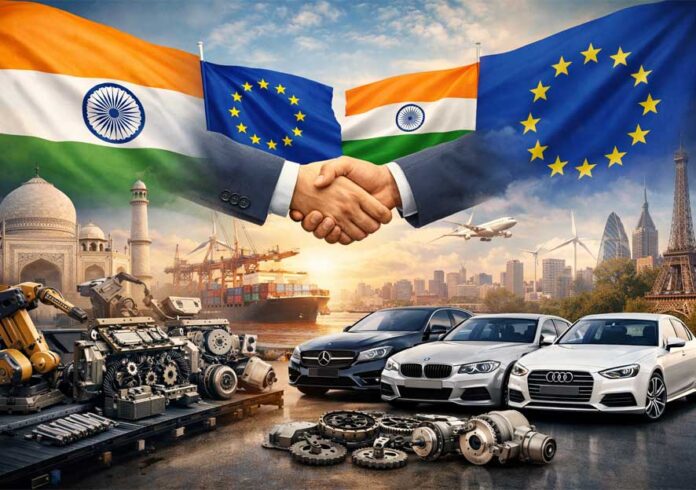
India has agreed to significantly lower import tariffs for European carmakers under the newly signed India–EU Free Trade Agreement (FTA), marking one of the country’s most ambitious market-access commitments in the automotive sector to date.
Under the pact, up to 2.5 lakh European-made vehicles will be allowed to enter India at a concessional import duty of 10%, sharply reduced from the earlier 110%. The quota is nearly six times larger than concessions offered in recent FTAs—far exceeding the 37,000-unit quota granted to the UK—underscoring the scale of market access extended to the European Union.
According to official data, India imported over €1.6 billion worth of motor vehicles from the EU in 2024. Of the agreed quota, around 1.6 lakh internal combustion engine (ICE) vehicles will see tariffs gradually reduced to 10% within five years, while 90,000 electric vehicles will qualify for similar concessions only by the tenth year of the agreement.
While the move is expected to benefit European luxury carmakers such as Audi, BMW and Mercedes-Benz, industry experts believe the impact on India’s mass market will remain limited. Passenger vehicles priced between ₹10 lakh and ₹25 lakh, which form the bulk of India’s auto market, continue to be dominated by domestic and locally entrenched players including Maruti Suzuki, Tata Motors, Mahindra & Mahindra, and Hyundai Motor India.
“The deal leaves out cars below ₹15 lakh and EVs, so it will not materially impact a large part of the market,” said Ashim Sharma, Senior Partner, Nomura Research Institute. Deloitte India Partner Saurabh Kanchan noted that while the tariff reduction is a major departure from past FTAs, its success will depend on whether reciprocal concessions by the EU adequately support Indian vehicle and component exports, particularly against competition from China and ASEAN countries.
Luxury carmakers have also downplayed any immediate pricing impact, citing high localisation levels. BMW Group India said over 95% of its sales come from locally manufactured models, while Mercedes-Benz India sources nearly 90% of its volumes domestically. Both companies indicated that while prices are unlikely to change in the near term, the FTA could enable the introduction of niche products and deeper localisation over time.
“The FTA is expected to strongly drive technological innovation and sustainable growth, with a focus on future mobility,” said Santosh Iyer, CEO, Mercedes-Benz India, adding that the agreement is unlikely to take effect before mid-2028, given the time required for legal ratification and implementation.
Audi India and Škoda Auto Volkswagen India welcomed the agreement but said commercial implications would be clearer once detailed terms and timelines are finalised. SAVWIPL Managing Director Piyush Arora called the pact a “win-win” for both regions, highlighting its potential to strengthen cooperation, enable technology transfer, and expand customer choice.
Component sector seen as key beneficiary
The FTA is expected to have a more pronounced impact on India’s auto component industry, particularly as global OEMs reassess supply chains amid geopolitical and trade uncertainties. In H1 FY26, Indian auto component exports to the EU stood at $3.73 billion, compared to $3.01 billion in imports.
Industry body ACMA said the agreement could enhance export competitiveness, attract long-term investments, and deepen technology collaboration. “A well-balanced FTA can position India as a reliable manufacturing and sourcing partner for Europe,” said Vikrampati Singhania, President, ACMA.
Tariffs on auto components are expected to be fully abolished over the next five to ten years, offering a significant boost to Indian suppliers. SIAM President and Tata Motors PV CEO Shailesh Chandra described the agreement as a calibrated approach that balances global participation with domestic manufacturing growth, investment, and employment—aligning with India’s long-term ‘Viksit Bharat’ vision.