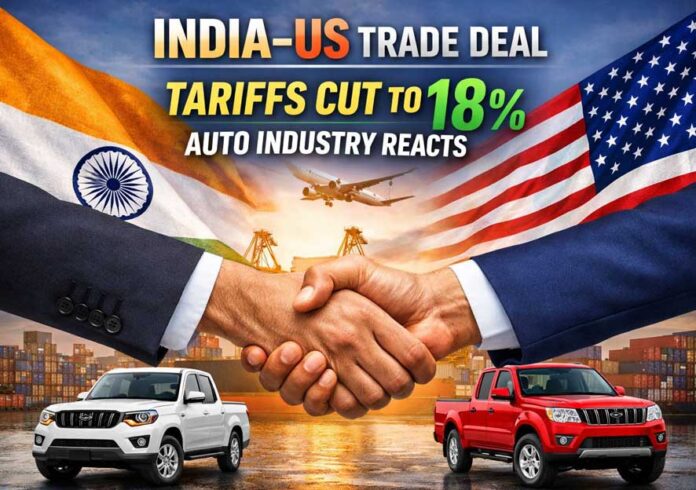
Indian industry leaders have welcomed the India–US trade agreement announced following a conversation between Prime Minister Narendra Modi and US President Donald Trump, which reduces US tariffs on Indian imports from 50% to 18%, signalling a major reset in bilateral trade relations.
The agreement comes after months of tariff escalation that had pushed US duties on Indian goods to among the highest globally. President Trump, in a post on Truth Social, confirmed that the US would withdraw a punitive 25% duty linked to India’s purchase of Russian oil, which had been imposed over and above a 25% reciprocal tariff.
Dr. Anish Shah, Group CEO and Managing Director, Mahindra Group, described the agreement as “a significant step forward in strengthening bilateral trade and investment ties.” He noted that the immediate tariff relief would improve business confidence and accelerate growth momentum. “With the Indian economy on a strong growth trajectory, this deal adds meaningful momentum to India’s growth ambitions,” Shah said.
Echoing similar views, Sudarshan Venu, Chairman, TVS Motor Company, termed the tariff reduction a “positive step that enhances export competitiveness and reinforces confidence in long-term India–US economic ties.” He highlighted the agreement’s alignment with the Viksit Bharat 2047 vision and pointed out that India has now secured multiple strategic trade deals with key global partners.
Beyond near-term tariff relief, industry observers see the deal as a pathway to deeper economic integration, potentially enabling stronger supply-chain linkages, faster technology collaboration and increased investment in advanced manufacturing.
Under the agreement, India has committed to halt purchases of Russian oil and source energy from the US instead. President Trump stated that India would significantly increase purchases of American goods, including over $500 billion worth of energy products such as coal, along with technology and agricultural imports. Trump also indicated that India would move towards progressively reducing tariff and non-tariff barriers on US goods.
Prime Minister Modi welcomed the development in a post on X, stating that closer cooperation between the world’s largest democracies would unlock “immense opportunities for mutually beneficial growth.”
The announcement triggered a positive market response, with US-listed shares of Indian companies such as Infosys, Wipro and HDFC Bank gaining, while India-focused funds also rallied on expectations of improved market access.
However, several aspects of the agreement remain unclear. Detailed timelines, implementation mechanisms, and specific commitments—particularly around energy sourcing and tariff phase-downs—have yet to be formally disclosed by either side.
Despite these uncertainties, the agreement marks a significant moment in India–US economic relations, with both governments positioning it as a mutually beneficial step amid shifting global trade dynamics.