
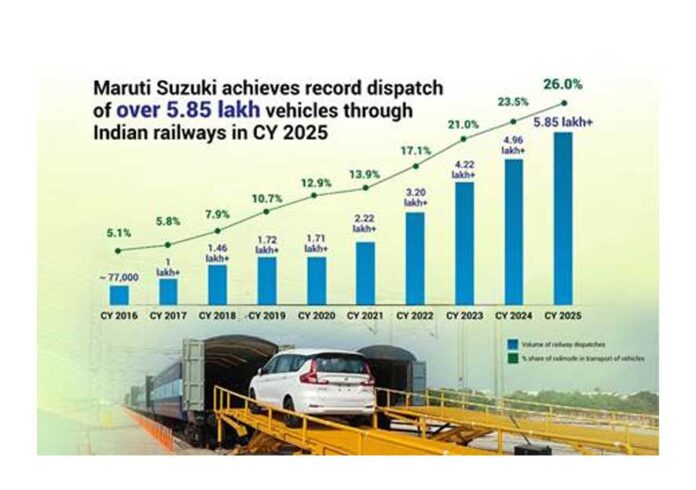
Maruti Suzuki India Limited has achieved a significant milestone in sustainable logistics, dispatching over 5.85 lakh vehicles through Indian Railways in calendar year (CY) 2025, marking an 18 per cent growth over CY 2024. The achievement underscores the company’s continued push towards greener, more efficient outbound logistics.
Over the past decade, Maruti Suzuki has sharply increased the share of rail transportation in its outbound logistics mix—from 5.1 per cent in 2016 to nearly 26 per cent in 2025. This shift has contributed to a reduction in carbon emissions, lower dependence on fossil fuel imports, and easing of road congestion across the country.
Commenting on the achievement, Mr. Hisashi Takeuchi, Managing Director and CEO, Maruti Suzuki India Limited, said that 2025 marked the company’s highest-ever rail dispatch volume. He highlighted two major milestones during the year: the inauguration of India’s largest automobile in-plant railway siding at Maruti Suzuki’s Manesar facility, and the successful dispatch of vehicles by rail to the Kashmir Valley via the world’s highest railway arch bridge over the Chenab River—a first for any automobile manufacturer in India.
Mr. Takeuchi added that Maruti Suzuki’s mid-term objective is to increase rail-based vehicle dispatches to 35 per cent by FY 2030–31, supporting India’s long-term goal of achieving net-zero emissions by 2070.
He further noted that the company has adopted a comprehensive ‘Circular Mobility’ approach to sustainability, aimed at reducing its carbon footprint across the entire vehicle lifecycle—from design and manufacturing to logistics operations and end-of-life vehicle (ELV) management.
Maruti Suzuki’s Green Logistics Journey
Maruti Suzuki has been a pioneer in promoting rail transport as a sustainable and efficient mode for vehicle movement. The company became the first automobile manufacturer in India to obtain an Automobile-Freight-Train-Operator (AFTO) licence in 2013. Since FY 2014–15, it has transported over 28 lakh vehicles by rail from 22 dispatch hubs, servicing more than 600 cities across India through a hub-and-spoke logistics model.
Currently, Maruti Suzuki operates over 45 flexi-deck rakes, each capable of carrying approximately 260 vehicles per trip. In CY 2025, rail dispatches from the company’s in-plant railway sidings at Gujarat and Manesar accounted for 53 per cent of its total rail-based vehicle dispatches, reinforcing its commitment to sustainable logistics infrastructure.