
FEV, a global innovation partner for sustainable mobility and advanced engineering, has released new findings highlighting the economic advantages of electrified commercial vehicles. The analysis, conducted as part of FEV’s internal research programme, evaluates extensive techno-economic data to assess total cost of ownership (TCO) across different truck powertrain architectures.
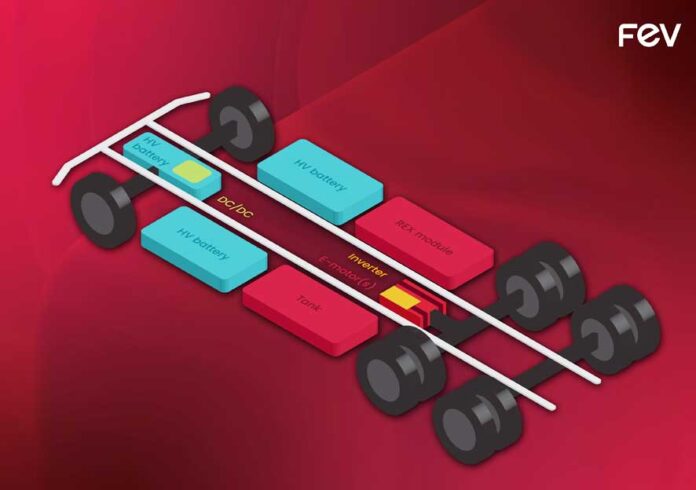
According to the study, trucks equipped with range-extender architecture (REEV or hybrid battery-electric vehicles) can reduce TCO by up to 33 per cent compared with conventional diesel trucks, depending on the driving cycle, while also delivering significant reductions in CO₂ emissions. Even under the most challenging long-haul operating conditions, the analysis indicates a TCO reduction of approximately 14 per cent.
The calculations are based on a realistic European operating profile, assuming overnight depot charging at industrial electricity prices of around €0.19 per kilowatt-hour. In markets with lower electricity costs, both at the national and international level, the economic benefits of range-extender truck solutions are expected to be even more pronounced.
Cost-effectiveness without megawatt charging infrastructure
A key lever of the REEV architecture is the significantly reduced battery size compared to purely battery-electric long-haul trucks. While a typical BEV truck requires battery capacities of around 560 kWh, a REEV truck can manage with around 280 kWh. Even with slower AC charging at 22 kW, around 240 kWh can be recharged overnight – enough to power the vehicle almost entirely electrically for the next day, depending on the application scenario. This means that the expansion of a megawatt charging infrastructure is not necessary for economical operation.
“Our analysis clearly shows that the range extender makes electric trucks immediately economically and ecologically viable – without waiting for the widespread expansion of high-performance charging infrastructure. This is precisely what is crucial in long-distance transport,” said Dr. Norbert W. Alt, COO of the FEV Group.
Significant TCO advantage in the cost-critical commercial vehicle market
The economic advantage of the range extender architecture results from several factors. The smaller battery of a REEV truck reduces vehicle costs as well as weight and increases payload. At the same time, the high proportion of electric driving enables low energy costs, especially when charging at depots at night at industrial electricity prices.
Due to their low dependence on public high-performance charging infrastructure, REEV trucks can already be seamlessly integrated into existing depot structures. This increases operational flexibility in long-distance transport and reduces investment risks for fleet operators.
Overall, this combination of lower investment costs, low operating costs, and high practicality in long-haul operation results in a TCO advantage of approximately 14 percent compared to conventional diesel trucks. In short-distance mode, this figure rises to as much as 33 percent – values that are considered highly relevant in terms of economic efficiency in the commercial vehicle segment. In addition to this, the analysis also shows a significant ecological effect: depending on the application profile and energy mix, the global warming potential can be reduced by up to 82 percent compared to conventional diesel trucks.
Focus on commercial vehicles – demonstrators in development
While FEV has already demonstrated the high decarbonization potential of Hybrid BEV and REEV concepts in the passenger car sector in earlier studies, the current focus is deliberately on the commercial vehicle and long-distance transport segment, where the technology’s economic strengths are particularly evident. The engineering service provider is currently working on corresponding demonstrator vehicles in order to validate the analysis results in a practical manner and, together with customers and partners, translate them into marketable solutions.
“Range extender-based Hybrid BEV trucks offer an immediately available, economically highly attractive solution for electrified long-distance transport. They combine high electric driving ranges with minimal infrastructure requirements – and deliver measurable added value precisely where cost decisions are particularly sensitive,” said Alt, summarizing the advantages.