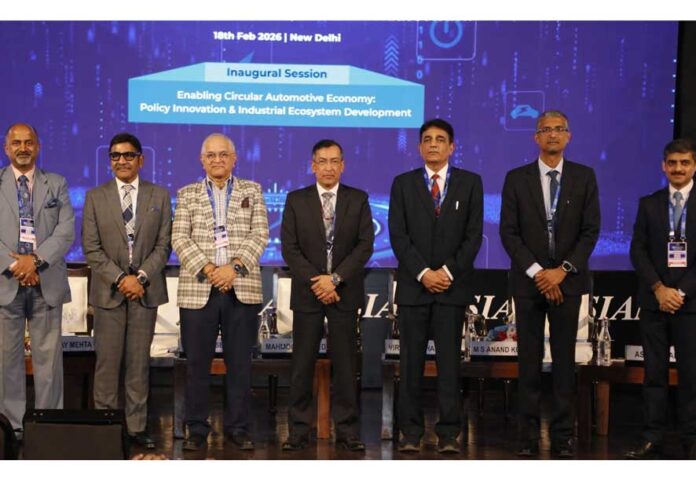
On the third day of SIAM Sustainable Mobility Week 2026, the Society of Indian Automobile Manufacturers (SIAM) organised the 4th International Conference on Sustainable Circularity at the India Habitat Centre. The conference, themed “Accelerating India’s Systemic Transition to an Automotive Circular Economy: Policy Leadership, Innovation and Collaborative Action,” underscored the need to integrate circular economy principles into India’s automotive growth strategy through enabling policies, technological innovation, and coordinated action across the entire value chain.
SIAM Sustainable Mobility Week 2026, being held from February 16–19, 2026, also features the Sustainable Mobility Zone, which showcases next-generation vehicle platforms, advanced safety technologies, alternative fuel solutions, and supporting infrastructure innovations. The four-day platform has convened policymakers, regulators, industry leaders, researchers, and technology innovators to outline a clear and actionable roadmap for India’s sustainable mobility future.
The conference emphasised a comprehensive lifecycle approach to automotive manufacturing — spanning eco-design, adoption of sustainable materials, robust recycling ecosystems, digital traceability systems, and regulatory harmonisation. Key discussions centred on decarbonisation, material compliance, post-crash vehicle management, and resource efficiency to accelerate the industry’s transition toward circularity.
Welcoming the dignitaries, Mr. Prashant K. Banerjee, Executive Director, SIAM, highlighted the urgency of addressing air quality challenges and strengthening vehicle end-of-life management, particularly in Delhi NCR. He stressed the need to enhance the flow of End-of-Life Vehicles (ELVs) to Registered Vehicle Scrappage Facilities (RVSFs) and called for the resolution of documentation gaps involving previous owners — especially in the two-wheeler segment — along with pending issues such as unpaid challans, insurance, and road tax.
“As we advance the circularity agenda, we must strike the right balance between growth and responsibility,” he said. “The industry must collaborate to develop practical, scalable solutions aligned with the vision of Viksit Bharat 2047.”
The Chief Guest, Mr. Mahmood Ahmed, Additional Secretary, Ministry of Road Transport and Highways, Government of India, said, “We have a larger responsibility to meet the needs of the country. Our regulations and standards are aligned to reduce emissions, improve fuel efficiency, and promote cleaner fuels. The Vehicle Scrapping Policy, is a major step forward and the ecosystem is now developing with nearly 125 to 130 Registered Vehicle Scrapping Facilities operational. We support a fitness based approach, while restrictions on older vehicles continue in Delhi NCR as per Supreme Court directions. Circularity and sustainability must remain central to our progress as we expand the world’s second largest road network.”
Guest of Honour Dr. Virinder Sharma, Member Technical, Commission for Air Quality Management, said – “Digital tracking of end of life vehicles has improved monitoring. It has also made disposal planning more strategic. The automotive sector contributes nearly 7 percent to GDP. It has a key role in driving decarbonisation and supporting India’s Net Zero 2070 commitment. A coordinated and circular economy is essential to achieve this.”
Addressing the gathering, Mr. Vikram Kasbekar, Executive Director and Chief Technology Officer, Hero MotoCorp Ltd, said – “The development of Registered Vehicle Scrapping Facilities is key to a sustainable mobility ecosystem. Initiatives like PM E-Drive have strengthened the industry and sped up readiness. Engaging non-registered recyclers constructively will help formalise processes. Our focus must remain on practical solutions for structured, inclusive and scalable progress.”
Setting the context, Mr. Ashim Sharma, Senior Partner, Nomura Research Institute, said – “We must adopt the 3R framework by reducing resource use, reusing components, and recovering secondary materials. Policies are in place, but implementation must be more uniform. Automated Testing Stations need to be strengthened with greater presence throughout the country and it needs to be ensured that majority of vehicles are tested at these facilities, which will help improve the availability of ELVs for scrapping.”
Taking the discussion ahead Sanjay Mehta, President, Material Recycling Association of India, said, “The automotive industry is facing higher input costs, stricter carbon targets, and rising global competition, making new revenue streams essential. End of life vehicles must be seen as future material banks. Strong EPR regulations and a robust framework will help build the right ecosystem.”
The Context Paper titled “Accelerating India’s Transition to an Automotive Circular Economy” was formally released during the session.
The session was concluded by Mr. M S Anand Kumar, Chairperson of SIAM Recycling & Material Groups and Assistant Vice President at TVS Motor Company, who highlighted the critical role of circular economy principles in shaping a sustainable and resilient automotive ecosystem.
The Thematic Session 1 on “Designing for Automotive Circularity: Materials Innovation, Recycling Systems, and Policy Pathways” opened with remarks by Ms. Kiran Sarkar, Head – Sustainability, Mahindra & Mahindra, followed by an address by Guest of Honour Mr Dinabandhu Gouda, Director, Central Pollution Control Board (CPCB). He added “The gap in advancing recycling was never technology; it was the lack of trust and coordinated promotion among producers, OEMs and government. Recycling technologies are available and globally recognised, but challenges remain around traceability, policy clarity, quality perception and informal leakages. With stronger institutional mechanisms and EPR implementation, we can build a credible, transparent ecosystem.”
The session also featured presentations by Mr. Kenichiro Yajima, Managing Director of Maruti Suzuki Toyotsu India; Mr. Anant Bhargava, CEO of IFP Petro; and Mr. Shridhar Rajappanavar, Founder and CEO of Key Sustainability. It concluded with a panel on integrating circularity into product design, promoting sustainable materials, and fostering collaboration among OEMs, suppliers, recyclers, and policymakers, with additional panellists Mr. Harsh Gandhi, Managing Director of GRP Ltd; Mr. Nitin Chitkara, CEO of Meta Material Circular Markets; and Ms. Archana S, Sustainability Expert at Global PCCS.
The Thematic Session 2 was moderated by Mr. Senthilkumaran V, Associate Chief Engineer and Sr General Manager & Head – Materials Technology & Component Validation, Systems Evaluation, Mahindra & Mahindra, on “Startups Driving Breakthrough Recycling Innovations That Overcome Scaling Challenges Through Collaboration with OEMs, Government, and Research Institutions, Supported by Financing and Regulations, with Proven Pilots Paving the Way for Commercial Growth”; the session also included presentations by Mr. Raman Sharma, Managing Director, Exigo Recycling India; Mr. Mayur Karmarkar, Managing Director, International Copper Association India; and Dr. Rinkel Jindal, Head – Global Regulatory Compliance, Apollo Tyres, Mr. Sunil Gupta, Principal Engineer, ICAT; Mr. Jaideep Garg, Head of Carbon Business, Lohum Cleantech; Dr. S K Goyal, HoD, CSIR NEERI and Mr. Richie Stephen, Senior Regional Standards Project Manager, UL Standards.
The conference reinforced that circularity is not limited to end of life recycling. It spans design philosophy, material sourcing, manufacturing practices, reverse logistics and digital tracking. Participants agreed that India has the opportunity to build a structured circular automotive framework that strengthens competitiveness while reducing environmental impact.
Sustainable Mobility Week will culminate on February 19, 2026 with the 1st International Conference on Automotive Material Compliance and Sustainability, marking the next step in strengthening the industry’s approach to responsible manufacturing and future focused mobility.
With consistent collaboration across government, industry, and civil society, SIAM continues to shape a mobility ecosystem that is cleaner, safer, and built on resource efficiency.