
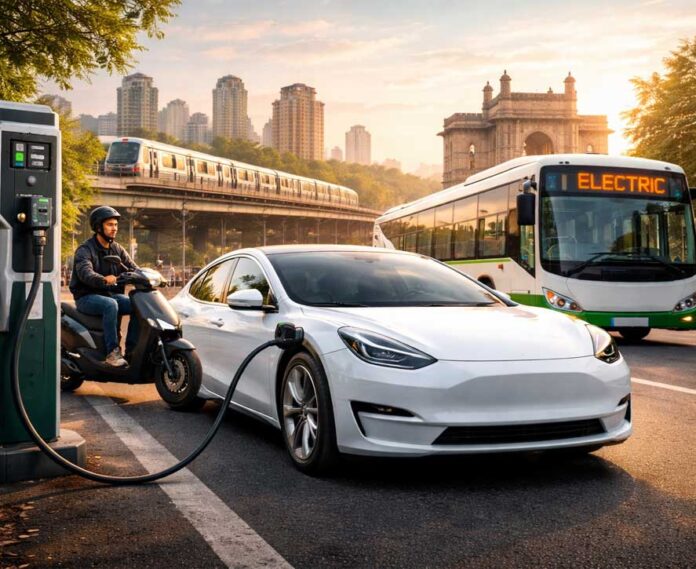
India’s evolving electric vehicle policy is no longer just about accelerating clean mobility — it is increasingly becoming a test case for how emerging economies balance industrial ambition, global trade rules, and strategic technology partnerships. As Tesla’s anticipated entry into India draws global attention, the country’s EV framework finds itself at the intersection of investment attraction, domestic industry protection, and World Trade Organization commitments. This moment represents more than a policy shift; it signals a broader recalibration of how India manages market access in a rules-based global economy.
In this guest analysis, Aaruni R. Shrivastava examines how India’s calibrated EV strategy reflects deeper tensions between openness and protection, and what Tesla’s potential entry reveals about the country’s evolving trade architecture. Drawing from international economic policy, trade law, and development strategy, the article explores whether India can successfully align its industrial goals with multilateral trade disciplines — and what that means for the future of electric mobility and global investment flows.
In contemporary trade policy, the central question is no longer whether the state should intervene, but how such intervention is structured within an increasingly rules-based global order. India’s evolving electric EV framework—particularly in anticipation of Tesla’s entry—illustrates this shift with unusual clarity. What is unfolding is not a straightforward case of liberalisation or protection, but a more calibrated exercise in managing market access under legal and economic constraint.
India’s transition towards electric mobility is driven by a convergence of environmental commitments and industrial ambition. With transport accounting for a significant share of emissions and a stated pathway towards net-zero, the policy emphasis on EV adoption is both necessary and strategic. Recent adjustments to import duties—conditional upon commitments to domestic manufacturing—reflect an effort to attract frontier technology while embedding it within local production ecosystems. In principle, this aligns with a familiar developmental logic: leveraging foreign investment to accelerate domestic capability.
Yet the structure of this approach introduces a more complex dynamic. India’s policy does not uniformly open the market, nor does it simply shield domestic producers. Instead, it differentiates between entrants, shaping access through conditional incentives and regulatory discretion. This form of selective market structuring may be economically intuitive, but it sits uneasily within the framework of the World Trade Organisation (WTO), where principles of non-discrimination remain foundational.
The Most-Favoured-Nation (MFN) principle, embedded in Article I of the General Agreement on Tariffs and Trade (GATT), requires that any advantage extended to one trading partner be made available to all. Preferential pathways—whether through tariff concessions, expedited entry, or tailored incentives—therefore risk being interpreted as discriminatory if not applied uniformly. The issue is not merely doctrinal. WTO jurisprudence has consistently demonstrated that selective treatment, particularly when it alters competitive conditions, can invite scrutiny under dispute settlement mechanisms.
India’s position becomes more intricate when viewed alongside its approach to other external actors, notably Chinese manufacturers. Safeguard provisions under Article XIX of GATT and the Agreement on Safeguards permit temporary protection against import surges, but only under strict conditions: demonstrable injury, transparency, and non-discriminatory application. A policy environment that appears to facilitate entry for one global manufacturer while constraining others introduces legal ambiguity. The question is not whether India can deploy safeguards, but whether such measures can be reconciled with simultaneous preferential access.
From an economic perspective, this tension reflects a familiar second-best problem. Safeguards and preferential incentives may deliver short-term objectives—protecting domestic industry or attracting high-value investment—but they do so by distorting market signals. Selective protection reallocates resources in ways that may not be welfare-enhancing, while regulatory uncertainty raises the cost of entry for both domestic and foreign firms. For potential competitors, the absence of clear, time-bound policy commitments complicates investment decisions and undermines predictability.
The result is a form of strategic ambiguity. India seeks, on one hand, to position itself as a credible destination for advanced manufacturing and technological investment. On the other, it remains committed to nurturing domestic industry through protective and promotional measures. These objectives are not inherently incompatible. Indeed, many development trajectories have relied upon precisely such dual strategies. The difficulty lies in maintaining coherence—ensuring that policy instruments are both economically rational and legally defensible.
This pattern of calibrated openness is not confined to the EV sector. Across strategically sensitive industries, there are indications of a broader approach in which market access is mediated through regulatory design rather than granted unconditionally. In adjacent domains, debates around the entry of frontier technologies have similarly reflected a balance between domestic incumbency and external participation. While sectoral dynamics differ, the underlying principle remains consistent: integration without full liberalisation.
In the EV context, Tesla’s prospective entry serves as a focal point for these dynamics. The firm’s technological capabilities and global positioning make it an attractive partner in India’s transition. At the same time, its presence raises legitimate concerns among domestic producers regarding competitive asymmetry and market displacement. The policy response—adjusting tariffs, signalling openness to investment, while retaining recourse to safeguards—suggests an attempt to navigate these competing pressures without fully resolving them.
The sustainability of this approach depends on its alignment with WTO disciplines. Environmental objectives, including the promotion of cleaner technologies, may offer a legitimate basis for policy intervention under Article XX of GATT. However, such justifications must be applied consistently and without constituting disguised restrictions on trade. Similarly, safeguard measures must remain temporary, proportionate, and non-discriminatory. Any deviation risks exposing policy to legal challenge, with attendant implications for trade relations and investor confidence.
A more durable pathway may lie in shifting emphasis from managing entry to building capacity. Policy instruments that enhance domestic competitiveness—such as targeted research and development support, performance-based incentives, and structured technology transfer—offer a means of achieving industrial objectives while remaining broadly consistent with multilateral commitments. These approaches reduce reliance on trade-distorting measures and provide clearer signals to market participants.
Ultimately, the significance of Tesla’s entry lies less in the firm itself than in what it reveals about India’s evolving trade policy. The current framework reflects an attempt to reconcile competing imperatives: growth and protection, openness and control, ambition and constraint. Whether this reconciliation proves sustainable will depend on the extent to which policy can move from selective discretion to systematic design.
In this sense, the question of whether Tesla represents disruptive innovation or innovative disruption is secondary. The more consequential issue is whether India’s policy architecture can accommodate such entry without undermining its own coherence. If it succeeds, it may offer a model for other developing economies seeking to navigate similar transitions. If not, the risks—of legal contestation, economic distortion, and strategic inconsistency—are likely to persist.
The challenge, therefore, is not one of intent, but of execution. In a system where trade rules and economic incentives are increasingly intertwined, the margin for ad hoc intervention is limited. India’s ability to align its industrial strategy with the disciplines of the WTO will determine not only the trajectory of its EV sector, but its broader credibility within the global trading system.
About the Author: Aaruni Shrivastava is an MA in Law & Diplomacy from The Fletcher School (Tufts University) and a Robert D. Hormats Scholar in International Economic Studies. His work focuses on trade, political economy, and development policy, with academic exposure at Harvard Kennedy School and Harvard Law School, alongside grassroots experience in rural India. An International Economic Relations scholar specializing in technology, trade, and geoeconomics, he has also worked in development economics as an advisor with Barefoot College and as a Fellow with the SBI Youth for India Fellowship — bringing a rare blend of policy, academic, and on-ground perspectives to India’s evolving EV debate.