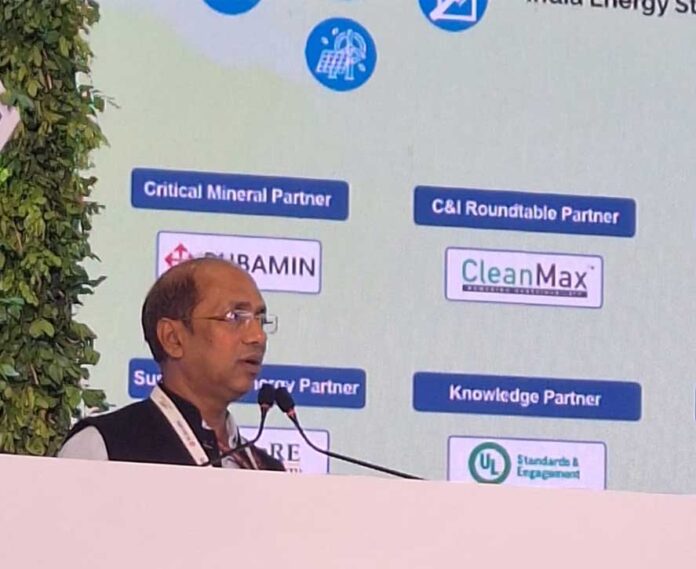
Speaking at the 12th India Energy Storage Week (IESW) 2026 at Yashobhoomi in New Delhi, Shri Vijay Mittal, Joint Secretary, Ministry of Heavy Industries (MHI), announced the Ministry’s plans to expand policy support for battery recycling and Advanced Chemistry Cells (ACC) as India’s energy storage ecosystem enters its next phase of growth.
Highlighting the government’s focus on strengthening the domestic battery value chain, Mittal said there have been repeated requests from industry stakeholders for dedicated policy frameworks covering niche battery technologies. He noted that the Ministry is also considering expanding the existing incentive system for Advanced Chemistry Cells to include a wider range of operators and industry partners.
“There have been repeated requests for creating specific policies for niche battery technologies, and going forward, we also see the need to expand the existing incentive system for advanced chemistry cells so that more operators and partners in the field can be covered. I would also like to state from this dais that the Ministry of Heavy Industries, along with the Office of the Principal Scientific Adviser to the Hon’ble Prime Minister, has tied up with the European Union to create pilot projects in the field of recycling,” Mittal said.
Organised by the India Energy Storage Alliance (IESA), the three-day IESW 2026 is being held at Yashobhoomi, New Delhi. The event has brought together over 200 exhibitors and more than 10,000 industry leaders, policymakers and technology experts to discuss policy, showcase innovations and drive collaboration across India’s rapidly evolving energy storage and clean mobility sectors.
Vinayak Walimbe, Managing Director, Customized Energy Solutions said, “Expanding policy support for battery recycling and advanced chemistry cells is a transformative move for India’s energy sector. This will drive domestic innovation and accelerate our transition to a sustainable, globally competitive battery ecosystem.”
Reflecting on the journey so far, Mr. Mittal shared, “What began as a chapter on electric vehicles has now grown into a dozen chapters, from increasing EV demand, to battery manufacturing, to dissecting batteries into various components, to cell technology, and then down to the mining of raw materials. As these sectors grew and matured, new areas emerged; recycling has become a very significant subject, and financing has also become vital to the ecosystem.”
He further emphasised the Ministry’s ongoing efforts to support the full battery value chain: “We are eager to explore every way we can support the ecosystem, not just by generating demand and supply, but also through component ecosystem policies. There are already proposals for an ALBM-type system, and we are evaluating requests for targeted policies for niche battery technologies. The Ministry of Mines has also introduced schemes to support the refining of critical materials for battery production.”
Dr. Harin Kanani, MD, Neogen Chemicals Limited, highlighted, “We started working with lithium chemistry decades ago, and today, Indian-made batteries are already showing better performance than imported ones. The government’s clear policy direction and strong support across ministries are inspiring unprecedented investment and innovation in the battery value chain. I am confident that, in the next five to ten years, India will be a global destination for battery technology and manufacturing.”
Concluding his remarks, Mr. Mittal said, “With the motivation and energy in this sector, I am confident that India will soon contribute significantly to global ACC consumption, and the rapid rise in imports will plateau as domestic capacity grows. The Ministry of Heavy Industries will work to the best of its capability to support this sector.”
Vikram Handa, Managing Director, Epsilon Advanced Materials, said, “As a component manufacturer ourselves, we are seeing great support from MHI recently, and we are very positive that the government will give us future signals to show that they would like to support.”
IESW 2026 features panels on gigafactories, grid modernisation, supply chain resilience, battery chemistries, recycling, and a dedicated track for women’s leadership in energy.
Dwarakanadha Reddy B, Business Head, Amararaja emphasised, “India’s success in solar manufacturing shows what is possible when government policies strongly support domestic industry. For battery cell manufacturing to thrive, we need clear tenders and ALBM-like policies, as well as collaboration across the value chain. With the right support, India can achieve its energy transition goals and become a global leader in advanced battery technologies.”