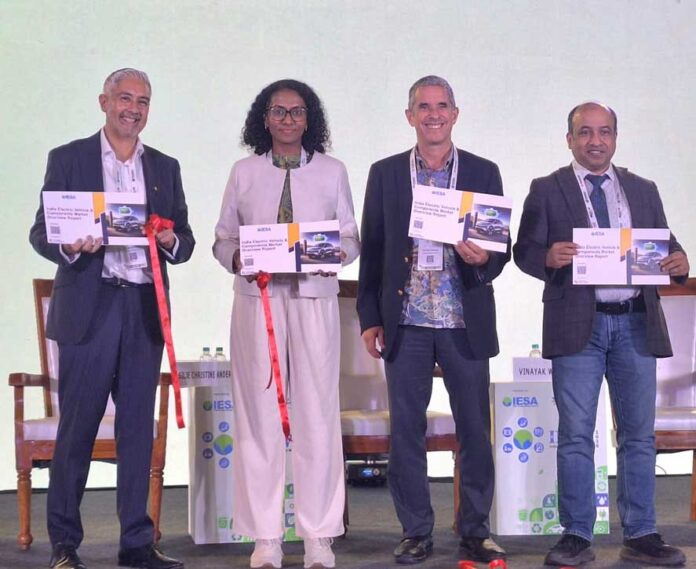
India’s electric vehicle (EV) components market is projected to grow eight-fold over the next seven years, expanding from ₹41,000 crore in 2025 to ₹3.55 lakh crore by 2032, according to the newly released “India Electric Vehicle & Components Market Overview Report.”
The report, published by the India Energy Storage Alliance (IESA) in collaboration with Customized Energy Solutions (CES) at India Energy Storage Week (IESW) 2026 in New Delhi, highlights the significant growth potential of India’s EV component ecosystem. It notes that the domestic EV component value chain is poised to become a key driver of the country’s industrial growth and clean mobility transition, supported by rising EV adoption, localisation efforts and manufacturing investments.
Vinayak Walimbe, Managing Director, Customized Energy Solutions, said, “India’s EV momentum is unmatched, powered by innovation and collaboration. Strengthening domestic supply chains will be central to our clean mobility success.”
The grand culmination of this week’s industry dialogue took place at India Energy Storage Week (IESW) 2026, a three-day event organised by the India Energy Storage Alliance (IESA) at Yashobhoomi (IICC), New Delhi. The summit brought together over 200 exhibitors and more than 10,000 industry leaders for policy discussion, technical exchange, and major announcements set to define India’s clean energy transition.
Dr. Ian Martinus, Investment and Trade Commissioner, India-Gulf, Government of Western Australia, said, “Western Australia is ready to partner with India not just as a supplier of critical minerals, but as an innovation and investment ally in the EV revolution. The future of electric mobility and industrial-scale storage will be defined by what nations achieve together, not alone.”
The report highlights how battery packs will account for more than half of the component market in 2025, with motors, inverters, and power electronics also playing significant roles. As original equipment manufacturers (OEMs) increase drivetrain integration and Indian industry leaders invest in advanced subsystems, the share of motors, inverters, and battery management systems (BMS) within the component market is set to rise rapidly. However, the report also warns that battery packs and inverters remain the most import-dependent segments of the value chain, together representing nearly 60% of an EV’s cost structure, while motors and BMS are localising faster due to their software-driven and lower capital intensity characteristics.
Avanthika Satheesh, Director, Consulting, CES, said, “India’s EV component market surge signals our readiness to lead in technology and manufacturing. Strategic investments now will secure India’s place in the global EV value chain.”
The report underlines that the Indian EV component market is poised to grow at a compound annual growth rate (CAGR) of 38% between 2025 and 2032, far outpacing global averages. The incremental opportunity of ₹3.14 lakh crore over this period will disproportionately reward domestic firms that invest in R&D, manufacturing capability, and supply chain resilience. Leading Indian companies such as Bharat Forge, Bosch India, Uno Minda, and Tata AutoComp are already scaling up their EV subsystem investments, though the report notes that technology depth and large-scale manufacturing remain uneven across the industry.
According to the report, the future of India’s EV sector depends not only on increased sales but also on building robust technology ownership, local supply chains, and intellectual property that can anchor the nation’s mobility landscape for the next decade.
The event brought together government officials, industry leaders, and innovators from 15 countries, including Germany, Sweden, Australia, Norway, the United States, Japan, Singapore, France, and South Korea, fueling cross-border collaboration and knowledge exchange. Highlights included the Women in Energy Forum on digital innovation and leadership, the IESA Awards and dynamic panels on India’s EV race and charging network, and hands-on IESA Masterclasses for industry professionals. Specialised workshops, roundtables, and international pavilions sparked focused dialogue and partnerships. With an emphasis on actionable insights, safety, and inclusion, IESW 2026 set the stage for the next wave of innovation and global collaboration in advanced energy storage, e-mobility, and green hydrogen.