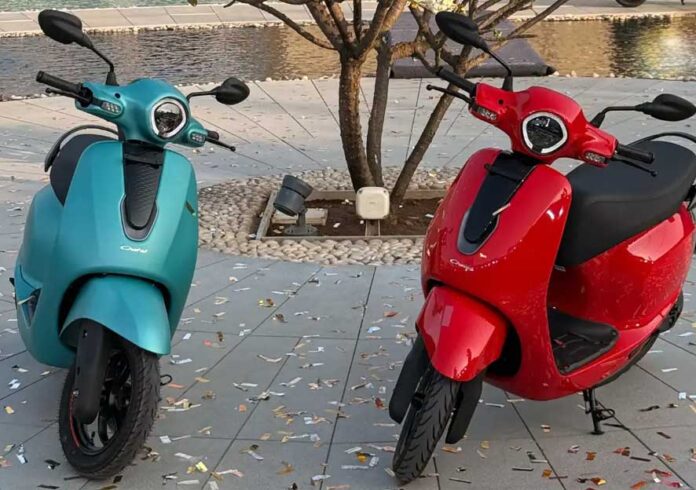
Bajaj Auto Ltd has expanded its mass-market electric two-wheeler portfolio with the launch of the Chetak C25, priced at ₹91,399 (ex-showroom, inclusive of the central government subsidy under the PM E-DRIVE scheme). Bookings for the new model are now open.
Positioned as the most affordable variant in the Chetak range, the C25 becomes Bajaj Auto’s second electric scooter priced below ₹1 lakh. It joins the existing Chetak lineup comprising the 3501, 3502, 3503 and 3001 variants. In the Indian market, the Chetak C25 will compete with rivals such as the TVS Orbiter, TVS iQube 2.2, Hero Vida VX2 Go and Ola S1X.
The electric scooter is powered by a 2.5 kWh NMC battery pack that delivers a claimed range of 113 km on a single charge, paired with a 2.2 kW hub-mounted motor offering a top speed of 55 km/h. Charging is handled by a 750W off-board charger, which enables the battery to be charged from 0 to 80 percent in 2 hours and 25 minutes.
Built on a tubular frame, the Chetak C25 offers 25 litres of under-seat storage. According to Bajaj Auto, the new variant is 22 kg lighter than the previous-generation model, resulting in improved efficiency and handling. The scooter is backed by a warranty of three years or 50,000 km.
In terms of sales, the Pune-based manufacturer e-scooter (Chetak and Yulu) moved up to No. 2 position in 2025 from No. 3 in 2024. Bajaj Auto sold 269,836 units in 2025, up 39% YoY, surpassing both the 200,000 and 250,000 milestones for the first time annually. This gives the company a 21% market share, rising strongly from the 17% in 2024 and 8% in 2023.
Bajaj Auto wore the No. 1 e-2W OEM crown for the first time in February 2025 and followed it up with its best-ever monthly sales in March 2025 (35,214 units). The company’s 12-month total would have been a lot better if it weren’t for the slowed-down production of the Chetak in July and August due to a hampered supply chain for critical rare earth magnets, which in turn impacted retail sales.
Bajaj Auto continues to expand its Chetak network which now stands at 390 exclusive stores and 4,280 points of sale in more than 500 cities. It also has more than 4100 service workshops.
In 2025, of the total 22,70,425 EVs sold across four zero-emission vehicle sub-segments in India (up 16% YoY), electric scooters, motorcycles and mopeds accounted for 1.28 million units (up 11% YoY) or a 56% share. This is down from the 59% share the e-2W segment had in 2024 when it accounted for 1.14 million of the total 1.95 million EVs across all segments.
Importantly, the 11% YoY growth has come on a high year-ago base and in the face of the reduced price differential between IC engine two-wheelers and EVs with the sharp reduction in GST. With a record 20.29 million two-wheelers sold across India in 2025, the e-2W penetration last year was 6.30% compared to 6.07% in 2024 (18.92 million 2Ws).
India’s electric two-wheeler market could have posted stronger growth in 2025 if not for a sharp slowdown at its former market leader, Ola Electric. The company’s sales declined more than 50 percent year-on-year to below 200,000 units, compared with 407,700 units in 2024, weighing on overall segment momentum.
Looking ahead, competitive intensity in India’s electric scooter market is set to increase further. Bajaj Auto, buoyed by the launch of its new mass-market electric scooter, is seeking to extend its lead over Ather Energy and Ola Electric, while simultaneously challenging TVS Motor Co for the top position in the segment.