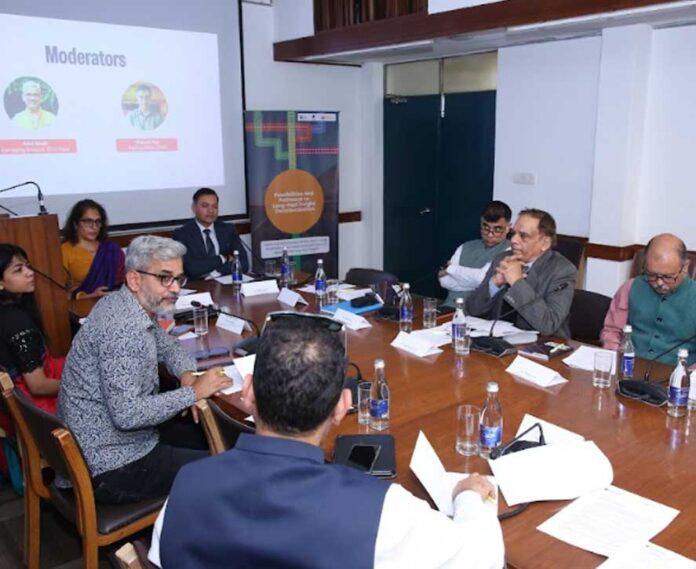
A high-level, closed-door roundtable convened by Riding Sunbeams and Purpose brought together senior policymakers, industry leaders, researchers, and financial stakeholders to explore actionable pathways for decarbonising India’s long-haul freight sector. Hosted at the India International Centre in New Delhi, the discussion formed part of Delhi Climate Innovation Week and focused on aligning regulation, technology deployment, and financing mechanisms to enable near-term progress in one of the country’s most difficult sectors to decarbonise.
With freight demand expected to expand rapidly alongside economic growth, India faces increasing challenges related to air pollution and fuel import dependence. Experts warned that without decisive policy and industry action, freight-related emissions could more than double by mid-century, jeopardising national climate commitments and air quality targets.
In his opening remarks, Rahul Kapoor, Director Finance at Dedicated Freight Corridor Corporation of India Ltd under the Government of India, emphasised the importance of coordinated action. He noted that policy development cannot occur in isolation and highlighted the need for a structured, integrated approach that brings together technology, regulatory ecosystems, workforce development, economic considerations, and livelihoods while aligning central and state governments.
Such coordination, he added, would help scale successful innovations emerging across the country and foster not only innovation, but affordable and inclusive innovation at scale.
The roundtable was structured across three themes: exploring fuel efficiency norms and regulatory ecosystems, innovation and technology readiness, and investment pathways for systemic action.
Speaking on the policy environment that can provide long-term demand certainty to the industry while keeping India’s decarbonisation goals in mind, Amit Bhatt, Managing Director, ICCT India stated, “There is a growing appetite for freight decarbonisation with massive changes happening in the regulatory system. This change needs to be driven at scale, incentives are good for an initial kickstart but sustaining long term change requires strategic policy pathways that defines the strength of various modes and delivers clear targets for different technologies”. Shifting focus to the viable technologies and the potential to scale them, Kaustubh Gosavi, Program Lead for Electric Mobility, WRI India added that, “With electrification of road freight, close to 10,000 trucks are expected in the next 5 years, what does this mean for the load on our grid? What solutions do we need to get our energy ecosystem for this demand and how do we integrate renewable energy while achieving viability.”
“This roundtable was designed not as a panel discussion, but as a working session to surface practical bottlenecks and identify investable solutions. If we are serious about net zero pathways, freight must move from the margins to the mainstream of climate strategy.” stated Mahak Agrawal, India Lead at Riding Sunbeams.
The roundtable successfully evoked exchanges where participants examined the readiness of electric and alternative fuel heavy duty vehicles, grid and charging infrastructure needs, multimodal logistics optimisation, and the role of concessional and catalytic finance.
Discussions emphasised the importance of creating demand certainty, derisking early adoption, and fostering stronger collaboration between public and private stakeholders.
The convening concluded with agreement to develop a concise post roundtable briefing note capturing key insights, areas of convergence and immediate next steps.