
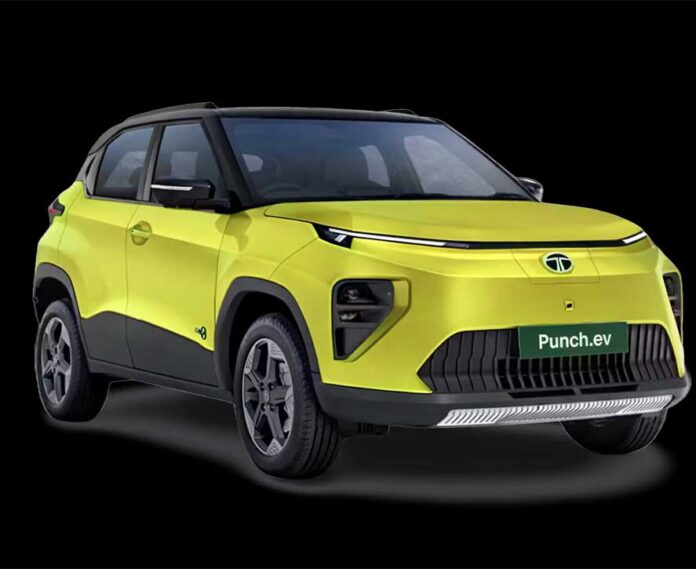
The updated Punch.ev is helping Tata Motors regain momentum in India’s fast-evolving electric passenger vehicle market, as rising fuel-price concerns, growing EV awareness, and stronger competition reshape consumer preferences.
Following its refreshed launch in February 2026, the Punch.ev played a major role in boosting Tata Motors’ EV sales during March and April. According to FADA data, Tata Motors sold around 8,253 electric passenger vehicles in March 2026, marking nearly 65% year-on-year growth, while April sales climbed further to approximately 8,543 units, up 77% compared to the same period last year. Industry estimates suggest the updated Punch.ev was a key contributor to this strong rebound.
The timing is significant for Tata Motors. Although the company retained its leadership position in India’s electric passenger vehicle segment during FY26, its market share declined to around 40% from nearly 55% in FY25 as rivals including JSW MG Motor and Mahindra aggressively expanded their EV portfolios. Despite rising competition, Tata Motors’ overall EV sales increased to 78,811 units in FY26 from nearly 57,994 units a year earlier.
For Tata Motors, the Punch.ev represents more than just a refreshed product. It plays a central role in the company’s strategy to make EV ownership more mainstream and accessible for mass-market buyers.
Growing uncertainty around global crude oil prices has further strengthened the appeal of electric mobility. Ongoing geopolitical tensions in West Asia have raised concerns over fuel supply disruptions and higher fuel costs, particularly for India, which imports over 85% of its crude oil requirements. Against this backdrop, EVs are increasingly being viewed as a practical alternative offering lower running costs and greater energy security.
The International Energy Agency has also projected strong global EV demand through 2026, driven partly by fuel-price volatility and energy-security concerns. In India, improving charging infrastructure, lower running costs, and flexible financing models are making EV adoption more attractive, especially for urban buyers upgrading from hatchbacks to compact SUVs.
Tata Motors has positioned the Punch.ev as an affordable gateway into electric mobility. Priced from ₹9.69 lakh (ex-showroom) under the company’s Battery-as-a-Service (BaaS) program, the electric SUV allows customers to either purchase the battery outright or opt for a subscription-based financing structure that lowers upfront ownership costs.
The refreshed Punch.ev also introduced several upgrades, including updated styling, connected LED lighting, a larger infotainment system, over-the-air software updates, vehicle-to-load functionality, and multiple battery pack options delivering up to 468 km claimed range.
Tata Motors Passenger Vehicles and Tata Passenger Electric Mobility Managing Director Shailesh Chandra had earlier stated that first-time EV buyers represent the company’s biggest opportunity. Tata Motors expects Punch.ev volumes to rise by 30-50% following the updated launch, supported by improved affordability, enhanced features, and better driving range.
The Punch.ev competes in one of India’s most crowded EV segments, facing rivals such as the Citroën eC3, MG Windsor EV, MG Comet EV, and Tata’s own Tiago.ev, while higher variants overlap with compact electric SUVs from Mahindra and JSW MG Motor. Competition has intensified further following Maruti Suzuki’s entry into the EV market with the e-Vitara.
The broader popularity of the Punch brand is also supporting the EV version’s growth. Tata Motors crossed cumulative sales of 700,000 units for the Punch nameplate in January, including both ICE and EV models, making it one of the company’s strongest-selling SUVs. Industry analysts believe this established brand recognition is helping reduce hesitation among first-time EV buyers.
India’s EV market is also witnessing rapid expansion. April 2026 became the country’s highest-ever month for EV sales, with industry-wide volumes crossing 239,000 units across categories. As charging infrastructure improves and more affordable EVs enter the market, passenger EV adoption is gradually moving beyond metro cities.
For Tata Motors, the updated Punch.ev is emerging as a critical product in its effort to defend leadership in India’s EV market while accelerating mainstream electric mobility adoption amid rising fuel costs and changing consumer priorities.