EMO Energy has released insights from over four years of real-world electric fleet operations, highlighting how large-scale data is reshaping the understanding of battery performance and intelligence.
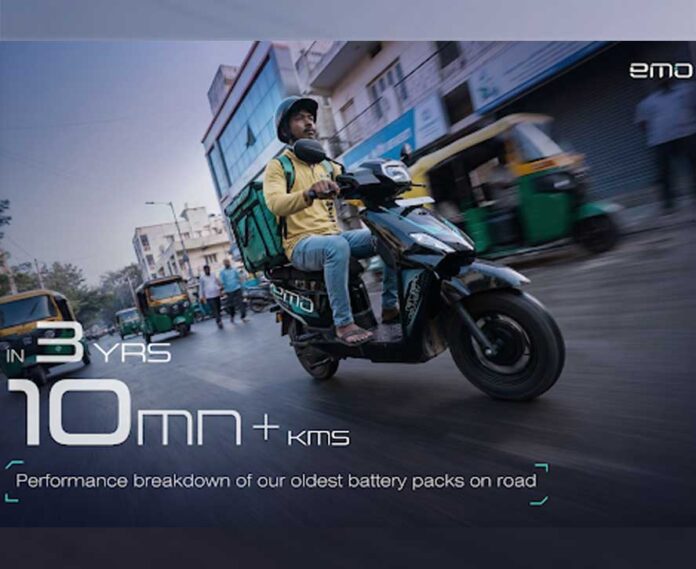
During this period, the company has developed and deployed battery systems tailored for high-utilisation electric fleets. Some of its earliest battery packs have been in operation for nearly three years, powering delivery vehicles across cities such as Bengaluru and Gurugram. These vehicles operate in demanding conditions, particularly in quick-commerce applications, often covering close to 100 kilometres daily while relying on multiple short fast-charging cycles to remain operational.
A segment of these batteries has surpassed 75,000 kilometres of real-world usage, largely dependent on fast charging. This extensive dataset provides valuable operational insights into how EV batteries perform under continuous fleet usage in Indian conditions—an area where the industry still lacks sufficient depth of understanding.
At the core of this analysis is SENS, EMO Energy’s proprietary battery health prediction and optimisation platform, which captures and processes performance data in real time. The findings challenge the conventional view of EV batteries as consumable components, instead positioning them as predictable, intelligent infrastructure capable of anticipating ageing patterns and performance over time.
Commenting on the findings, Sheetanshu Tyagi, CEO of EMO Energy, noted that battery performance in fleet operations depends not just on chemistry, but also on usage patterns, charging behaviour, thermal management, and long-term ageing. He emphasised that a holistic approach is essential to designing battery systems that can meet the demands of modern electric mobility.
A dataset built in demanding conditions
The dataset comes from 100 EMO battery packs deployed in commercial delivery fleets operating in Bangalore and Gurgaon. These vehicles run in some of the toughest conditions for EV batteries: high daily utilisation, frequent rapid charging, and constant climate exposure across Indian summers, monsoons, and winters. In Delhi summer conditions, ambient temperatures can cross 45°C, which typically increases thermal stress during charging and discharge.
Unlike passenger EVs that depend largely on overnight charging, these fleet vehicles charge multiple times through the day to maximise uptime. Typical patterns include four to five charging sessions daily, roughly five minutes per session, adding up to about twenty minutes of total charging time per day. The battery capacity is 2 kWh, fast charging power is 3.3 kW, and 0–80% charge time is around twenty minutes. Under conventional assumptions, this kind of frequent fast charging is expected to accelerate degradation. EMO’s long-term field data suggests the outcome can be materially different when the system is designed for this exact use case.
What changes after 75,000 kilometers
Across the dataset, the oldest packs have crossed approximately 75,000 kilometers. EMO’s reported State of Health numbers show a relatively gradual decline. After 20,000 km, packs sit around 96–98% State of Health. After 50,000 km, they are around 90–92%. At 75,000 km, they remain around 85–88%. In practical terms, that corresponds to roughly 15% degradation after 75,000 kilometers of real-world operation.
What makes this notable is the comparison to typical degradation patterns in conventional EV packs operating under frequent fast charging. In many such systems, degradation of 25–30% by 75,000 kilometers is not uncommon, with State of Health often falling into the 70–75% range at that distance. In EMO’s deployments monitored through SENS, packs retained around 85% of original capacity while operating under similarly high utilisation patterns. The difference is not only the end number. It is the ability to manage battery ageing in a more controlled, predictable way.
Why EV batteries need intelligence, not only monitoring
Battery degradation rarely has a single cause. It is the result of many small stresses adding up over time. Charging too quickly when the battery is cold, operating in high ambient heat, repeated deep discharge, and hundreds of cycles under inconsistent conditions all influence how a battery ages.
Traditional battery management systems are designed primarily for safety in the moment. They monitor temperature, voltage, and current, and intervene if something crosses a threshold. That is necessary, but it does not answer the question fleet operators care about most: how will this battery evolve over months and years of intensive use.
This is where predictive battery intelligence becomes important. SENS continuously analyses telemetry from charging sessions, temperature profiles, cycle history, and usage patterns to model how each battery is aging. The intent is not to react only when the battery is under stress, but to anticipate how degradation is likely to unfold and adjust charging behaviour and operational parameters before long-term wear accelerates. This turns the battery from a passive component into a predictable energy asset.
The intelligence layer and what it does
SENS acts as an intelligence layer across EMO deployments. It analyses telemetry such as cell voltage behaviour, charge and discharge profiles, temperature distribution, cycle history, and usage patterns across fleets. Using this, it builds predictive models of battery health performance.
The outputs are practical. It can forecast degradation trajectories, detect early signals of abnormal behaviour, optimise charging profiles for longevity, and maintain performance consistency across fleets. For an operator managing thousands of vehicles, this kind of predictability matters more than dramatic specifications on paper. It helps reduce surprises, reduce downtime, and plan asset life with greater confidence.
Thermal architecture still matters
Predictive intelligence cannot compensate for poor battery design. EMO batteries use a patented immersion cooling system where cells are surrounded by a proprietary dielectric coolant circulating throughout the pack. The objective is uniform thermal management across cells, including during rapid charging.
In real-world operation, EMO reports that this keeps cell temperatures between 24°C and 28°C during fast charging. Maintaining a narrow thermal range reduces the electrochemical stress that typically drives faster degradation. EMO also reports zero cases of thermal runaway across the dataset, even under high ambient temperatures.
What this means for quick commerce fleets
For quick commerce companies, electrifying delivery fleets is increasingly an operational decision as much as a sustainability one. These fleets often run 80–120 km daily, charge multiple times through the day, and have minimal tolerance for downtime. Two concerns typically slow adoption: degradation under frequent fast charging and uncertainty around long-term battery health.
The field data from EMO’s deployments suggests that this risk can be significantly mitigated when batteries are designed for high-frequency fleet environments and supported by predictive intelligence. Vehicles operating in Bangalore and Gurgaon, many charging four to five times a day, have crossed 75,000 kilometers while retaining over 85% State of Health. For fleet operators, the question shifts. It becomes less about whether EV batteries can survive heavy use and more about how quickly fleets can scale when batteries behave like reliable infrastructure.
The bigger takeaway
Much of the EV conversation focuses on vehicles and charging networks. But as fleets electrify at scale and age, what becomes clear is that batteries must be treated as long-term assets that need both robust thermal architecture and intelligent systems around them. EMO’s long-term dataset, monitored through SENS, offers a view into what is possible when battery design, fast charging infrastructure, and energy intelligence work together.
Because the future of electric mobility will not be defined by batteries alone. It will be defined by the energy systems built around them.