
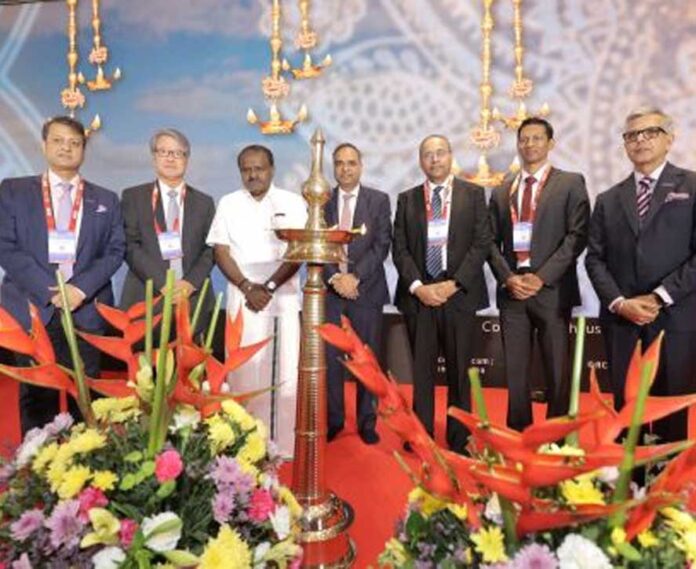
The Automotive Component Manufacturers Association of India (ACMA) Mobility Foundation hosted its 66th Annual General Meeting under the theme “Beyond Resilience,” bringing together policymakers, industry leaders, global stakeholders and technology experts to discuss the next phase of growth for India’s automotive component industry.
With the sector targeting a landmark $200 billion valuation by 2030, discussions at the annual session focused on moving beyond resilience and building India into a stronger global manufacturing and sourcing hub.
India’s auto component industry recorded a turnover of ₹7.6 lakh crore ($85.9 billion) in FY26, marking a 12.7% year-on-year increase. The sector has doubled in size over the past five years, while exports reached $24 billion and supplies to OEMs grew by 16.3%, highlighting the industry’s expanding role in global automotive supply chains.
The ACMA-BCG report, ‘Beyond Resilience,’ released during the session reflected strong confidence within the industry. Around 90% of respondents across large, medium and small component manufacturers said they believe the industry is “in the right place at the right time.”
The findings point to growing optimism around India’s ability to attract global manufacturing and sourcing opportunities as international supply chains undergo structural shifts. Innovation, quality, manufacturing scale and increasing localization are expected to strengthen India’s position as a reliable global automotive supplier.
Government Support for Auto Component Industry
Delivering the special address as Chief Guest, Shri H.D. Kumaraswamy, Minister for Heavy Industries & Steel, Government of India, highlighted the government’s continued efforts to support investment, localization and advanced manufacturing.
“The theme ‘Beyond Resilience’ captures the ambition that must guide the Indian industry. The automotive and auto components industry is central to this journey.”
He said the Production Linked Incentive (PLI) scheme for automobiles and auto components was delivering encouraging results, supporting investments, domestic value addition, advanced technology manufacturing and the transition towards cleaner mobility.
The annual session also featured keynotes from Shailesh Chandra, President, SIAM and Managing Director, Tata Motors Passenger Vehicles & Tata Passenger Electric Mobility; R Mukundan, President, CII and Managing Director & CEO, Tata Chemicals; and Hisashi Takeuchi, Managing Director & CEO, Maruti Suzuki India.
The speakers discussed emerging opportunities and disruptions across the automotive value chain, including technological transformation, electrification, evolving consumer expectations and changing global supply-chain dynamics.
Industry 5.0 to Drive the Next Phase
ACMA highlighted Industry 5.0 as a key pillar of the industry’s next growth phase. The approach combines artificial intelligence, automation, robotics, IoT and human expertise to create manufacturing ecosystems that are more agile, collaborative, resilient and sustainable.
The association stressed that upskilling workers in areas such as AI, robotics, automation and digital manufacturing will be critical to maintaining India’s competitiveness as a global manufacturing destination.
At the same time, energy-efficient manufacturing, circular production and responsible resource use are increasingly becoming essential requirements for companies seeking to compete in international markets.
ACMA also called for deeper cooperation between industry, government and technology partners to accelerate technology adoption, innovation and skill development across the automotive component ecosystem.
India Can Do More, Says Piyush Goyal
The proceedings were closed by Shri Piyush Goyal, Minister for Commerce & Industry, Government of India, who reaffirmed India’s growing importance as a trusted global business and manufacturing partner.
“In this global turmoil, India is the one country that has stayed the course and has continued to be the fastest-growing among the large economies of the world.”
Goyal highlighted India’s 7.8% economic growth and said the country’s demographic and economic strengths provide significant opportunities for further expansion.
“The story has just begun,” he said, emphasizing the potential for India to do considerably more in global trade and manufacturing.
The session concluded with a vote of thanks by Sriram Viji.
ACMA Calls for a Shift From Resilience to Leadership
In his welcome address, Vikrampati Singhania, President, ACMA and Managing Director, JK Fenner, reflected on the industry’s ability to withstand major disruptions over recent years, including the pandemic, supply-chain constraints, geopolitical conflicts, commodity price volatility and rapid changes in mobility.
“Resilience is about responding to change. Leadership is about shaping it. And I believe that is where India must now set its sights.”
The annual session brought together senior government officials, OEM representatives, component manufacturers, global suppliers, diplomats and other industry stakeholders, reinforcing ACMA’s role in representing India’s automotive component ecosystem and its increasing relevance in global automotive discussions.
FTAs Open New Opportunities for Indian Component Makers
The event concluded with a valedictory session titled “FTAs – Exploring Newer Avenues for the Indian Auto Component Industry.”
The session examined how emerging trade agreements could improve market access for Indian component manufacturers and integrate domestic suppliers more deeply into global value chains.
Guests of Honour included Harjinder Kang, His Majesty’s Trade Commissioner for South Asia and British Deputy High Commissioner for Western India, Government of the UK, and H.E. Sergio Gor, Ambassador of the United States of America to India.
Gor highlighted the potential for stronger India-US cooperation in the automotive sector, particularly through greater market access, two-way investment and deeper partnerships between Indian and American suppliers.
“The United States and India are natural partners, and the automotive sector is a great example of what we can achieve together.”
He added that stronger ties between suppliers, particularly small and medium-sized businesses, could create jobs, strengthen supply chains and open new opportunities in advanced manufacturing and mobility.
Kang said the India-UK CETA could provide a platform for deeper cooperation in the automotive sector by expanding market access, encouraging two-way investment and helping Indian suppliers, especially MSMEs, become more integrated into global value chains.
He also highlighted opportunities in advanced mobility, innovation and sustainable manufacturing, saying stronger cooperation could help build resilient supply chains and generate long-term value for both countries.
With rising exports, stronger OEM demand, accelerating localization and expanding trade opportunities, the discussions at ACMA’s 66th Annual Session underscored the industry’s ambition to move beyond simply absorbing disruptions and position India as a leading global automotive component manufacturing and sourcing destination by 2030.