
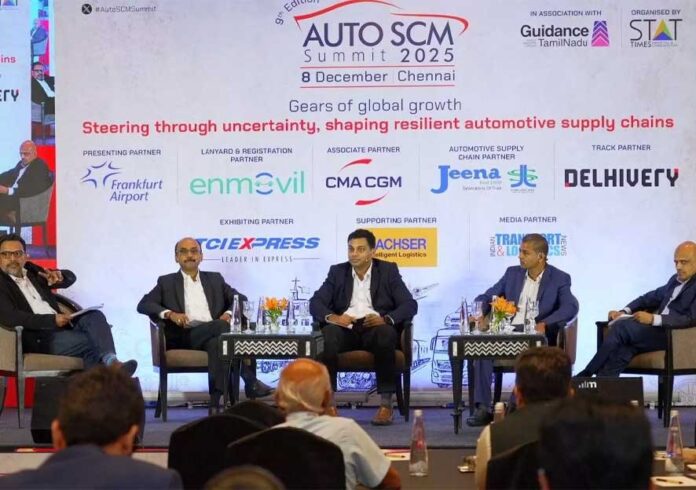
India is rapidly strengthening its position as a global automotive manufacturing and export hub, powered by deeper localisation, structured supplier development and a steadily improving logistics ecosystem. As global OEMs and component makers realign sourcing strategies to manage uncertainty and diversify supply chains, India is increasingly being viewed as a central pillar in global automotive value networks.
Against this backdrop, the 9th edition of the Auto SCM Summit 2025 was held on 8 December 2025 in Chennai, under the theme “Gears of Global Growth: Steering through Uncertainty, Shaping Resilient Automotive Supply Chains.” The summit brought together OEMs, auto component manufacturers, logistics providers, policymakers and global supply chain experts to discuss emerging opportunities and pressing challenges.
Opening the summit, Joachim von Winning, Director – Cargo Partnerships, Frankfurt Airport, highlighted the strength of Indo-German trade relations, with automotive at its core. Emphasising collaboration beyond commerce, he said India and Germany are united by “trade, trust and technology,” positioning India as an increasingly critical node in global supply chains.
The opening panel focused on India’s transition from a regional sourcing base to a global manufacturing hub. Shyamsundar N, Area General Manager – South & East India, CMA CGM India, noted that global manufacturers are increasingly shifting production to India as supply chains diversify. Girish DM, Vice President – Truck Purchasing, Volvo Group India, underlined that localisation is driven as much by capability building as by cost efficiencies. He added that the government’s Make in India initiative is enabling closer collaboration between global suppliers operating in India and strong domestic players.
Supplier development emerged as a recurring theme. Sahil Seshadri, Head – Global Sourcing (India & Southeast Asia), Knorr-Bremse Systems for Commercial Vehicles India, stressed that long-term sourcing success depends on capacity strengthening and constant engagement with suppliers. Echoing this view, Ponraj Pandian, Head – Materials Management, ZF Commercial Vehicles, said India is being positioned as an innovation hub, with early R&D collaboration enabling Indian suppliers to take on high-precision global mandates.
However, speakers also flagged near-term export headwinds. Shikhar Biswas, Head – Logistics & Supply Chain, International Operations, Farm Equipment Sector, Mahindra & Mahindra, pointed out that demand planning has become a major challenge amid recent tariff-related disruptions in key export markets such as the US. He stressed the importance of agile planning and market diversification to mitigate volatility.
Highlighting India’s long-term export potential, Anand Mimani, CEO – EV & New Energy Business, Blue Energy Motors, said India is strategically positioned to emerge as a global export hub for automotive components, provided planning and execution are strengthened. Shanmugapriya Murugananth, Senior Manager – Investment Promotion (Automotive), Guidance Tamil Nadu, reaffirmed the state government’s role as an active enabler, particularly during periods of trade uncertainty, by supporting manufacturers and exporters across the automotive ecosystem.
Digitalisation, visibility and sustainability were identified as next-phase priorities. Agnelo D’Lima, Chief Sales & Marketing Officer, Jeena & Company, highlighted the growing role of digital control towers in enabling end-to-end logistics visibility. Naveen Prakash, Co-founder & Director, Global Logistics Solutions India, drew attention to structural inefficiencies in trucking and called for data integration to accelerate sustainable logistics adoption.
Sustainability leadership, speakers agreed, must be driven from the top. Michael Moebius, President & Chief Procurement and Supply Chain Officer, Daimler India Commercial Vehicles, emphasised that supply chains are the backbone of the economy and that disruptions in logistics have far-reaching consequences.
The Auto SCM Summit 2025 delivered a clear message: India’s rise in the global automotive supply chain is being driven by capability building, innovation and deeper global integration. With stronger localisation, focused supplier development and robust ecosystem support, India is not merely participating in global automotive growth—it is actively shaping its future.