
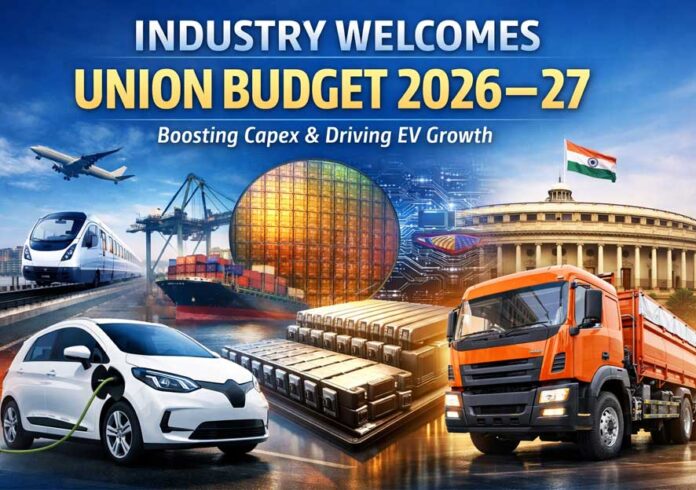
Industry leaders across India’s automotive, mobility, infrastructure, manufacturing, technology and logistics sectors have welcomed the Union Budget 2026–27, calling it a forward-looking and execution-focused roadmap that reinforces India’s long-term growth ambitions.
The Budget’s strong emphasis on higher public capital expenditure, manufacturing competitiveness, infrastructure expansion, clean mobility, electronics and semiconductor ecosystems, and supply-chain resilience has received broad endorsement from OEMs, commercial vehicle manufacturers, auto component suppliers, EV players, and logistics and infrastructure solution providers.
The increase in capital expenditure to ₹12.2 lakh crore, alongside sustained investment in highways, freight corridors, urban mobility and logistics infrastructure, is being viewed as a key catalyst for demand creation and industrial activity. Targeted incentives for electric mobility, battery manufacturing, rare earths, semiconductors and advanced electronics further strengthen the foundation for future-ready manufacturing.
Collectively, industry reactions highlight that the Union Budget 2026–27 offers policy clarity and long-term visibility, fosters investment and innovation, and positions the automotive and mobility sectors as central to India’s journey towards a Viksit Bharat.
Mr. Shailesh Chandra, MD & CEO, Tata Motors Passenger Vehicles Ltd.
“The Union Budget 2026 is an inclusive, growth-oriented and forward-looking roadmap designed to accelerate sustainable economic expansion with fiscal prudence. The proposal to raise public capital expenditure to ₹12.2 lakh crore strengthens the foundation for long-term growth, while the focus on competitiveness, resilience and broad-based development aligns strongly with the nation’s evolving priorities.
Targeted initiatives for data centres, semiconductors, rare earths and electronic components will reduce critical import dependencies and position India as a global high-tech manufacturing hub. The higher Auto PLI allocation for FY27, customs duty exemptions on capital goods for lithium-ion cell manufacturing, and increased outlay under the PM e-Drive scheme reflect the Government’s continued commitment to catalysing the EV ecosystem.
Overall, the Budget builds on the reform momentum of recent years, reinforcing India’s resilience and advancing the nation’s journey towards the Viksit Bharat vision.”
Mr Alexander Schoen, Chief Financial Officer, Daimler India Commercial Vehicles (DICV)
“The Union Budget 2026 reinforces India’s long-term growth narrative by placing manufacturing, infrastructure and supply-chain resilience at the centre of economic policy. The continued thrust on infrastructure development—especially in Tier-II and Tier-III cities—will directly stimulate demand for commercial vehicles while improving logistics efficiency nationwide.
The proposed Dedicated Freight Corridor from Dankuni in West Bengal to Surat in Gujarat, spanning key industrial states, will significantly strengthen east–west logistics efficiency and reduce freight costs. Initiatives to scale up strategic manufacturing sectors, strengthen MSMEs, and deepen domestic capabilities in semiconductors, advanced materials and chemicals will further enhance India’s manufacturing competitiveness.
Overall, the Budget creates a conducive environment for commercial vehicle manufacturers to invest, innovate and support India’s transition towards a resilient, self-reliant and future-ready mobility ecosystem, positioning the CV industry as a key enabler of economic expansion.”
Mr. Balbir Singh Dhillon, Brand Director, Audi India
“The Union Budget’s strong emphasis on infrastructure and capital expenditure is a positive enabler for India’s mobility landscape. Improved highways and intercity connectivity—especially across Tier-II and Tier-III markets—are strengthening the ownership and usage ecosystem for luxury automobiles.
The Government’s focus on fiscal prudence, macroeconomic stability and ease of doing business reinforces confidence for long-term investments in the automotive sector. Initiatives such as rare earth corridors and the advancement of ISM 2.0 under the India Semiconductor Mission signal a clear intent to build resilient domestic supply chains and a technology-driven manufacturing ecosystem to support the future of automotive and electric mobility in India.”
Mr. Vikram Gulati, Country Head & Executive Vice President – Corporate Affairs and Governance, Toyota Kirloskar Motor
“Toyota Kirloskar Motor welcomes the Union Budget 2026–27 and appreciates the Government’s continued focus on fiscal discipline, economic strengthening, structural reforms and large-scale infrastructure development. The emphasis on healthcare and education further reinforces the foundations of inclusive growth while investing in India’s youth and future workforce.
The Budget’s thrust on strengthening manufacturing value chains—particularly through incentives for upstream processing of critical raw materials such as rare-earth metals for permanent magnets—along with the announcement of the India Semiconductor Mission 2.0 and the Electronic Component Manufacturing Scheme, will significantly bolster the domestic supply ecosystem, including for the automotive sector.
Additionally, excise relief on biogas-blended CNG and dedicated allocations for Carbon Capture, Utilisation and Storage (CCUS) underline India’s strong commitment to decarbonisation. Collectively, these measures will support the sustainable growth of the automotive industry while accelerating India’s transition towards clean, inclusive and future-ready mobility in line with the vision of Viksit Bharat.”
Mr. Tarun Garg, MD & CEO, Hyundai Motor India Limited
“Building on the GST 2.0 reforms, the Union Budget 2026–27 presents a long-term roadmap that accelerates India’s rise as a global manufacturing hub and Atmanirbhar Bharat. The focus on rare earth corridors, EV battery and electronics manufacturing, MSME empowerment, inclusivity and AI investments positions India for global leadership.
The strong push for tourism, rural growth and regional connectivity will spur economic activity and open new opportunities for advanced mobility and logistics solutions. With a bold capital outlay, simplified taxation and improved ease of doing business, this Budget reinforces confidence in India’s growth story and the vision of a Viksit Bharat.”
Mr. Gwanggu Lee, MD & CEO, Kia India Private Limited
“The Union Budget 2026–27 sets out a clear and forward-looking path for sustained economic growth, with a strong focus on manufacturing, infrastructure and fiscal discipline. Continued investments in roads, railways, freight corridors and regional connectivity, along with the development of new economic regions and high-speed corridors, will open-up fresh opportunities and support balanced growth across the country.
The emphasis on advanced manufacturing, electronics and battery production, rare earth corridors and MSME empowerment strengthens India’s journey towards becoming a competitive global manufacturing hub under the vision of Atmanirbhar Bharat. Together, these measures reinforce consumer confidence and accelerate the transition towards technology-led and sustainable mobility. As India progresses towards a Viksit Bharat, Kia India looks forward to contributing meaningfully to this transformation through future-ready mobility solutions.”
Mr. Vinod Aggarwal, MD & CEO, VE Commercial Vehicles
“The Union Budget 2026 sets out a clear and purposeful roadmap to strengthen India’s growth trajectory and advance the vision of Viksit Bharat. The ₹12.2 lakh crore allocation for infrastructure will sustain demand for trucks, buses and logistics assets that underpin economic activity nationwide.
The emphasis on rare earth mineral corridors is a strategic step toward securing critical inputs for electric motors and advanced components, reducing import dependence and strengthening domestic value chains. Continued duty exemptions for battery manufacturing further accelerate EV adoption while improving total cost of ownership.
Overall, the Budget strikes the right balance between near-term confidence and long-term capacity building, reinforcing India’s position as a resilient and globally competitive manufacturing hub.”
Mr. Dheeraj Hinduja, Chairman, Ashok Leyland
“The Union Budget 2026 is pro-growth and development-focused, aligned with the vision of a competitive, resilient and self-reliant India. Increased spending on infrastructure, manufacturing and defence will drive economic growth and support demand in the commercial vehicle sector, while initiatives in AI, rare earths and energy transition sustain long-term momentum.”
Mr Piyush Arora, Managing Director & CEO, Škoda Auto Volkswagen India Pvt Ltd
We welcome the Union Budget 2026–27 for the clear direction it sets on India’s long-term economic priorities as the country progresses towards the Viksit Bharat 2047 vision. It sends a strong message of policy stability, which is essential for sustained manufacturing investments.
The continued emphasis on manufacturing competitiveness and trade facilitation, including progress on the India–EU FTA, strengthens India’s position in global supply chains and reinforces its role as a key automotive manufacturing and export base. The focus on SME growth and the revival of legacy industrial clusters will further enhance the resilience and depth of India’s industrial and supplier ecosystem.
At Škoda Auto Volkswagen India Private Limited, this aligns well with our ‘Make in India, for India and the world’ commitment as we advance our sustainable mobility roadmap and continue to deepen localisation and skilling across our ecosystem.
Mr. Deepak Shetty, MD & CEO JCB India
We warmly welcome Budget 2026, which charts a transformative course to accelerate India’s economic growth and advance the vision of a ‘Viksit Bharat’. The focus on scaling up manufacturing across seven strategic sectors and promoting champion MSMEs is a decisive step toward strengthening India’s domestic capabilities while establishing the country as a global manufacturing hub.
A significant boost comes for the construction equipment industry, with a focus on domestic manufacturing of high-value capital goods such as tunnel boring machines, earthmoving equipment, and crane systems. This initiative is set to drive demand for advanced, locally produced equipment, fuel innovation and elevate India’s position as a globally competitive hub in the construction ecosystem. The strong emphasis on infrastructure, particularly the development of seven high-speed rail corridors as growth connectors, will further enhance regional integration, improve urban mobility, and boost productivity, making India an attractive destination for global investment.
Complemented by reforms such as a review of the Foreign Exchange Management framework, measures to deepen the corporate bond market, and enabling non-resident investors to participate in equities through the Portfolio Investment Scheme, the Budget creates a robust environment for long-term capital flows and enterprise growth.
Overall, Budget 2026 strikes the perfect balance between growth, structural reforms, and long-term competitiveness, paving the way for India to emerge as a world-class manufacturing and infrastructure hub while generating opportunities that benefit countries across the globe.
Dr. Uday Narang, Founder & Chairman, Omega Seiki Mobility
“The Union Budget 2026–27 marks a decisive shift in positioning India as a global hub for smart and sustainable mobility. Higher public capex, MSME financing, advanced manufacturing and EV supply-chain initiatives create the right environment to scale innovation and accelerate EV adoption across Tier-II and Tier-III markets.
Together, these measures position India not just as a large EV market, but as a competitive global export base for clean, tech-driven mobility solutions.”
Mr. Harinder Singh, Managing Director & CEO, Yokohama India Pvt. Ltd.
“The Union Budget’s continued emphasis on manufacturing depth, infrastructure expansion, critical mineral ecosystems and clean-energy value chains sends a strong and progressive signal for India’s industrial future. Enhanced support for electronic components manufacturing, battery storage, lithium-ion cells and critical minerals provides long-term policy visibility for EV platform localisation, battery assembly and advanced power electronics manufacturing—strengthening investment confidence across emerging mobility ecosystems.
For the tyre industry and the broader automotive sector, sustained capital expenditure of ₹12.2 lakh crore and expansion of highways, freight corridors, ports and multimodal logistics networks will significantly improve supply-chain resilience, logistics efficiency and last-mile connectivity, particularly across Tier-II and Tier-III markets.
Customs duty rationalisation and exemptions on select capital goods further enhance cost competitiveness by lowering capex and operating costs for high-technology manufacturing. At Yokohama India, this direction reinforces our confidence to accelerate investments in localisation, sustainability and next-generation manufacturing aligned with India’s long-term growth trajectory.”
Mr. Dilip Chandak, Managing Director, Vega Helmets
Commenting on the Union Budget 2026–27, Mr. Dilip Chandak said, “The exemption of TDS and income tax on MACT interest awards is a pragmatic and victim-centric reform that addresses a long-standing challenge in India’s road safety ecosystem. Accident compensation cases often stretch over several years, eroding the real value of awards due to deductions and inflation. This measure ensures faster and full payouts to natural persons, easing financial distress for affected families while also encouraging insurers to settle claims more promptly—potentially lowering systemic costs.
From Vega Helmets’ perspective, as one of India’s leading helmet manufacturers producing millions of units annually, this reform complements the Budget’s broader thrust on MSME support and infrastructure development. A stronger focus on awareness and compliance—supported by economic incentives—could significantly improve helmet adoption, reduce accident fatalities, and drive sustainable growth across legacy safety-focused industries. The Finance Minister’s approach effectively aligns fiscal policy with road safety priorities; the key now lies in robust on-ground implementation.”
Mr. Shivam Sisodiya, CEO & Co-Founder, Bijliride
Sharing his views on the Budget, Mr. Shivam Sisodiya stated, “Union Budget 2026 takes a decisive step toward strengthening India’s electric mobility and energy storage ecosystem by addressing both supply-side resilience and demand-led adoption. The continued customs duty exemptions on capital goods and lithium-ion cells, along with targeted support for battery energy storage systems, will meaningfully reduce cost barriers and accelerate fleet-scale electrification.
Investments in electronic components manufacturing, rare earth processing, and container manufacturing will further stabilise supply chains and enhance India’s export readiness. The inclusion of electric buses in public transport expansion reinforces the government’s commitment to clean mobility at scale, creating strong momentum for shared, rental, and technology-led EV solutions across urban India.”
Dr. Sudhir Mehta, Founder & Chairman, EKA Mobility
“The Union Budget 2026 places clean transportation firmly at the centre of India’s development agenda. The deployment of 4,000 electric buses is a strong endorsement of public transport electrification as a scalable solution to urban congestion, emissions and rising mobility demand, while also improving access to emerging tourism and regional connectivity corridors.
Investments in high-speed rail corridors, dedicated freight corridors and transport-led tourism growth reflect a shift towards cleaner, more efficient inter-city mobility. Rising public capex to ₹12.2 lakh crore, supported by the proposed Infrastructure Risk Guarantee Fund, further strengthens the environment for large-scale EV and transport infrastructure investments.
For EKA Mobility, the Budget provides a solid foundation to expand electric vehicle offerings and integrate smart, low-carbon mobility solutions aligned with the vision of Viksit Bharat.”
Mr. Jalaj Gupta, Managing Director, Montra Electric
“This year’s Union Budget lays a strong foundation for India’s clean mobility and advanced manufacturing ambitions. Support for lithium-ion cell manufacturing, rare-earth processing, semiconductors and electronics through ISM 2.0 will help build a fully integrated EV supply chain, deepen localisation and strengthen India’s position as a global hub for sustainable mobility.”
Mr. Nemin Vora, CEO, Odysse Electric
“The Government’s strong focus on local manufacturing and MSME support will significantly benefit the mobility ecosystem. Rising disposable incomes, particularly among the middle class, will boost purchasing power and accelerate the transition towards sustainable mobility. Enhanced credit guarantees for MSMEs and startups further strengthen the foundation for long-term growth and economic resilience.”
Mr. K. K. Kapila, President Emeritus, International Road Federation (IRF)
“The Budget reinforces the Government’s long-term vision of building a modern, resilient and globally competitive infrastructure ecosystem. Sustained investment in highways, multimodal logistics parks, urban mobility and last-mile connectivity will reduce logistics costs, enhance supply-chain efficiency and improve ease of doing business across sectors.”
He added that higher investments in road transport, freight corridors, warehousing and technology-driven logistics will accelerate economic activity, generate employment and improve regional connectivity. “A well-integrated logistics framework is essential for India’s $5-trillion economy aspiration, and the Budget’s infrastructure-led approach is a step in the right direction.”
Mr. Ravi Mehra, Managing Director, Uno Minda
“We welcome the Union Budget 2026–27, which is firmly focused on strengthening India’s manufacturing ecosystem, advancing the vision of Viksit Bharat, and fostering Aatmanirbharta. The emphasis on MSME growth, along with the proposal to constitute a high-level committee to enhance industrial resilience and reduce import dependence, is a positive step towards building a stronger and more competitive industrial base.
The strong push for electronics and advanced manufacturing—underscored by the ₹40,000 crore allocation under the Electronics Components Manufacturing Scheme and the launch of India Semiconductor Mission 2.0 focused on equipment and material design—will significantly strengthen domestic value chains and provide a major boost to the auto components sector. The proposal to establish dedicated rare-earth corridors will further secure supplies of critical materials by promoting research and mining.
Ease-of-doing-business reforms, including the increase in portfolio investment limits to 10 percent, will enhance investor confidence. We particularly welcome the addition of 35 capital goods for EV battery manufacturing to the list of exempted capital goods, which will meaningfully boost domestic lithium-ion battery production, reduce import dependence, and support the growth of electric mobility and energy storage in India.
Measures aimed at strengthening capital goods manufacturing, including the development of high-tech toolrooms, will help improve scale, quality and cost efficiencies. Overall, the Budget lays a strong foundation for sustainable and self-reliant manufacturing growth.”
Ravi Krishnamoorthi, Group President – Strategic Initiatives, Rosmerta Technologies
“The Government’s infrastructure-led growth strategy sends a clear and unambiguous signal. At a time when private investment is re-engaging, the nearly 20 percent increase in capital expenditure to ₹12.2 lakh crore provides both scale and certainty, while disciplined fiscal management—with the deficit projected at 4.3 percent through FY27—reinforces macroeconomic stability and investor confidence.
With ₹40,000 crore allocated to the ECMS, seven new Dedicated Freight Corridors, coastal infrastructure upgrades and a strong push for domestic tooling and component manufacturing, the focus is clearly structural and long-term. Combined with tax rationalisation and cumulative GST reforms, these measures will sustain demand and strengthen India’s global competitiveness.”
Sorab Agrawal, Executive Director, ACE
“The Union Budget 2026 recognises construction and infrastructure equipment as a critical enabler of execution capacity. Higher capital expenditure and a dedicated scheme for equipment enhancement will boost productivity, safety and domestic manufacturing, while reducing import dependence.”
Mr. Vaibhav Kaushik, Co-Founder & CEO, Nawgati
“For the mobility ecosystem, viewing fuel and charging access as an integrated national network aligns well with the Budget’s emphasis on sustainable and efficient infrastructure. Continued support for EV expansion, digital payments and logistics modernisation can improve utilisation across fuel stations and charging points in cities and along highways.
Going forward, execution clarity, common standards and interoperable data systems will be critical. If implemented effectively, these measures can reduce congestion and downtime, optimise fleet operations, and ensure infrastructure delivers stronger economic and environmental outcomes.”
Sandeep Lanjewar, Senior Director, Palladium India
“Union Budget 2026 presents a cohesive national vision centred on skill development and MSME-led growth. In the textile sector, modernised clusters, mega parks and sustainability-driven innovation will strengthen MSMEs and empower artisans—particularly critical as India gains a competitive edge through the recent India–EU trade agreement.
At the same time, the expansion of ABGC creator labs across 15,000 schools and colleges, along with the establishment of a new National Institute of Design, is building a future-ready talent pipeline. The skilling thrust extends to tourism as well, with plans to train 10,000 guides across 20 iconic destinations. Together, these interventions enable inclusive growth and globally competitive value chains across sectors.”
Kailas Patil, Senior Director, Palladium India
“The Union Budget 2026 marks a watershed moment in India’s approach to road safety—elevating it from a peripheral concern to a core engineering mandate. With the Ministry’s allocation rising to ₹2.90 lakh crore, the focus is shifting decisively from ‘pavement to prevention’.
By leveraging the newly allocated 30 GHz radio frequency for vehicle-to-vehicle (V2V) communication and integrating AI-based crash prediction models into national highways, India is moving towards a proactive, zero-harm mobility ecosystem. The deployment of 4,000 additional e-buses under the expanded PM e-Bus Sewa scheme further underscores the commitment to making public transport not just greener, but safer and more reliable. This truly is the era of ‘Sadak Suraksha, Jeevan Raksha’—where technology meets accountability.”
Mr. Khursheed Alam, Founder, Atmos Systems
“The Budget reinforces India’s focus on manufacturing and infrastructure, creating a robust ecosystem for technology-driven logistics and material-handling solutions. Sustained capital expenditure provides the visibility required to scale automation and digitalisation across supply chains.”
Nagendra Nath Sinha, Managing Director, Rodic Digital & Advisory
“The FY27 Budget presents a strong execution-focused framework for transport and infrastructure. Higher sectoral allocations, improved access to finance and incentives for domestic equipment manufacturing will accelerate project execution and strengthen private participation.”
Mr. Anant Badjatya, CEO, Indofast Energy
“The Budget’s strong focus on electronics, semiconductors and battery energy storage will localise key EV components, reduce import dependence and support scalable models such as battery swapping—making electric mobility more affordable and accessible.”
Mr. Sudheer Narayan & Mr. Balaji Thirumalai, Partners, Bain & Company
“The launch of ISM 2.0 and enhanced ECMS support signals India’s commitment to building a full-stack semiconductor ecosystem—from IP and equipment to materials—deepening domestic value chains and attracting sustained global investment.”
Mr. Balaji Thirumalai, Partner, Bain & Company
“The Budget’s announcement of ISM 2.0 sends a strong signal that India is committed to building a full-stack semiconductor ecosystem, extending beyond fabs and OSATs to IP, semiconductor equipment, and materials. The expanded ECMS support with an investment of INR 40,000 crore further strengthens component localisation, helping deepen domestic value chains and position India more firmly within the global semiconductor landscape.”
Mr. Gaurav Dolwani, Founder & CEO, LICO Materials Pvt. Ltd.
“The Budget recognises the importance of recycling and secondary materials in strengthening India’s battery supply chain. Customs duty exemptions on battery waste and critical minerals improve feedstock availability, support domestic recycling and strengthen a circular manufacturing ecosystem.”