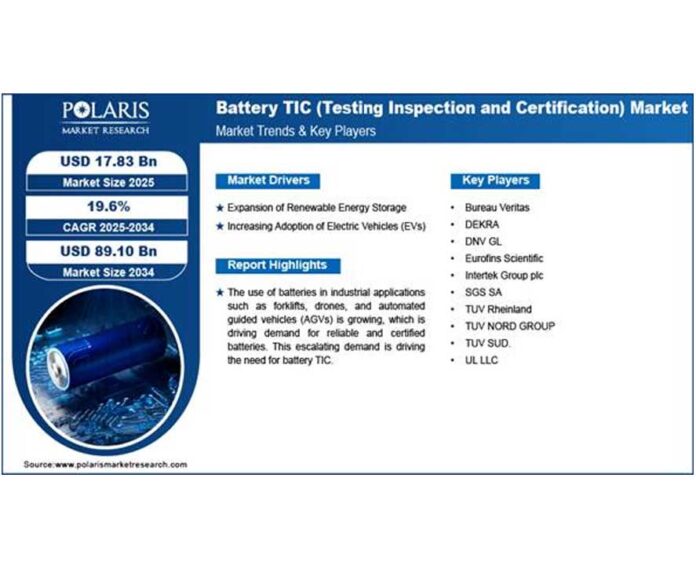
The global Battery TIC (Testing, Inspection, and Certification) market is witnessing rapid expansion, driven by the accelerating adoption of electric vehicles, renewable energy storage solutions, and next-generation battery technologies. As batteries increasingly power electrification across multiple industries, ensuring safety, performance reliability, and regulatory compliance has emerged as a critical industry priority. According to a recent industry assessment by Polaris Market Research, the market was valued at USD 14.93 billion in 2024 and is projected to reach USD 89.10 billion by 2034, registering a strong CAGR of 19.6% during the forecast period.
The projected growth highlights the rising importance of testing, inspection, and certification services in supporting the safe deployment of batteries across automotive, energy storage, consumer electronics, and industrial applications. As advanced battery chemistries — including lithium-ion, solid-state, and lithium-sulfur technologies — continue to redefine energy storage performance, stringent validation and certification frameworks are becoming essential to maintain operational safety, product reliability, and compliance with evolving global regulations.
Advanced Materials Innovation and Electrification Drive Battery TIC Market Growth
The rapid evolution of advanced battery materials and technologies is a major catalyst driving demand for TIC services. Modern batteries must meet strict safety, durability, and performance requirements, particularly in high-risk applications such as electric vehicles, aerospace systems, and grid-scale energy storage. The Battery TIC market plays a crucial role in validating battery quality, ensuring compliance with international safety standards, and minimizing risks associated with thermal runaway, performance degradation, and system failure.
Innovations such as solid-state batteries, lithium-sulfur chemistries, and high-energy-density lithium-ion batteries are enabling longer range, faster charging, and improved efficiency. However, these advancements also introduce complex safety and performance challenges. Comprehensive TIC processes—including electrical testing, environmental testing, and lifecycle analysis—are essential to ensure these advanced materials meet industry standards and deliver reliable performance across diverse operating environments.
Furthermore, increasing battery integration in mission-critical infrastructure such as data centers, medical devices, telecommunications systems, and industrial automation platforms is accelerating the need for certification services to ensure uninterrupted power and operational safety.
Electric Vehicle Revolution Accelerates Demand for Battery Testing and Certification
The global transition toward electric mobility represents one of the most significant growth drivers for the battery TIC market. As electric vehicle adoption accelerates worldwide, ensuring battery safety and compliance has become essential to support large-scale deployment. In 2023 alone, electric vehicle sales exceeded 14 million units globally, with EV market share increasing dramatically from 4% in 2020 to 18% in 2023.
Battery TIC services enable automotive manufacturers to validate battery safety, performance, durability, and regulatory compliance throughout the product lifecycle. Certification ensures batteries meet international standards for crash safety, thermal stability, charging performance, and environmental durability. As EV manufacturers invest heavily in next-generation battery technologies, TIC services are becoming integral to product development, commercialization, and regulatory approval.
Additionally, the rapid growth of battery manufacturing facilities worldwide is increasing the demand for independent testing and certification services. Battery cell production capacity is expected to expand significantly, requiring advanced testing protocols to maintain product quality and safety across global supply chains.
Renewable Energy Storage Expansion Strengthens Battery TIC Market Outlook
The rapid expansion of renewable energy systems is further accelerating demand for battery TIC services. Energy storage solutions are critical to stabilizing intermittent renewable energy sources such as solar and wind power. Battery storage capacity has grown dramatically, increasing from just 47 MW in 2010 to over 17,380 MW in 2023, highlighting the growing reliance on energy storage technologies.
Energy storage systems require extensive safety validation to ensure long-term reliability, operational efficiency, and regulatory compliance. Testing and certification services play a vital role in evaluating battery performance under extreme conditions, verifying lifecycle durability, and ensuring compliance with international safety standards.
As governments and utilities continue to invest in large-scale renewable energy infrastructure, the demand for certified, high-performance batteries will continue to increase, strengthening the role of TIC services in ensuring grid reliability and energy security.
Lithium-Ion Batteries and Industrial Applications Dominate Market Demand
Lithium-ion batteries represent the fastest-growing segment in the battery TIC market due to their widespread use across consumer electronics, electric vehicles, and industrial systems. Their high energy density, long cycle life, and efficiency make them the preferred choice for modern energy storage applications. However, ensuring their safety and performance requires rigorous testing protocols to prevent overheating, degradation, and system failures.
Industrial equipment emerged as the largest application segment in 2024, driven by increasing battery adoption in automated guided vehicles (AGVs), forklifts, robotics, and backup power systems. Industrial operations require highly reliable batteries capable of operating in demanding environments, making TIC services essential for performance validation and lifecycle management.
Consumer electronics, including smartphones, laptops, wearable devices, and IoT-enabled systems, also represent a major growth segment. As these devices rely heavily on battery performance and safety, manufacturers are increasingly investing in certification services to ensure compliance and protect brand reputation.
Asia Pacific Leads Global Market While North America Emerges as Innovation Hub
Asia Pacific dominated the battery TIC market in 2024, driven by rapid industrialization, expanding EV adoption, and significant investments in battery manufacturing and renewable energy infrastructure. Countries such as China, India, Japan, and South Korea are leading battery production and deployment, creating substantial demand for testing, inspection, and certification services.
China, in particular, is investing heavily in renewable energy projects and battery manufacturing, further strengthening its position as a global leader in energy storage and certification demand. The region’s growing healthcare and industrial sectors are also increasing reliance on battery-powered medical devices and automation systems, driving TIC service adoption.
North America is expected to experience the fastest growth during the forecast period, driven by advancements in battery technology, EV manufacturing, and research initiatives. Expanding battery production capacity and increasing investments in next-generation battery technologies are fueling demand for advanced certification services.
Strategic Investments and Technological Advancements Strengthen Market Competition
Leading TIC providers are investing heavily in expanding their testing capabilities, research facilities, and certification services to meet growing global demand. Major industry players include Bureau Veritas, DEKRA, DNV GL, Eurofins Scientific, Intertek Group plc, SGS SA, TÜV Rheinland, TÜV SÜD, TÜV NORD, and UL LLC.
These companies are expanding laboratory infrastructure, developing advanced testing methodologies, and integrating digital technologies such as AI-based diagnostics and simulation platforms to enhance testing accuracy and efficiency. Strategic collaborations between battery manufacturers, automotive companies, and TIC providers are accelerating innovation and strengthening global certification ecosystems.
Future Outlook: Advanced Materials and Electrification to Redefine Battery Certification Landscape
The future of the battery TIC market will be shaped by continued advancements in battery materials, electrification, and renewable energy integration. Emerging technologies such as solid-state batteries, AI-driven battery diagnostics, and digital twin simulation models will require sophisticated certification frameworks to ensure safety and performance.
As global industries transition toward electrification and sustainable energy systems, battery TIC services will play a critical role in ensuring product safety, regulatory compliance, and supply chain reliability. Certification processes will become increasingly integrated with digital technologies, enabling real-time performance monitoring, predictive maintenance, and lifecycle optimization.
Conclusion: Battery TIC Market Positioned as Critical Enabler of Global Electrification
The Battery TIC market is emerging as a foundational pillar of the advanced materials and energy ecosystem. With market value projected to increase sixfold by 2034, testing, inspection, and certification services will become essential for enabling safe, reliable, and scalable battery deployment across industries.
As electric mobility, renewable energy storage, and advanced battery technologies continue to expand, TIC providers will play a crucial role in ensuring safety, performance, and regulatory compliance. Organizations investing in advanced certification capabilities will gain a competitive advantage while supporting the global transition toward electrification, sustainability, and next-generation energy infrastructure.