Amid ongoing geopolitical tensions disrupting global oil markets and driving fuel price volatility, fresh data from corporate mobility platform Routematic underscores the growing financial advantage of electrifying fleet operations.
Routematic, an AI-enabled corporate mobility provider serving over 400 enterprises across more than 24 cities in India, has deployed a fleet of over 400 company-owned electric vehicles (EVs) within its employee transportation networks in Bengaluru and Pune.
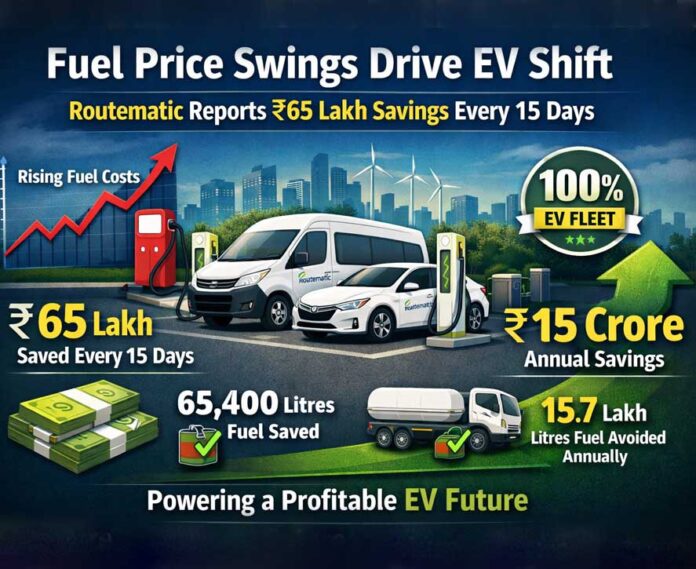
Operational insights reveal that these EVs are collectively helping avoid the consumption of approximately 65,400 litres of fuel every 15 days when compared to conventional internal combustion engine (ICE) vehicles under similar usage conditions. With fuel prices hovering around ₹100 per litre, this translates to an impressive ₹65 lakh in fuel cost savings every 15 days.
On an annual basis, these savings are projected to exceed ₹15 crore, reinforcing the strong business case for EV adoption in corporate fleet operations while reducing dependence on fluctuating fuel markets.
If the ongoing situation is sustained over an entire year, the company estimates that its current EV deployments could help avoid the consumption of over 15.7 lakh litres of fuel annually, translating into annual fuel cost savings of approximately INR 15.7 crore at present fuel prices.
These estimates are based on Routematic’s current EV deployments and prevailing market fuel prices, illustrating the savings potential from electrifying even a portion of corporate transportation fleets. The company noted that if its entire fleet were to transition to electric vehicles, the fuel savings and cost efficiencies could be significantly higher.
The data highlights the growing economic rationale behind electrification as fuel prices fluctuate amid global geopolitical developments. For enterprises, EV adoption is emerging as a strategic hedge against global fuel volatility, not just a sustainability initiative. However, despite the clear economic and sustainability benefits, adoption of structured and optimized corporate commute systems remains limited. According to a recent Routematic research report, “Navigating Corporate Commute for GCCs in India: Benchmarking Corporate Commute Maturity Report,” over 60% of Global Capability Centres (GCCs) in India still lack integrated commute systems, indicating a significant gap in how enterprises approach employee mobility.
Sriram Kannan, Founder & CEO, Routematic, said the latest global energy disruptions are reinforcing the strategic importance of fleet electrification. “Global geopolitical tensions and the resulting volatility in fuel prices once again highlight the vulnerability of fuel-dependent mobility systems. Electrification in mobility is no longer just about sustainability, it is increasingly about cost stability and operational efficiency, particularly for enterprises running large, round-the-clock transportation networks. At Routematic, we are seeing how transitioning corporate transportation to EVs, combined with intelligent routing and fleet optimization, can significantly reduce fuel dependency while improving efficiency and cost benefits”.
Employee transportation vehicles typically travel 100-150 kilometres daily across fixed pickup and drop routes, making them particularly well suited for electrification due to their predictable routes and high utilization levels. Routematic’s EV fleet currently averages around 120 kilometres of daily operations per vehicle, allowing enterprises to achieve significant fuel cost savings while reducing emissions.
The company leverages its AI-driven fleet intelligence platform to optimize routing, scheduling and vehicle deployment across employee transportation networks. The platform also analyses battery charge levels and charging cycles, ensuring EVs are deployed efficiently while maintaining high fleet utilization.
As fuel price volatility continues to influence transportation economics, electrification of high-utilization corporate fleets is increasingly being seen as a practical pathway for enterprises to stabilize operating costs while supporting India’s broader sustainability and energy transition goals. Routematic currently manages over 15,000 employee transportation trips every day across its network with a fleet of more than 7,500 vehicles. As part of its long-term sustainability roadmap, the company is actively expanding its EV fleet, working with enterprise clients and fleet partners to accelerate the adoption of electric mobility across corporate transportation networks.