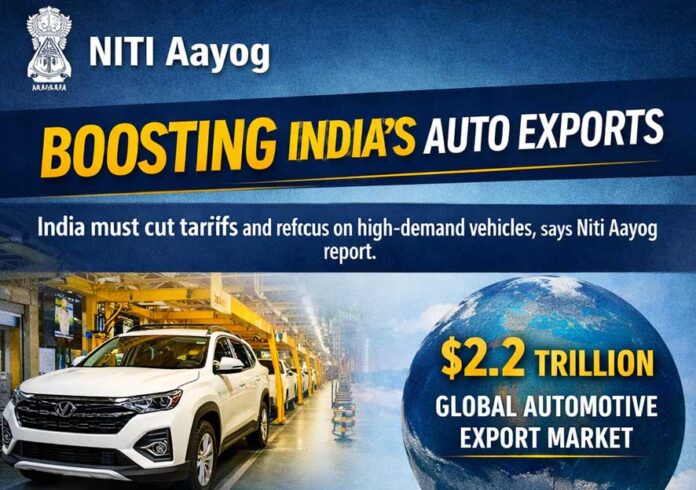
India needs to rationalise tariffs and reorient its manufacturing base towards high-demand segments such as passenger vehicles to strengthen its global competitiveness, government think tank Niti Aayog said in a new report.
In its Trade Watch Quarterly for April–June 2025, released on Tuesday, Niti Aayog called for a series of strategic measures—including tariff rationalisation, stronger two-way trade linkages and increased participation in cross-border platforms—to improve India’s export performance.
The report emphasised the importance of upgrading quality standards, certification frameworks and technology adoption, along with deeper integration into global supply chains, to sustain long-term export growth. It noted that India’s trade profile is undergoing a structural shift, with technology-intensive exports gaining traction, services continuing to anchor growth, and imports increasingly reflecting participation in global value chains.
Focusing specifically on the automotive sector, the report assessed India’s export footprint across vehicles and auto components, examining tariff structures, intra-industry trade dynamics and integration into global value chains. While acknowledging India’s strong performance in select segments, Niti Aayog highlighted significant untapped potential to expand the country’s share in the $2.2 trillion global automotive export market.
Based on global export mapping and extensive stakeholder consultations, the analysis outlined key policy priorities aimed at enhancing competitiveness, expanding trade opportunities and shifting production towards segments with stronger and more sustainable global demand.