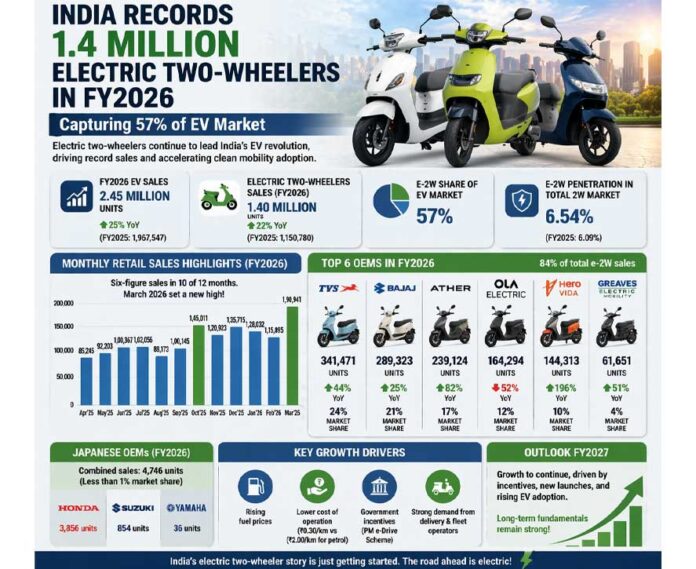
FY2026 has emerged as a landmark year for India’s electric vehicle industry, with total EV retail sales crossing 2.45 million units, reflecting 25% year-on-year growth compared to 1.97 million units in FY2025. The surge was largely driven by the electric two-wheeler (e-2W) segment, which continues to dominate India’s EV landscape.
According to Vahan portal data (April 1, 2026), 1.40 million electric two-wheelers were sold during FY2026, marking 22% growth YoY over FY2025’s 1.15 million units. This performance gave electric two-wheelers a 57% share of India’s total EV market, reinforcing their position as the backbone of India’s electric mobility transition.
Despite a reduced price gap between petrol and electric two-wheelers following GST changes in September 2025, demand remained resilient. Electric two-wheeler penetration rose to 6.54% of India’s total two-wheeler market in FY2026, up from 6.09% in FY2025. Rising petrol prices, lower operating costs, and growing model availability continued to attract buyers.
The segment also benefited from increasing demand in last-mile delivery, e-commerce, and fleet operations, where lower total cost of ownership (TCO) makes EVs especially attractive. Fleet operators, in particular, are accelerating adoption due to the operational efficiency of electric vehicles.
Top Electric Two-Wheeler OEMs in FY2026
The Indian e-2W market remained concentrated, with five manufacturers accounting for 84% of total sales. Among them:
TVS Motor Takes the Lead
TVS Motor emerged as the new market leader in FY2026, selling 341,471 units, up 44% YoY, and capturing 24% market share. Strong demand for the iQube and Orbiter models, along with the introduction of Battery-as-a-Service (BaaS), helped drive growth.
Bajaj Auto Climbs to No. 2
Bajaj Auto secured second position with 289,323 units, up 25% YoY, and achieved 21% market share. The launch of the Chetak C2501 contributed to its continued growth.
Ather Energy Posts Fastest Growth
Ather Energy recorded 239,124 units, marking 82% YoY growth and 17% market share. The Rizta family scooter, accounting for nearly 70% of sales, played a major role in the company’s expansion.
Ola Electric Sees Sharp Decline
Former market leader Ola Electric experienced a significant drop, selling 164,294 units, down 52% YoY, reducing its market share to 12% and slipping to fourth position.
Hero MotoCorp’s Vida Surges
Hero MotoCorp’s Vida brand posted 144,313 units, representing a 196% YoY increase, capturing 10% market share. Strong demand for the Vida VX2 drove this growth.
Greaves Electric Mobility Maintains Position
Greaves Electric Mobility ranked sixth with 61,651 units, up 51% YoY, supported by new product launches and expanding demand.
Japanese OEMs Struggle to Gain Traction
Japanese manufacturers Honda, Suzuki, and Yamaha together sold just 4,746 electric scooters in FY2026, highlighting the dominance of Indian manufacturers. Late entry, limited availability, and premium pricing contributed to modest adoption.
Growth Drivers in FY2026
Several factors accelerated electric two-wheeler adoption:
- PM e-Drive Scheme incentives
- Rising petrol prices
- Expansion of charging infrastructure
- Growing fleet and delivery demand
- Wider product portfolio across price segments
- Lower operating and maintenance costs
Electric two-wheelers typically cost 30 paise per kilometre, compared to ₹2 per kilometre for petrol vehicles, making them increasingly attractive for both personal and commercial use.
FY2027 Outlook
While FY2026 set a new benchmark, FY2027 growth will depend on:
- Extension or withdrawal of government incentives
- Global oil price trends
- New product launches
- Expansion into Tier-2 and Tier-3 markets
Despite uncertainties, the strong fundamentals of lower ownership costs, environmental benefits, and rising consumer awareness suggest continued growth for India’s electric two-wheeler market.
India’s e-2W industry has demonstrated resilience and momentum, firmly positioning electric mobility as a mainstream transportation choice in the years ahead.