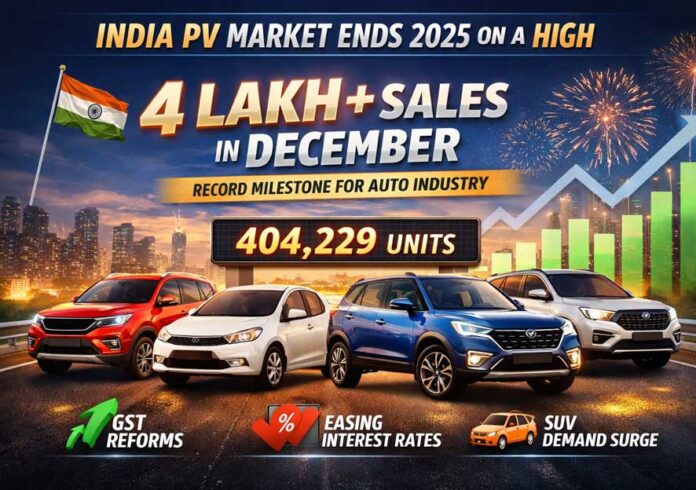
India’s mass passenger vehicle (PV) market wrapped up calendar year 2025 on a strong note, with December wholesales crossing the 4 lakh mark for the first time. Domestic dispatches rose 26% year-on-year (YoY) to 404,229 units during the month, marking one of the industry’s strongest monthly performances in recent years and reinforcing signs of a structurally stronger recovery after multiple quarters of volatility.
The rebound was underpinned by a supportive macroeconomic environment, including GST rationalisation, easing interest rates and improving consumer sentiment, particularly in rural markets. Aggressive product actions by automakers further aided demand, with growth spanning both SUVs and entry-level hatchbacks. Seven of the top ten mass PV manufacturers reported YoY growth in December, highlighting the broad-based nature of the recovery.
Maruti Suzuki Extends Its Lead
Maruti Suzuki retained its position as India’s largest passenger vehicle manufacturer, reporting domestic sales of 178,646 units in December, up 37% YoY. Demand was driven largely by its entry-level and compact car portfolio, supported by improved affordability and a revival in rural markets. Compact car sales grew 43% YoY, mini cars surged 92%, while utility vehicle volumes rose 33%.
The automaker closed calendar year 2025 with its highest-ever retail sales of 1.87 million units. December alone saw retail volumes of 286,000 units, with dealer inventory dropping to just three days, indicating tight supply conditions. Pending bookings stood at around 175,000 units at the end of the month, reflecting sustained demand across urban and non-urban markets.
“From October onwards, the market has seen strong traction,” said Partho Banerjee, Senior Executive Officer, Marketing and Sales, Maruti Suzuki. “GST rationalisation, income tax relief and a 100 basis point cut in interest rates have all supported demand. If these tailwinds continue and the monsoon remains normal, there is no reason why the auto industry should not grow at 6–7% in 2026.”
Tight Battle for Second Place
Mahindra & Mahindra continued its strong run, retaining its position as the second-largest PV maker with domestic sales of 50,946 units in December, up 23% YoY. Demand for SUVs such as the Scorpio-N, XUV700 and Thar remained robust. For the April–December period, Mahindra sold 476,476 units, marking an 18% YoY increase.
“The calendar year 2025 ended on a positive note, with Mahindra recording its highest-ever volumes in both the SUV and LCV (<3.5T) segments,” said Nalinikanth Gollagunta, CEO, Automotive Division, Mahindra & Mahindra. “This reflects the sustained strength of our product portfolio and growing customer preference for our SUVs.”
Tata Motors Passenger Vehicles stayed close behind, reporting December domestic sales of 50,046 units, up 13% YoY. The company’s electric vehicle (EV) volumes rose 24% to 6,906 units, supported by steady demand for the Nexon, Punch and Tiago. Tata Motors’ multi-powertrain strategy across ICE, CNG and EVs continued to support growth.
“December was another standout month as we continued our growth trajectory with 22% YoY growth,” said Shailesh Chandra, Managing Director and CEO, Tata Motors PV. “Retail sales outpaced wholesales, bringing dealer inventory down to around 18 days, reflecting our disciplined, demand-led approach.”
Chandra added that 2025 marked Tata Motors’ fifth consecutive year of record sales, with volumes reaching 587,218 units. EV sales hit an all-time high of 81,125 units during the year, strengthening the company’s leadership in electric mobility. With deliveries of recently launched models such as the Sierra and petrol versions of the Harrier and Safari commencing in Q4, Tata Motors expects momentum to continue into FY26.
Hyundai Leverages Export Strength
Hyundai Motor India closed December 2025 with total sales of 58,702 units, registering a 6.6% YoY increase, as strong export growth offset relatively flat domestic sales after the festive season. Exports rose 26.5% YoY, underscoring Hyundai’s “Made-in-India, Made-for-the-World” strategy.
Managing Director and CEO Tarun Garg attributed December’s performance to positive momentum from GST 2.0 reforms and sustained interest in Hyundai’s refreshed product lineup. The newly launched Hyundai Venue played a key role, garnering over 32,000 bookings within a month of launch and crossing 55,000 bookings by December.
Toyota, Kia and Others Post Strong Gains
Toyota Kirloskar Motor reported a 33% YoY rise in overall sales in December to 39,333 units, driven by strong demand for the Innova Hycross, Fortuner and Urban Cruiser Hyryder. Domestic sales stood at 34,157 units, while exports increased to 5,176 units. For calendar year 2025, Toyota sold 388,801 units, up 19% YoY, with exports growing a sharp 42%.
Kia India posted one of the strongest growth rates among major automakers, with domestic sales surging 108% YoY to 18,659 units — its highest-ever December performance since entering India in 2019. Full-year 2025 wholesales reached 280,286 units, reflecting 15% growth over 2024.
Other manufacturers also reported positive trends. Honda Cars India posted a 3% YoY increase in December, supported by steady demand for the City, Amaze and Elevate. Skoda Auto India recorded a 22% rise in wholesales, aided by the Kylaq and renewed interest in its sedan range. Renault India saw sales rise 33%, driven by the refreshed Triber and Kiger.
However, a few automakers bucked the broader trend. JSW MG Motor reported a 13.5% YoY decline to 6,500 units, while Volkswagen India saw volumes fall 11% to 4,256 units. Nissan Motor India’s sales declined 10% YoY to 1,902 units, reflecting challenges from a limited portfolio and intense competition.
2025 Wrap-Up and Outlook
After a subdued start, India’s PV market regained momentum in the final quarter of 2025, supported by GST 2.0 reforms, easing interest rates and a wave of new launches. Despite headwinds from high base effects and macroeconomic softness earlier in the year, the industry closed 2025 on a strong footing, with total passenger vehicle sales estimated at around 4.58 million units.
This positioned India as the world’s second-fastest growing major car market, behind China, underscoring the resilience of domestic demand amid global uncertainty. Looking ahead, automakers remain cautiously optimistic about 2026, expecting stable macro conditions, improving rural incomes and continued product action across ICE, hybrid and electric segments to sustain growth. While challenges such as input cost pressures and evolving regulations persist, the overall outlook points to a more balanced and sustainable growth trajectory for the Indian passenger vehicle market.