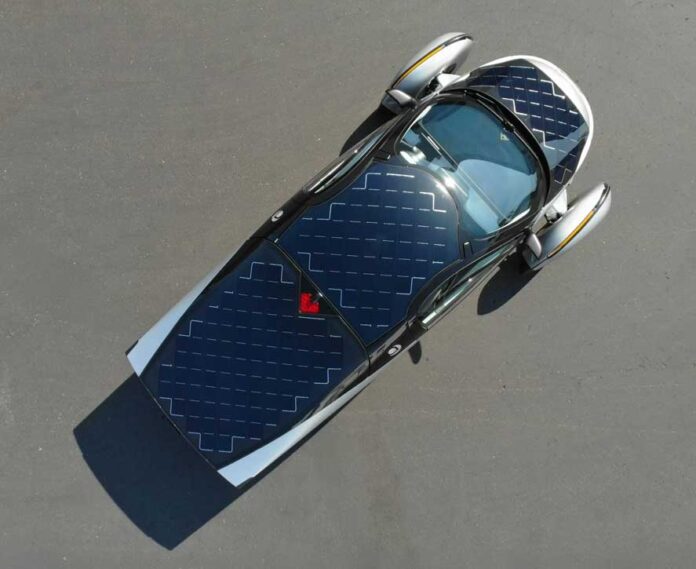
Aptera’s solar electric vehicle generated more than 4kWh of usable solar energy per day during independent testing conducted by TÜV Rheinland in Southern California.
Aptera Motors has announced that its solar electric vehicle has exceeded its targeted daily solar energy generation during independent testing conducted by TÜV Rheinland. The testing was carried out over three consecutive days in July at Aptera’s facility in Southern California. On each day, TÜV Rheinland independently measured the vehicle’s solar energy generation and recorded more than 4kWh of usable solar energy delivered to the battery pack.
The results highlight Aptera’s focus on using integrated solar technology to improve the efficiency and energy independence of electric mobility.
TÜV Rheinland is one of the world’s leading independent testing and certification organizations, founded in Germany in 1872 and operating from roughly 500 locations in more than 50 countries. It has tested and certified solar technology since 1982, and its findings are relied upon across the global solar industry by investors, lenders, and buyers.
Aptera is an electric vehicle that can be charged from any standard outlet or charging station. What sets it apart from other electric and hybrid vehicles are integrated solar panels capable of providing meaningful range by charging from the sun. Aptera has long stated a target of achieving up to approximately 40 miles of solar range per day at 100 watt hours per mile, or 4.0 kWh of useable energy, under favorable conditions. Now TÜV Rheinland’s tests have exceeded this metric on three separate test days.
The bar TÜV Rheinland measured against was 4.0 kWh of usable energy delivered to the battery in a single calendar day. Their solar expert Dr. Giorgio Bardizza was on site at Aptera’s final assembly facility in Carlsbad, California for three separate days in July, each day testing a different scenario at Aptera’s request, measuring from sunrise to sunset with their own calibrated instruments. In each case the energy was measured where it entered the battery, after conversion losses, rather than at the panels. The solar range figures below are calculated from that measured energy, assuming Aptera’s targeted 100 watt-hours per mile vehicle efficiency.
- Parked and untouched. Fixed position, hatch closed, left completely alone all day. 4.23 kWh, roughly 42 miles estimated of solar range.
- Repositioned once at solar noon. Turned a single time when the sun was highest, the way an owner might park facing the other direction after lunch. 4.40 kWh, roughly 44 miles of estimated solar range.
- Solar maxxed. Rear hatch raised and angled toward the sun through the day. 4.75 kWh, roughly 47 miles of estimated solar range, achieved on the day with the least available sunlight of the three.
Even without repositioning the vehicle at all, the measured energy exceeded Aptera’s stated daily solar target. Every additional condition tested widened the margin. These results reflect clear July conditions in Southern California; actual daily solar contribution will vary with weather, geographic location, parking orientation, and season.
Aptera and TÜV Rheinland have published the complete test report so anyone can review the methodology, instrumentation, and full data set. The full report is available here, and a video documenting the testing is available on Aptera’s YouTube channel.
“When American innovation turns sunlight into miles, independent testing helps turn that promise into confidence,” said Jonathan Kotrba, Vice President of Products at TÜV Rheinland North America. “TÜV Rheinland is proud to help advance the next generation of solar technology.”
“The most exciting result is the day we simply parked the vehicle in the sun and let it do the work,” said Steve Fambro, Co-Founder and Co-CEO of Aptera. “We built this system because we believed the sun could do this much work, and now an independent lab has measured it. Solar mobility is here.”
This tested solar power system is Aptera’s own work end to end, spanning the compound-curved panel architecture, a proprietary multi-channel solar charge controller with custom firmware, and the vehicle’s power distribution architecture. That full-stack ownership is what allowed the system to be optimized and verified as a complete power production unit.
“A technology that can reshape how the world moves has now been independently verified,” said Chris Anthony, Co-Founder and Co-CEO of Aptera. “For drivers in sunny climates, that means everyday driving powered by the sun instead of fuel or the grid. This is the high standard we’re holding ourselves to as we move toward production.”
Aptera’s validation program continues, with further independent validation work planned on a range of vehicle performance metrics.