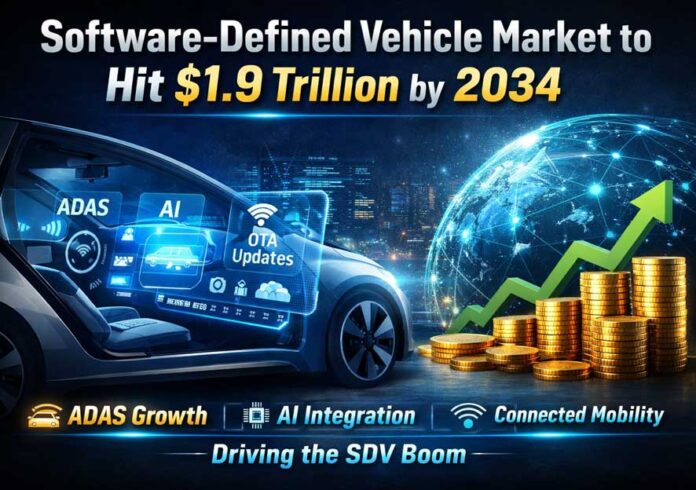
The global software-defined vehicle (SDV) market, valued at USD 258.9 billion in 2024, is projected to grow significantly to USD 1,902.9 billion by 2034, registering a strong CAGR of 22.6 percent between 2025 and 2034, according to a report by Allied Market Research.
What is a Software-Defined Vehicle?
A Software-Defined Vehicle (SDV) represents a fundamental shift in automotive engineering, where core vehicle functions are increasingly managed, updated, and enhanced through software rather than fixed hardware components. Unlike conventional vehicles that depend heavily on hardware-based systems, SDVs enable continuous upgrades and feature enhancements through digital platforms.
Often described as electronic devices on wheels, SDVs allow automakers to deliver advanced functionality, improved user experiences, and greater operational flexibility through software integration.
Semi-SDVs to Lead Market Growth
Based on SDV type, the market is segmented into semi-SDVs and fully software-defined vehicles. The semi-SDV segment accounted for the largest market share in 2024, driven by growing demand for intelligent mobility solutions and the industry’s gradual transition toward software-centric vehicle architectures.
While not entirely dependent on centralized computing systems, semi-SDVs integrate software across critical areas such as connectivity modules, infotainment platforms, advanced driver assistance systems (ADAS), and vehicle diagnostics. Embedded computing systems process data from cameras, sensors, and GPS to support features like adaptive cruise control, real-time traffic updates, and lane-keeping assistance.
Domain-Centralised Architecture Gains Momentum
By electrical and electronic architecture, the domain-centralised architecture segment led the market in 2024. The increasing integration of advanced features including ADAS, infotainment systems, and powertrain management has made traditional distributed ECU setups more complex and costly.
Domain-centralised architectures address this challenge by consolidating vehicle controls into high-performance domain controllers. This reduces the number of electronic control units (ECUs), simplifies wiring complexity, and lowers both manufacturing and maintenance costs.
ADAS Segment to Remain Key Growth Driver
In terms of applications, the market includes infotainment systems, ADAS, autonomous driving, telematics, powertrain control, battery management systems, vehicle-to-everything (V2X) communication, and others.
The ADAS segment dominated the market in 2024, supported by stricter safety regulations, rising consumer expectations for intelligent features, and the global push toward vehicle automation.
Growing road safety concerns and advancements in semi-autonomous and autonomous mobility are driving adoption of technologies such as adaptive cruise control, lane-keeping assistance, collision avoidance systems, and traffic sign recognition.
North America to Maintain Market Leadership
Regionally, the SDV market spans North America, Europe, Asia-Pacific, and LAMEA. North America emerged as the leading market in 2024, supported by strong consumer demand for connected vehicle technologies and the region’s advanced automotive ecosystem.
The United States continues to play a pivotal role due to its leadership in technology innovation and the presence of major automakers and software developers. Increasing investments in vehicle autonomy, electrification, and connectivity are accelerating SDV adoption across both passenger and commercial vehicle segments.
Furthermore, rising focus on vehicle safety, personalized user experiences, and advanced driver assistance technologies is strengthening demand. As automakers expand the use of over-the-air (OTA) updates, artificial intelligence, and cloud-based vehicle platforms, software-defined vehicles are expected to witness rapid adoption across the region.