
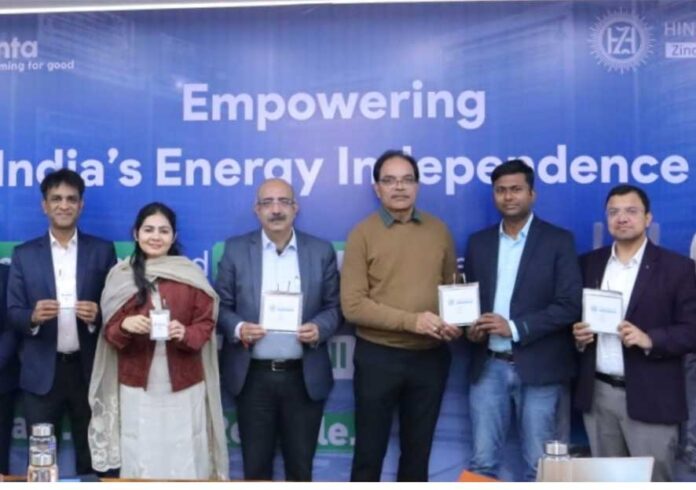
Hindustan Zinc Limited, the world’s largest integrated zinc producer and among the top five silver producers globally, has partnered with the Jawaharlal Nehru Centre for Advanced Scientific Research (JNCASR) to advance zinc-ion battery technology for large-scale renewable energy storage in India.
As part of the collaboration, the two organisations have successfully developed stable and reliable zinc-ion battery pouch cell prototypes, marking a significant milestone in India’s indigenous research and development efforts in energy storage technologies.
Zinc-ion batteries are gaining traction as a promising solution for stationary energy storage due to zinc’s abundance, cost-effectiveness, and wide availability. While challenges such as improving cycle life and energy density through electrode and electrolyte optimisation remain, the Hindustan Zinc–JNCASR collaboration is addressing these issues through the development of low-cost electrolyte formulations and enhanced battery stability.
Researchers at JNCASR, supported by Hindustan Zinc, have formulated electrolytes that improve battery stability and enable longer operational life. The zinc-ion battery pouch cell prototypes have been tested under realistic operating conditions, including solar energy capture and discharge cycles, demonstrating their potential suitability for large-scale renewable energy storage applications.
The development highlights the growing potential of zinc-ion batteries as a safe, reliable, and scalable energy storage solution to support India’s renewable energy ambitions.
Highlighting the significance of the ongoing work, Mr. Arun Misra, CEO and Whole Time Director, Hindustan Zinc Limited, said: “Zinc-ion battery technology represents an important opportunity to leverage India’s abundant zinc resources for the energy transition. Our partnership with the Jawaharlal Nehru Centre for Advanced Scientific Research reflects our commitment to enabling safe, cost-effective, and scalable energy storage solutions that can support the growing integration of renewable energy.”
While zinc-ion batteries currently have lower performance metrics than lithium-ion batteries, they offer distinct advantages, including exceptional safety, lower material costs, and non-flammable aqueous electrolytes, key attributes for large-scale and long-duration deployment.
Dr. Prem Senguttuvan, Associate Professor at the Jawaharlal Nehru Centre for Advanced Scientific Research, also mentioned, “Zinc batteries hold immense promise for sustainable and secure energy storage. This partnership with Hindustan Zinc underscores JNCASR’s commitment to impactful industry–academia collaborations. It will strengthen indigenous research capabilities and contribute to building reliable, India-centric solutions for the clean energy transition.”
Hindustan Zinc aims to accelerate the shift toward sustainable energy solutions, as zinc plays a critical role across industries such as steel, renewable energy, battery storage, electrical and electronic components, and mobility. Through the development of next-generation zinc materials, and in partnership with JNCASR, the company is laying the foundation for a safer, greener, and more self-reliant energy future for India.