
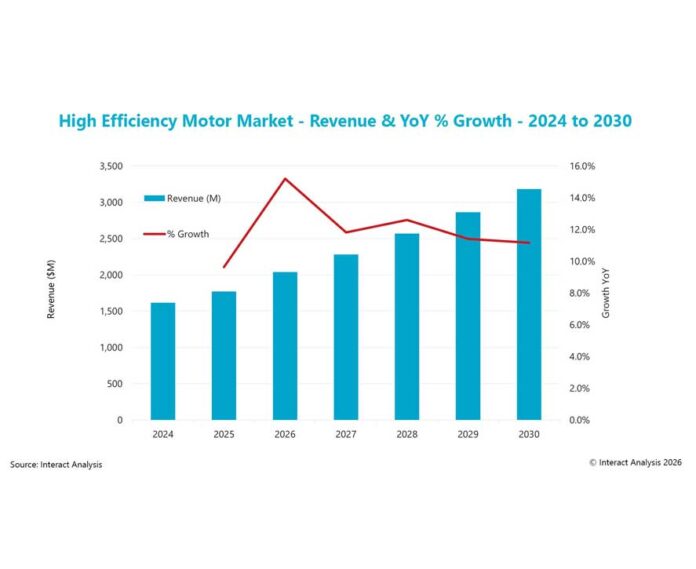
The global high-efficiency motors market is expected to witness sustained expansion through the second half of the decade, with revenues projected to exceed $3 billion by 2030, according to the latest research from Interact Analysis. The market intelligence firm anticipates a strong rebound beginning in 2026, forecasting revenue growth of around 15% following a slowdown in 2025 caused by challenging macroeconomic conditions and weakened industrial demand worldwide.
Growth momentum is being supported by increasing adoption of energy-efficient motor technologies across key industrial segments, particularly data centers, alongside stricter regulatory frameworks — especially across Europe. Overall, the market is expected to grow at an average annual rate of 12% between 2024 and 2030, rising from approximately $1.6 billion in 2024 to an estimated $3.1 billion by the end of the forecast period.
EMEA Maintains Market Leadership
The Europe, Middle East and Africa (EMEA) region remained the dominant contributor to global revenues in 2024, accounting for roughly 48.5% of the high-efficiency motors market. Europe’s early regulatory action requiring motors to meet IE4 efficiency standards has been a major driver of adoption. Legislation introduced by the European Union, combined with rising regional energy costs since 2022, has significantly accelerated demand.
Market revenues in EMEA reached approximately $782.8 million in 2024 and are forecast to climb to nearly $1.6 billion by 2030.
Asia-Pacific (APAC) ranked as the second-largest regional market, generating $519.9 million in revenue in 2024 and expected to reach $942.6 million by 2030. Unlike Europe, adoption in APAC is not currently driven by IE4 regulatory mandates but rather by the scale and energy demands of its extensive manufacturing base.
Meanwhile, the Americas accounted for about 19.4% of total global revenue in 2024, equivalent to $312.9 million, with projections indicating growth to $600.5 million by 2030. Although demand is expanding steadily, the absence of strong legislation has slowed adoption compared with Europe.
Outlook for 2026: A Peak Growth Year
Market conditions began improving during the second half of 2025, with many motor manufacturers reporting stronger order activity — a trend expected to continue into 2026.
According to Blake Griffin, Research Manager at Interact Analysis, numerous capital investment projects were delayed throughout 2025 amid economic uncertainty and elevated borrowing costs. However, as tariff policies stabilized and financing conditions improved, investment confidence gradually returned.
The firm expects 2026 to represent a peak year for demand, particularly in Europe, as industries replace IE3 motors in the 75kW to 200kW range to comply with IE4 efficiency legislation. Strong growth is forecast to continue across the remainder of the decade, with market values in most major regions projected to nearly double by 2030.
The High Efficiency Motors report focuses on IE4-and-above low-voltage AC motors, highlighting the accelerating shift toward higher energy performance standards. EU legislation introduced in mid-2023 marked the first major regulatory requirement mandating IE4 efficiency levels for motors between 75kW and 200kW, signaling a broader global transition toward stricter efficiency standards.
Further regulatory action is expected across additional regions, making market understanding and motor topology evolution increasingly important for manufacturers and industrial users alike.
Interact Analysis is a global market intelligence specialist focused on supply chain automation and industrial technologies. Drawing on more than 200 years of combined industry expertise, the firm provides research spanning factory automation, warehousing and distribution systems, and transportation logistics, helping organizations identify growth opportunities driven by emerging technologies.