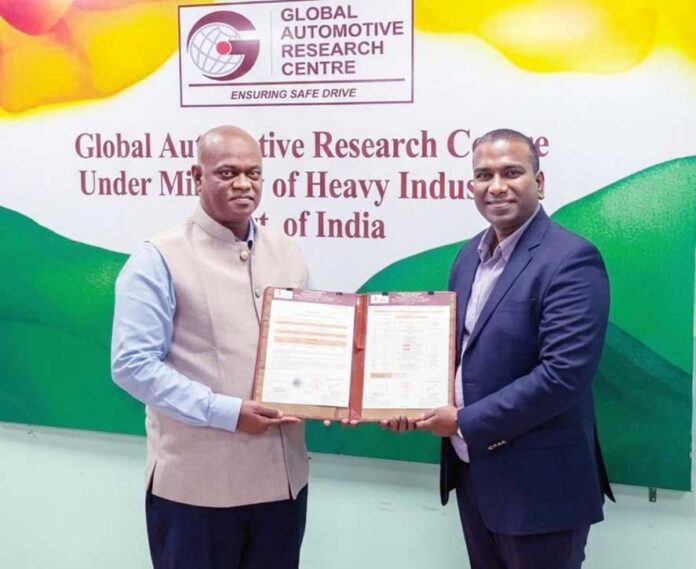
Keto Motors, an electric vehicle manufacturer, has received CMVR Type Approval certification for its 9-metre Urbanova KE9 electric bus from the Global Automotive Research Centre (GARC), marking a key milestone in the company’s expansion within India’s electric public mobility segment.
The certification confirms that the Urbanova KE9 complies with all statutory safety and performance standards under the Central Motor Vehicles Rules (CMVR). These include parameters related to structural integrity, passenger safety, driving range efficiency, and overall operational reliability.
With regulatory approvals now secured, Keto Motors plans to begin customer demonstrations and move toward commercial deployment of the Urbanova KE9 across multiple segments. The company is targeting adoption by State Transport Undertakings (STUs), employee transportation operators, school bus fleets, and urban mobility providers seeking to transition from conventional diesel buses to electric platforms.
The company benefits from proven leadership experience and a technology partnership with TRON, Taiwan’s largest E-bus OEM, which provides access to patented liquid-cooled Battery, self-developed BMS and FMS systems, unmatched reliability and highly efficient propulsion technology. This collaboration strengthens Keto Motors’ ability to deliver high-performance, future-ready electric buses tailored to Indian operating conditions.
Speaking on the milestone, Mr. Venkatesh Challa, Director, Keto Motors, said, “Securing CMVR Type Approval for the Urbanova KE9 is a defining milestone for Keto Motors. This certification reinforces our commitment to delivering dependable, high-performance electric mobility solutions designed specifically for Indian roads and fleet operators. With approvals in place, we are now focused on accelerating customer deployments and supporting India’s transition toward clean, zero-emission public transport.”
The upcoming 9-metre electric bus has been engineered for efficient and comfortable urban mobility. Built on an urban-grade chassis suitable for STUs and smart city networks, the model offers a range of up to 225 km and is powered by a 245 kW motor delivering 3000 Nm torque, enabling reliable performance across gradients and dense traffic. Key features include air suspension, ABS, regenerative braking, and CCS2 fast charging, supporting higher uptime and lower operating costs for fleet operators.
The vehicle accommodates 31 seated passengers along with 11 standing passengers and uses a liquid-cooled PMSM motor delivering a cruise range of 188 km (IDC). It supports a top speed of 80 km/h and 20% gradability, and features electro-hydraulic power steering and air suspension with disc brakes for enhanced control.
Production is scheduled to commence in early FY26, positioning Keto Motors to scale deliveries across Pan India. Manufacturing of the 9-metre electric bus will take place at the company’s 20-acre integrated production facility in Jadcherla, Telangana, equipped with advanced testing systems and in-house bus body manufacturing capabilities. The state-of-the-art facility enables end-to-end production, stringent quality control, and faster scale-up for commercial and public mobility applications.
Alongside the 9-metre model, Keto Motors is also developing 12-metre and 6-metre electric bus platforms that will complement the 9-metre bus and broaden the company’s presence across major public transport and commercial mobility segments.
Keto Motors’ electric buses produce zero tailpipe emissions and directly support India’s vision for cleaner and healthier cities. The company continues to expand its presence in the e-mobility ecosystem through ICAT and ARAI-approved products, strategic supplier partnerships, and a nationwide service network. With an annual manufacturing capacity of 1,000 units, Keto Motors is scaling steadily to meet the growing demand across public and commercial mobility segments, supporting India’s transition to modern electric public transportation.