India’s automobile industry recorded its highest-ever February sales, driven primarily by strong demand for two-wheelers, passenger vehicles, and three-wheelers, according to the latest data released by the Society of Indian Automobile Manufacturers.
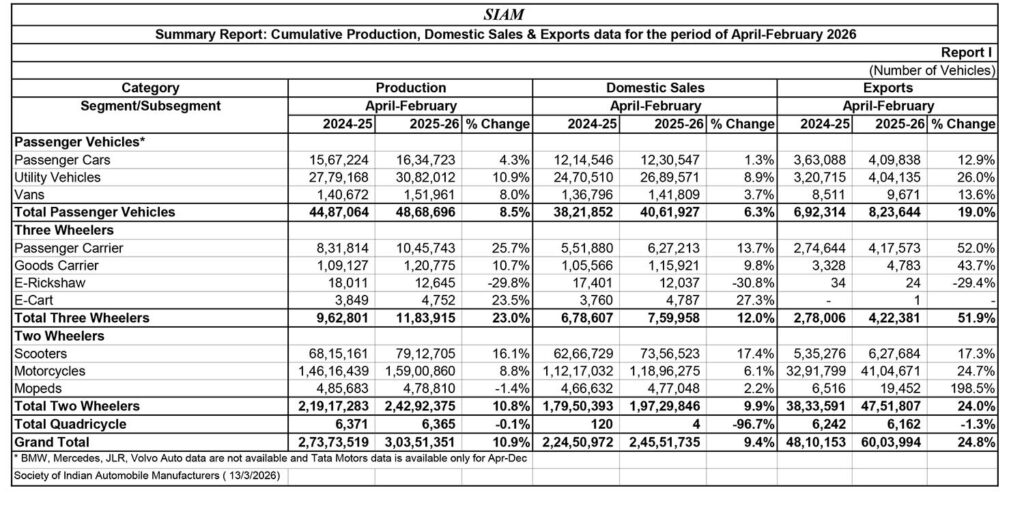
The total production of Passenger Vehicles (PVs), Three-Wheelers (3Ws), Two-Wheelers (2Ws), and Quadricycles during February 2026 stood at 28,64,612 units.
Domestic Sales Performance
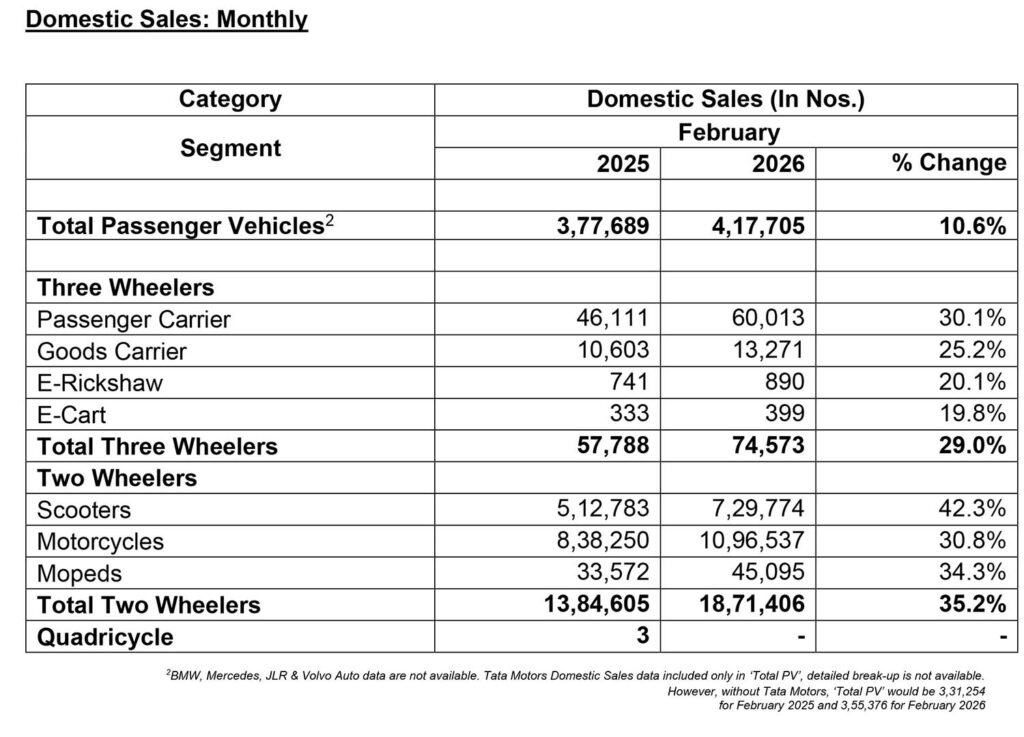
- Passenger Vehicles: 4,17,705 units sold in February 2026.
- Three-Wheelers: 74,573 units sold in February 2026.
- Two-Wheelers: 18,71,406 units sold in February 2026.
Two-Wheelers Drive Growth
The two-wheeler segment emerged as the key growth driver, recording a 35.2% year-on-year increase with 18,71,406 units sold, compared to 13,84,605 units in February 2025.
- Scooters witnessed a sharp 42.3% growth, reaching 7,29,774 units.
- Motorcycles grew 30.8%, with 10,96,537 units sold during the month.
Passenger Vehicles and Three-Wheelers
The passenger vehicle segment reported sales of 4,17,705 units, marking a 10.6% increase from 3,77,689 units in February 2025.
Meanwhile, the three-wheeler segment registered strong momentum with 29.0% growth, reaching 74,573 units, up from 57,788 units in the same period last year. Within this category, passenger carriers recorded over 30% growth, totaling 60,013 units.
Industry Outlook
Commenting on the performance, Rajesh Menon, Director General of the Society of Indian Automobile Manufacturers, said the industry continues to witness positive sentiment.
He noted that passenger vehicles, two-wheelers, and three-wheelers all recorded their highest-ever February sales in 2026, with double-digit growth compared to the same month last year.
Menon also pointed out that March could see further momentum due to festive demand across several regions in India. However, he cautioned that the ongoing geopolitical tensions in West Asia could pose challenges for supply chains, manufacturing processes, and exports, and the industry will continue to closely monitor the situation.