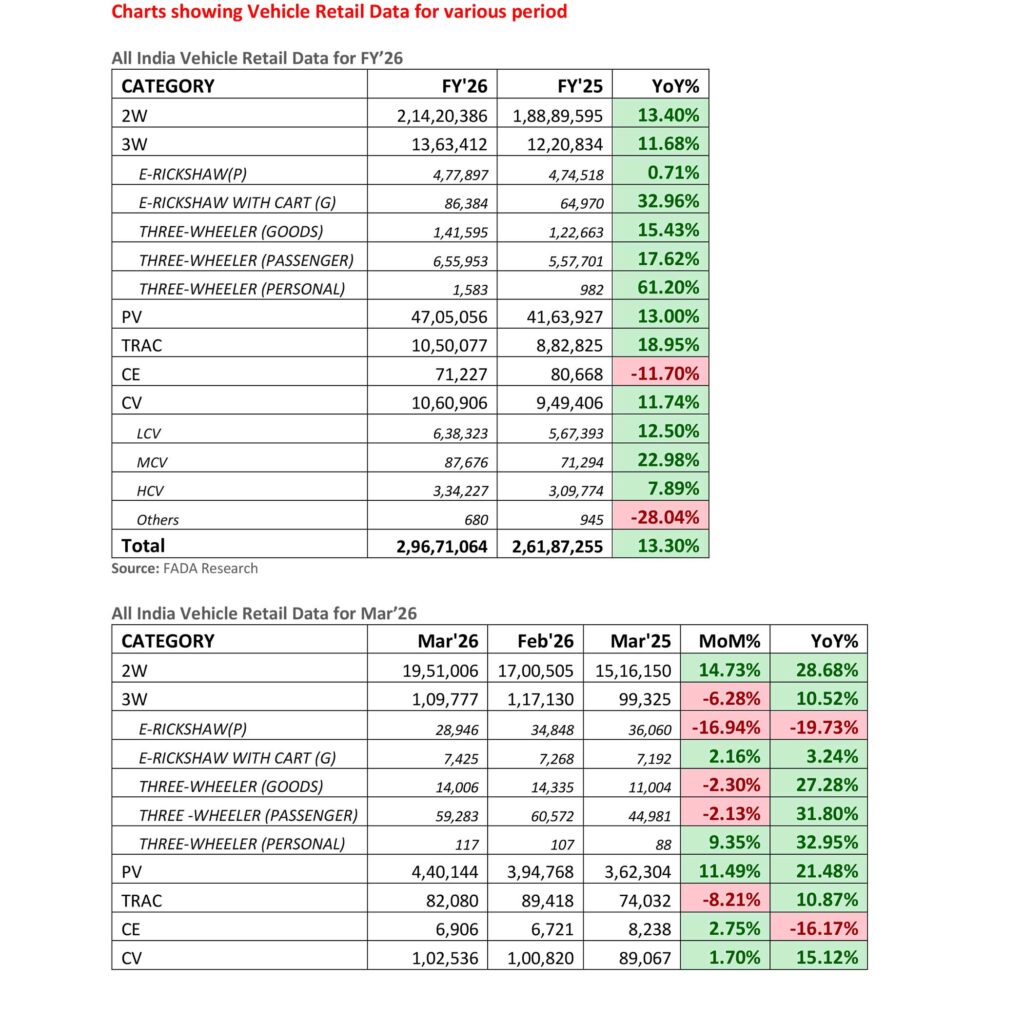
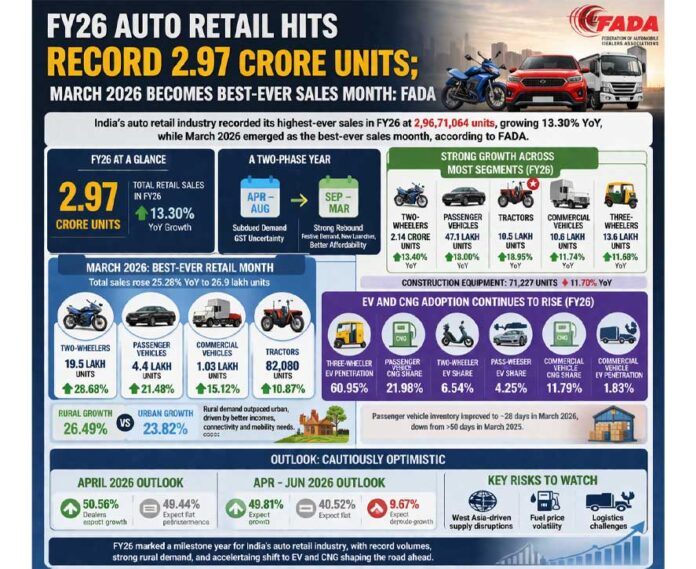
India’s automobile retail industry closed FY26 at an all-time high of 2,96,71,064 units, marking a strong 13.30% year-on-year growth, according to the Federation of Automobile Dealers Associations (FADA). The surge was largely driven by improved affordability following GST 2.0 changes and stronger demand in the second half of the financial year.
FADA described FY26 as a “two-phase” year. The April–August period saw subdued demand due to cautious consumer sentiment and uncertainty surrounding GST changes. However, the September–March period witnessed a sharp rebound, supported by festive demand, improved affordability, and multiple new product launches.
Strong Growth Across Most Segments
During FY26, two-wheelers led overall volumes, registering retail sales of 2.14 crore units, up 13.40% year-on-year. Passenger vehicles (PVs) also posted healthy growth, rising 13% to 47.1 lakh units.
Tractors recorded the highest growth rate among all segments, expanding 18.95% to cross the 10-lakh milestone at 10.5 lakh units. Commercial vehicles (CVs) grew 11.74% to 10.6 lakh units, while three-wheelers increased 11.68% to 13.6 lakh units.
Construction equipment remained the only segment to decline, falling 11.70% year-on-year to 71,227 units.
According to FADA President C S Vigneshwar, the broad-based growth reflected strong demand from both urban and rural markets, supported by new launches and improving affordability.
March 2026 Becomes Best-Ever Retail Month
March 2026 emerged as the strongest month in India’s auto retail history, with total sales rising 25.28% year-on-year to 26.9 lakh units.
Two-wheelers led the surge, growing 28.68% to 19.5 lakh units. Passenger vehicles recorded their highest-ever March performance at 4.4 lakh units, up 21.48%.
Commercial vehicle sales rose 15.12% to 1.03 lakh units, while tractor sales increased 10.87% to 82,080 units.
Rural markets outperformed urban areas during March, with rural retail growth at 26.49% compared to 23.82% in urban markets. FADA noted that this trend highlights expanding mobility demand beyond major cities, driven by improved rural incomes, connectivity, and growing personal mobility needs.
EV and CNG Adoption Continues to Rise
Powertrain transition gathered pace in FY26 across segments:
- Three-wheeler EV penetration reached 60.95%
- Passenger vehicle CNG share rose to 21.98%
- Two-wheeler EV share stood at 6.54%
- Passenger vehicle EV share reached 4.25%
- Commercial vehicle CNG share increased to 11.79%
- Commercial vehicle EV penetration improved to 1.83%
FADA also noted improved passenger vehicle inventory levels, with dealer stock reducing to around 28 days in March 2026, compared to more than 50 days in March 2025 — indicating healthier supply-demand balance.
Outlook Remains Cautiously Optimistic
Looking ahead, dealer sentiment remains positive but cautious:
- 50.56% of dealers expect growth in April 2026
- 49.81% expect growth in the April–June quarter
However, key risks remain:
- West Asia-related supply disruptions
- Fuel price volatility
- Logistics challenges
Despite near-term uncertainties, FY26 marked a milestone year for India’s auto retail industry, with record volumes, strengthening rural demand, and accelerating adoption of EV and CNG vehicles shaping the future growth trajectory.
The industry is now approaching the 3-crore annual sales milestone, highlighting the strong structural growth of India’s automobile market.