Hyundai Motor Group is expanding its Center of Excellence (Hyundai CoE) initiative in India by building a pan-India network of academic and industrial partners aimed at accelerating research and development in battery and electrification technologies.
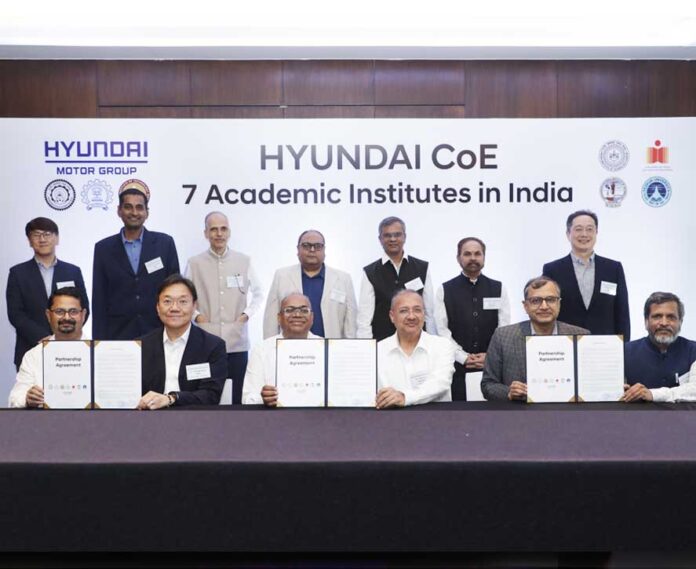
As part of this expansion, the Group has signed agreements with four additional institutions — Indian Institute of Technology Kanpur, Indian Institute of Technology Hyderabad, Visvesvaraya National Institute of Technology Nagpur, and Tezpur University.
With these additions, the collaborative platform has evolved into a seven-university consortium, bringing together some of India’s leading academic institutions. The new partners join the three founding members announced during the 2025 launch — Indian Institute of Technology Madras, Indian Institute of Technology Delhi, and Indian Institute of Technology Bombay.
The expanded network further strengthens Hyundai Motor Group’s commitment to nurturing local talent and advancing India-focused mobility and electrification solutions.
Hyundai Motor Group officials — including Chang Hwan Kim, Head of the Electrification Energy Solutions Tech Unit and Hyundai CoE Co-Chair; Tarun Garg, Managing Director of Hyundai Motor India Limited; Eul Kyo Lim, Head of R&D Planning & Coordination Center; and Chang Yeon Cho, Head of Hyundai Motor India Engineering Center — attended the main agreement ceremony held in New Delhi.
Sudhendu Jyoti Sinha, Advisor of Hyundai CoE, joined the Group representatives alongside IIT officials, including Prof. Bijaya Ketan Panigrahi, Dean of IIT Delhi and Hyundai CoE Co-Chair; Prof. Ashwini K Agrawal, Dean of IIT Delhi; Prof. Amarendra Kumar Das, Pro Vice Chancellor of Tezpur; Prof. Tarun Gupta, Dean of IIT Kanpur; Prof. Yashwant Bhaskar Katpatal, Dean of VNIT, Nagpur; Prof. Shrikrishna Vyankatesh Kulkarni, Dean of IIT Bombay; Prof. Garikapati Narahari Sastry, Dean of IIT Hyderabad; and Prof. Coimbatore Subramanian Shankar Ram, Associate Dean of IIT Madras.
This initiative aims to accelerate the development of India-specific EV technologies and strengthen India’s research and development ecosystem. The expansion solidifies the Hyundai CoE as a central pillar of fostering strong industry-academia partnerships that drive India’s electrification transition.
“By bringing together the distinguished professors and emerging researchers from these seven institutes, we can create powerful synergies that will yield immense value for both Hyundai and India’s sustainable growth. I strongly believe that the Hyundai CoE will grow to become the premier expert network of the Indian academic community” – Chang Hwan Kim, Head of the Electrification Energy Solutions Tech Unit
What Are the Key Investment and Research Areas?
The Group initiated a strategic investment program in 2025 to support and expand research activities across the Hyundai CoE network. The research agenda spans battery cells, management systems (BMS), energy density, safety, durability and diagnostic technologies — each a foundational pillar of EV readiness that the Hyundai CoE is advancing through India-based academic collaboration.
The platform is currently advancing 39 joint projects across its seven partner universities, bringing together leading academic institutions and industry partners. Among these, key examples include battery design and material research optimized for India’s market, and the development of an AI-powered Vehicle-to-Grid (V2G) platform.
How Will The Initiative Foster Knowledge Exchange?
The Group is launching several complementary programs to ensure a robust exchange of knowledge and expertise. A Korea Visiting Program will facilitate academic exchange between Indian and Korean researchers, enabling shared learning on EV technology development and research advancements for India’s mobility transition.
Additionally, the Group will host a global e-conference for leading academics and experts to discuss emerging technologies, while upcoming tech forums will unite leaders from government, industry and academia to advance collaborative research initiatives.
What Is The Long-Term Strategic Goal?
The ultimate vision is to evolve the Hyundai CoE from a research center into a comprehensive research hub that supports India’s EV transition. By strengthening partnerships with IITs and academic institutions, the initiative will contribute to advancing EV technology development through research findings, strategic insights and collaborative seminars that serve India’s electrification goals.
By bringing together India’s leading research institutions and industry expertise, the Hyundai CoE will support the development of innovative EV solutions. Through sustained engagement and knowledge exchange, the initiative aims to foster a vibrant research ecosystem that benefits India’s automotive industry.