The FICCI Ladies Organisation (FLO) marked World Environment Day by launching a three-month nationwide sustainability initiative focused on transforming waste into wealth. The programme will be implemented across FLO chapters throughout the country. FLO also signed a Memorandum of Understanding (MoU) with the National Productivity Council (NPC) to promote capacity building in green technologies, sustainability practices, and the circular economy.
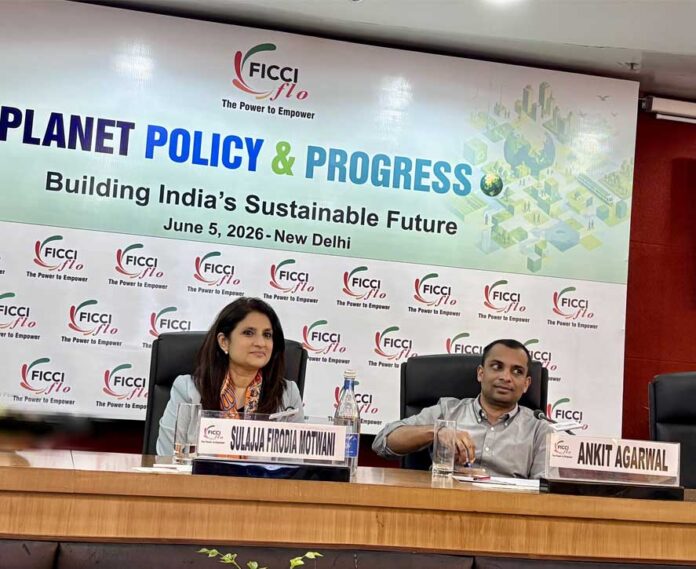
Speaking at a panel discussion titled “Planet, Policy & Progress: Building India’s Sustainable Future,” Dr. Sulajja Firodia Motwani, Founder and CEO of Kinetic Green Energy and Power Solutions Limited, said that while electric vehicles (EVs) are witnessing growing acceptance in India, particularly for urban mobility, they should currently be viewed as an alternative rather than a complete replacement for internal combustion engine (ICE) vehicles.
Dr. Motwani noted that most EV owners charge their vehicles overnight at home and use them throughout the day without relying heavily on public charging infrastructure. She explained that the typical range of 100–150 kilometres offered by electric two-wheelers and three-wheelers is generally sufficient to meet daily commuting requirements.
“For urban mobility, expensive fast-charging infrastructure is often not essential, as home charging adequately serves the majority of users’ needs. Most EV owners charge their vehicles overnight and comfortably use them throughout the day,” she said.
Highlighting the challenges facing the EV ecosystem, Dr. Motwani described the current situation as a classic “chicken-and-egg” dilemma, where large-scale EV adoption and charging infrastructure development must progress simultaneously.
She observed that while the government initially assigned public sector undertakings (PSUs) the responsibility of establishing charging networks, many early projects encountered challenges related to technology evolution, location planning, and commercial viability.
However, she emphasized that increasing participation from private sector players is beginning to strengthen the charging ecosystem. According to Dr. Motwani, greater private investment is expected to improve accessibility, efficiency, and the overall viability of charging infrastructure across the country.
“As charging infrastructure evolves into a sustainable private business opportunity, it will naturally become more efficient and widespread. The ecosystem is maturing, but the transition will require time and continued investment,” she added.
Dr. Motwani encouraged consumers who already own conventional vehicles to consider electric vehicles as a second family car, particularly for city commuting. She noted that EV prices are becoming increasingly affordable, making them a practical mobility solution for urban users.
Highlighting the advancements in battery technology and vehicle performance, she said that several new electric models now offer driving ranges of 500–600 kilometres, significantly reducing concerns around range anxiety and making EV ownership more convenient than ever before.
Expressing confidence in the future of India’s EV ecosystem, Dr. Motwani said the country is steadily moving towards the development of a robust highway charging network supported by digital platforms that enable drivers to easily locate charging stations.
“EVs can ultimately replace ICE vehicles, but this transition will be evolutionary rather than revolutionary. Increased EV adoption will encourage further investments in charging infrastructure, creating a virtuous cycle that will strengthen the entire ecosystem,” she added.
On the occasion, the FICCI Ladies Organisation (FLO), the women’s wing of FICCI, announced the launch of its pan-India ‘Initiative on Waste Collection and Responsible Disposal’, aimed at promoting responsible waste management practices and encouraging greater community participation towards building a cleaner and greener India.
Speaking at the panel discussion, Ms. Puja Garg, National President, FICCI Ladies Organisation (FLO), unveiled the FLO National Waste to Wealth Drive, a three-month sustainability campaign that will be implemented across FLO chapters nationwide.
“The initiative aims to encourage waste segregation, promote recycling, reduce landfill waste, and help members understand the true value of a circular economy. Through this nationwide drive, we hope to inspire sustainable behaviour and create a meaningful environmental impact at the grassroots level,” said Ms. Garg.
As part of its broader sustainability agenda, FLO also signed a Memorandum of Understanding (MoU) with the National Productivity Council (NPC) to promote capacity building in green technologies, resource efficiency, sustainability practices, and circular economy initiatives. The collaboration is expected to strengthen awareness, knowledge-sharing, and skill development among stakeholders, supporting India’s transition towards a more sustainable and environmentally responsible future.