
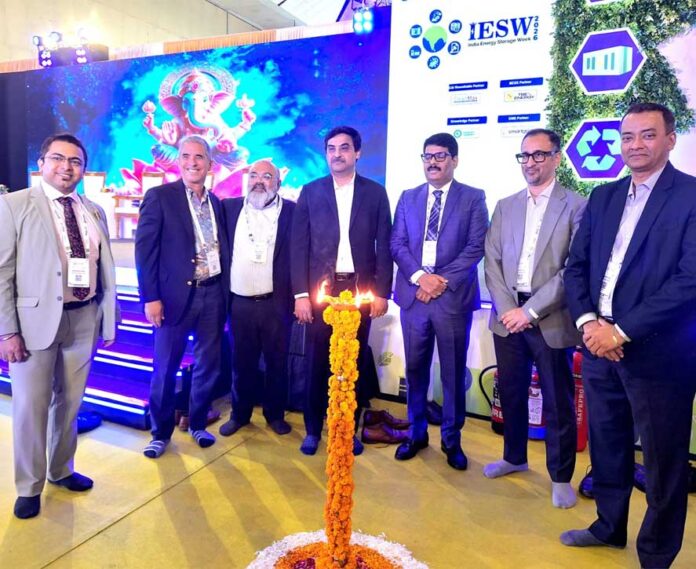
India’s energy storage capacity requirement is projected to increase dramatically from the current 1 GWh to 888 GWh by 2035-36, according to the “India BESS Market Review” released by the India Energy Storage Alliance (IESA) and Customized Energy Solutions (CES) during the opening of India Energy Storage Week (IESW) 2026 in New Delhi.
The report underscores the rapidly growing role of Battery Energy Storage Systems (BESS) in supporting India’s clean energy transition, highlighting energy storage as a critical enabler of grid reliability, renewable energy integration, and long-term energy security.
The inaugural session of IESW 2026 brought together prominent industry leaders, including Nitin Bhatia of Radiance Renewables, Venugopal Rao Maddisetty of Pace Digitek, Avinash Rao of Mahindra Susten, Nikhil Bhuta of DC&T, Belding India, and Suman Nag of Envision Energy. The event also witnessed participation from industry delegates representing 15 countries, reflecting the growing global interest in India’s rapidly evolving energy storage market.
Debmalya Sen, President of IESA, said, “IESW 2026 is more than an industry summit; it’s a testament to how far India has come on its clean energy journey. The 888 GWh target by 2035-36 signals a new era where energy storage is at the centre of our energy ambitions. With policy, industry, and innovation converging here in New Delhi, we are building the foundation for a reliable and sustainable future.”
Organised by IESA, the three-day event at Yashobhoomi (IICC), New Delhi, brings together over 200 exhibitors and more than 10,000 industry leaders for policy discussion, technical exchange, and announcements that will define India’s clean energy transition.
Nitin Bhatia, CEO, Radiance Renewables, said, “We believe solar plus battery energy storage is the way forward. If industry, policymakers, and equipment suppliers work together to make batteries more competitive and policies more consistent, there’s a bright future ahead with only increasing growth rates.”
The report further shows that India’s installed BESS capacity increased 11-fold in just six months, from 0.78 GWh in December 2025 to 8.7 GWh in H1 2026, and the country is on track to surpass 10 GWh of installed BESS capacity by the end of the year. In H1 2026, 47 GWh of ESS tenders were floated, bringing the total ESS tender pipeline to 260 GWh.
Tanya Singhal, Vice President, Country Head – India, Global Energy Alliance for People and Planet said, “The true measure of success is not just how many gigawatts we install, but how much renewable energy we can actually deliver and utilise. To build a truly flexible and resilient grid, storage must be integrated at the generation, transmission, distribution, and consumption levels.”
Eighteen BESS projects have been commissioned so far, with 70% of the capacity addition in H1 2026 coming from merchant BESS installations. India’s manufacturing momentum is also accelerating, with current Li-ion battery cell manufacturing capacity at around 2 GWh and announced targets of approximately 110 GWh by 2030. Cell/pack to container capacity is expected to reach 180-200 GWh by 2030.
Venugopal Rao Maddisetty, Chairman and Managing Director, Pace Digitek, said, Energy storage is now indispensable national infrastructure, enabling renewable energy to become dispatchable, stabilising the grid, and enhancing resilience. This represents one of India’s largest industrial opportunities and a chance to become a global hub for advanced energy storage technologies.”
The report underscores that, despite global supply chain volatility and rising battery prices, India’s BESS sector has demonstrated remarkable resilience and is now recognised as one of the world’s fastest-growing markets.
Nikhil Bhuta, Director, DC&T (Belding India), said, “Energy storage transforms renewables from weather-dependent instruments into dispatchable, bankable assets. To secure our future, India must build and master storage systems domestically, owning the value chain and setting cost curves for the world.”
With robust manufacturing expansion, strong policy tailwinds, and sustained tendering activity, India is laying the groundwork for a reliable, renewable-powered future, driven by energy storage.