
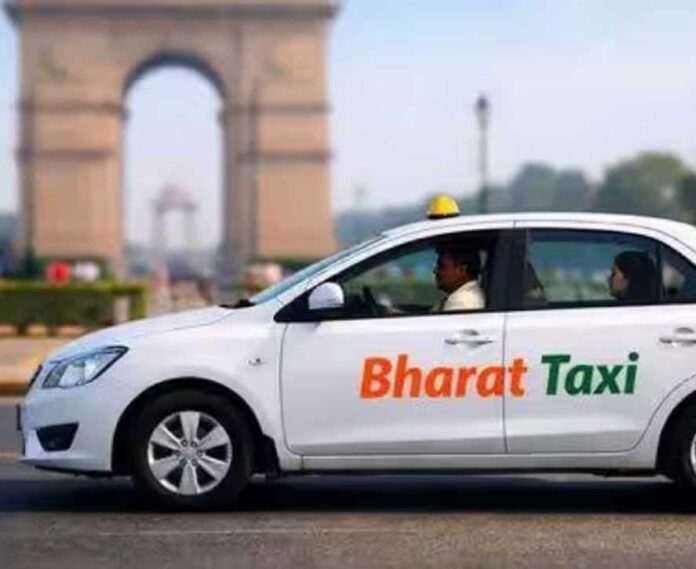
Bharat Taxi, which began operations at just 10 Delhi Metro stations in January 2026, is now available across the entire Delhi-NCR Metro network as the Delhi Metro Rail Corporation (DMRC) expands last-mile mobility options for commuters.
The expansion is aimed at improving first- and last-mile connectivity and providing commuters with more convenient options to travel to and from metro stations.
Bharat Taxi operates under the brand name of Sahakar Taxi Cooperative Ltd. (STCL), an initiative of the Ministry of Cooperation. The service currently covers all stations across the Delhi-NCR Metro network, after being gradually expanded from its initial 10 stations.
“DMRC entered into an MoU with Sahakar Taxi Cooperative Ltd. (STCL), an initiative of the Ministry of Cooperation, in January 2026 for providing mobility services under the brand name Bharat Taxi. Starting with modest 10 stations, the service got gradually extended to other stations and is now covering all stations across Delhi-NCR network,” a DMRC official said.
Bharat Taxi follows driver-owned model
Bharat Taxi is positioned as India’s first cooperative-based ride-hailing platform. It follows a driver-owned, zero-commission model, with drivers, known as ‘Sarathis’, becoming shareholders of the platform and receiving fares directly into their bank accounts.
DMRC is also working to improve commuter access and the visibility of Bharat Taxi services at metro stations.
“To further facilitate commuter access and improve visibility of the service, geo-tagging of operational Bharat Taxi locations is under process, along with the installation of standees at operational locations,” the official said.
2,299 e-autos operational at 52 metro stations
Alongside Bharat Taxi, DMRC has expanded the availability of electric three-wheelers across its network. A total of 2,299 e-autos are currently operational at 52 metro stations.
These include major stations such as Saket, Hauz Khas, Dwarka, Azadpur, Janakpuri West and Malviya Nagar.
“DMRC has facilitated these services through operators and aggregators. Four operators are currently providing the service,” a DMRC official said.
The e-auto network is currently recording an average daily ridership of around 60,192 passengers, highlighting the growing role of electric mobility in connecting commuters with Delhi Metro stations.
Bicycle and e-bike services expand
DMRC’s public bicycle-sharing ecosystem is also providing commuters with additional last-mile mobility options.
Pedal-cycle services, operated by one service provider, are currently available at eight metro stations. Meanwhile, battery-operated e-bike services are being provided by three operators across 77 sites.
In addition, battery-swapping infrastructure for e-rickshaws is available through three operators at 20 metro stations, supporting the growing use of electric three-wheelers for short-distance commuter journeys.
DMRC integrates last-mile mobility into digital platforms
DMRC is also working to integrate first- and last-mile transport options into its digital ecosystem.
The Smart Door to Door feature on the DMRC Sarthi Mobile App allows commuters to plan their complete journey from their origin to destination, extending beyond the metro network.
“The Smart Door to Door feature of the DMRC Sarthi Mobile App provides an integrated mobility solution that enables commuters to plan their complete journey from origin to destination, extending beyond the metro network,” the official said.
The expansion of Bharat Taxi, e-autos, e-bikes, bicycles and supporting battery-swapping infrastructure is expected to give Delhi-NCR commuters a wider range of sustainable last-mile mobility options while strengthening connectivity with the Metro network.