
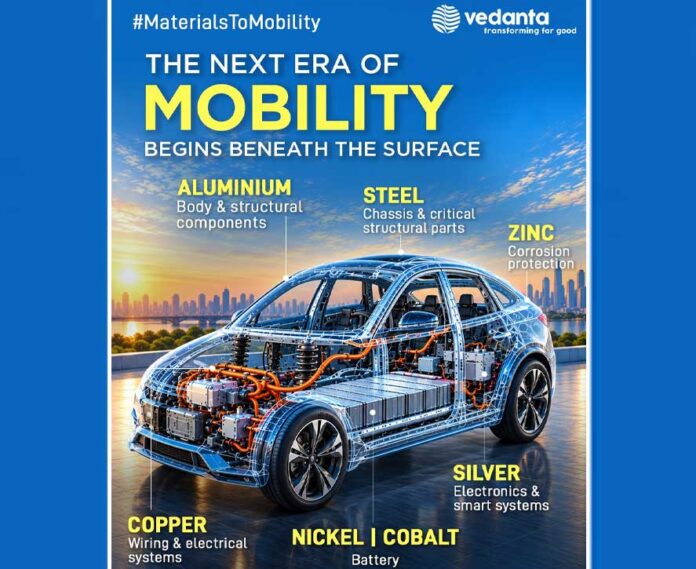
Vedanta Group has invested over ₹21,000 crore through FY2026 in ongoing metal production and capacity expansion projects across aluminium, zinc, value-added alloys, copper, steel, nickel and ferrochrome. The investments are aimed at strengthening India’s metals ecosystem and supporting the materials needed for the country’s growing electric mobility and automotive sectors.
India is the world’s third-largest automobile market by production and sales. As EV adoption expands, demand is expected to rise for materials used in battery cells, energy storage, electric motors, power electronics, semiconductor chips, charging infrastructure and lightweight vehicle components.
With India currently importing more than 80% of its critical mineral requirements, demand for critical minerals and rare earth elements could increase by four to ten times by 2047, highlighting the need to strengthen domestic capabilities and supply chains.
Addressing this growing dependence, Vedanta has placed itself at the forefront of the country’s critical minerals push, becoming the only company to have secured 10 critical mineral blocks across commodities including copper, nickel-chromium-PGE (Platinum Group Elements), tungsten, graphite, vanadium, rare earth elements and potash. With exploration already underway across five blocks, Vedanta is building domestic access to materials that will become increasingly important for vehicular safety, fuel efficiency, sustainability and ergonomics.
Supporting the EV Battery Value Chain Through Metals
Vedanta Group’s diversified metals portfolio provides a strong foundation for its participation in India’s growing electric mobility ecosystem.
Aluminium’s lightweight properties are particularly relevant for electric vehicles, where reducing vehicle weight can help improve energy efficiency and extend driving range. In FY2025–26, Vedanta Aluminium Metal Limited (NSE: VAML) produced a record 24.5 lakh tonnes of aluminium, reinforcing its position as India’s largest primary aluminium producer. Its aluminium portfolio supports automotive applications through products including primary foundry alloys, rolled products, billets and slabs.
The company has also developed low-carbon ‘green’ aluminium offerings, Restora and Restora Ultra, providing automotive manufacturers with options to lower the carbon footprint associated with their material sourcing.
Investments in Vedanta Aluminium’s plants at Chhattisgarh (BALCO) and Jharsuguda in Odisha are expanding aluminium smelting and value-added capacity for automotive, electrical and advanced applications. To support the future of mobility, Vedanta Aluminium Metal Limited recently launched Copper-Doped Alloy, developed for high-performance automotive applications, and the Vedanta Foundry Alloy (VFA), a versatile material for enhanced durability, developed in collaboration with IIT Delhi, under its best-selling Primary Foundry Alloy (PFA) range.
Nickel remains one of the Group’s most direct links to the EV battery value chain. As India’s sole primary nickel producer, Vedanta plays an important role in strengthening domestic availability of this critical mineral, intrinsic to battery-metals ecosystem.
Vedanta Limited’s (NSE: VEDL) zinc and silver businesses through subsidiary Hindustan Zinc Limited (NSE: HZL), the world’s largest integrated zinc producer and India’s sole silver producer, support the country’s growing electrification ecosystem. In FY2025–26, Hindustan Zinc produced 851 kt of refined zinc and 627 tonnes of saleable silver. Its portfolio includes specialised automotive zinc alloys and EcoZen, its low-carbon ‘green’ zinc offering, with Tata Steel and Silox India among its early customers.
EVs require 3–4 times more copper than conventional vehicles, making copper critical to vehicle electrification. Vedanta Limited recorded its highest-ever cathode production of 170 kt in FY2025–26, supporting applications across motors, cables, conductors and electrical systems. Its investment in the Copper Rod Plant in Kingdom of Saudi Arabia (KSA) further strengthens downstream copper production capacity.
Commenting on the announcement, Arun Misra, CEO, Vedanta Group, said: “As EV adoption accelerates, the strength of India’s journey will increasingly depend on its ability to secure reliable access to the metals and critical minerals that underpin vehicles, batteries and charging infrastructure. Building these capabilities domestically will be essential to creating supply chains capable of supporting India’s long-term mobility ambitions. At Vedanta, we are investing across this opportunity through our presence in key metals, while building capabilities in critical minerals. We are expanding our role across the resource base that will support the next generation of mobility and battery value chains.”
Advancing Next-Generation Battery Technologies
Vedanta is also advancing next-generation battery technologies as part of its efforts to support India’s evolving EV and energy storage ecosystem. Through partnerships with IIT Madras and JNCASR, the Group is developing sustainable zinc-based battery solutions.