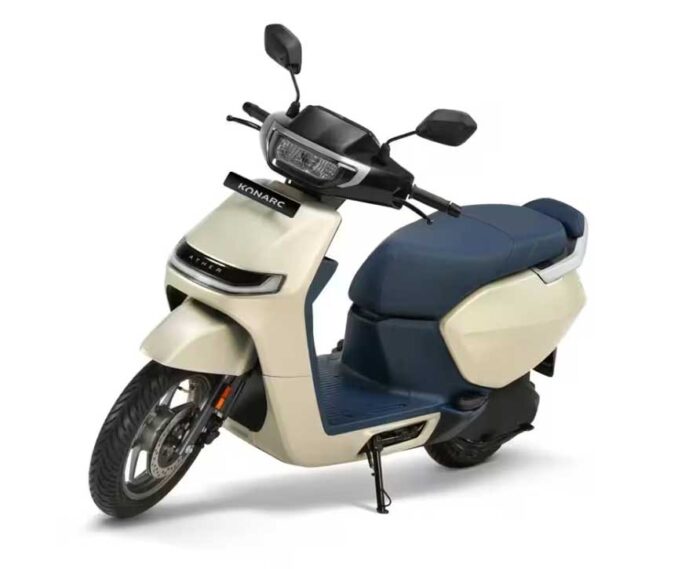
Ather Energy has introduced the Konarc, its latest electric scooter, as the company looks to accelerate EV adoption in India with a greater emphasis on everyday usability, battery durability, charging convenience and the overall ownership experience. The new scooter was unveiled at the fourth edition of Ather Community Day, where the company also showcased its fifth-generation Bedrock battery platform, AtherNode intelligent charging solution and Ather True Health connected vehicle assessment tool.
The Konarc is the first product based on Ather’s new EL platform and will be offered in six variants across the S and Z product lines. The scooter comes with IDC range options spanning from 100 km to 200 km.
The S range will be available in four variants offering 100 km, 125 km, 161 km and 200 km of IDC range, while the Z range will comprise 125 km and 161 km versions. Prices for the Konarc S 100 km start at ₹99,999, while the S 125 km and S 161 km variants are priced at ₹1,21,999 and ₹1,44,999, respectively, ex-showroom Bengaluru.
“Konarc has been designed to make EVs mainstream in India. We have understood the needs of the vast majority of buyers who are still waiting to go electric and have engineered Konarc for them,” said Tarun Mehta, Co-Founder and CEO, Ather Energy.
Longer Service Intervals and New Battery Technology
Ather has doubled the Konarc’s service interval to 10,000 km while reducing the number of service checkpoints and improving access to wear-and-tear components. The company says these changes are aimed at making ownership more convenient and reducing maintenance-related hassles.
The scooter also introduces Ather’s fifth-generation Bedrock battery platform, which features BreachSense, a real-time monitoring system designed to identify microscopic damage to the battery following a high-impact accident.
The new battery platform also offers five times greater cell-balancing capability compared with the previous generation. According to Ather, the battery is expected to retain 70 per cent state of health at around 1 lakh-1.2 lakh km, compared with approximately 80,000-1 lakh km for the previous generation.
All Konarc variants come with a 10-year/1,00,000-km battery warranty, whichever comes first, along with a guarantee that the battery will retain at least 70 per cent of its state of health during the covered period.
AtherNode Targets Apartment Charging Challenges
Alongside the Konarc, Ather has introduced AtherNode, an intelligent charging solution designed to address charging limitations in apartment complexes and other multi-unit developments.
The system uses a central gateway capable of managing up to 1,000 chargers within a residential or commercial complex. It dynamically distributes available power between connected chargers and can reduce or temporarily pause charging when the building approaches its maximum power load.
The solution is intended to make EV charging more practical in locations where electrical capacity and shared infrastructure can pose challenges for residents.
Ather True Health Adds Connected Vehicle Assessment
Ather also unveiled True Health, a connected-vehicle health and resale assessment tool designed to provide owners with a clearer picture of their scooter’s condition.
The system uses connected-vehicle data such as vehicle age, kilometres ridden, riding behaviour, component condition, battery status and service history to generate a vehicle health score out of five.
For eligible scooters, Ather True Health also provides an estimated resale value and allows owners to share the complete vehicle health report with potential buyers. The service is available for scooters that have been on the road for at least three years and are equipped with AtherStack Pro.
Bookings and Deliveries
Bookings and deliveries for the Konarc S 125 km and S 161 km variants are scheduled to begin in mid-September. The initial rollout will cover select states before being expanded to additional locations across India.
With the Konarc, new battery technology and connected ownership solutions, Ather is looking to address several of the key barriers to wider EV adoption, including range concerns, battery longevity, charging accessibility, maintenance and resale confidence.