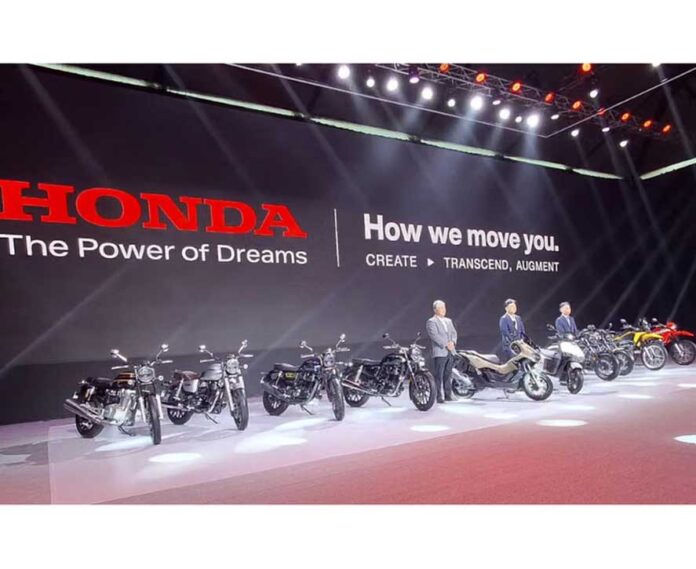
Honda Motorcycle & Scooter India (HMSI) has unveiled 10 two-wheeler models across internal combustion engine (ICE), electric vehicle (EV) and flex-fuel technologies, reinforcing its multi-pathway mobility strategy ahead of the festive season. The product offensive comes as competition intensifies in India’s two-wheeler market, with Honda looking to strengthen its position against rivals including Hero MotoCorp and Bajaj Auto.
Of the 10 models showcased, six are all-new products—the ADV160 Flex-Fuel scooter, QC3 electric scooter, CB500, Rebel 300, XR L300 and XR300 Rally. Honda also introduced updates to existing models, including the CB350, now offered in three refreshed variants, and the Rebel 500.
Honda bets on multiple powertrain technologies
Speaking at the unveiling, Tsutsumu Otani, President, Honda Motorcycle & Scooter India, said the company remains committed to a multi-pathway approach, believing no single powertrain can address the diverse requirements of customers across different markets.
“No single technology can meet every need of all customers in all markets. Honda follows a multi-pathway approach. This includes advanced ICE, electric mobility and alternative fuels,” Otani said.
He noted that India’s two-wheeler industry is rapidly evolving, with consumers increasingly seeking vehicles that offer enhanced comfort, safety, connectivity and overall ownership experience, while continuing to value fuel efficiency and lower running costs.
“The Indian two-wheeler industry is changing fast. It’s moving beyond basic mobility. Customers now expect more from their vehicles. They want a better ownership experience. They want more comfort. They want better safety,” he added.
Strategy focuses on affordability and ecosystem readiness
Otani said Honda’s future product roadmap is designed around customer requirements, infrastructure readiness, affordability and practical usability, rather than relying solely on one technology.
“Our roadmap looks at customer needs, ecosystem readiness, infrastructure, practical use and affordability,” he said, adding that Honda also evaluates sustainability across the complete energy lifecycle—from energy generation to vehicle operation.
India remains central to Honda’s global plans
Honda continues to expand its manufacturing footprint and localisation efforts in India as it seeks to strengthen its market position. While the company aims to narrow the gap with the segment leader over the long term, it also sees India as an increasingly important global manufacturing and innovation hub.
“India is not only an important market for Honda. India is also becoming a source of new ideas, strong capability and manufacturing power for the world,” Otani said.
He reaffirmed Honda’s commitment to the ‘Make in India, for India and for the World’ vision, highlighting continued investments in localisation, manufacturing excellence and an expanded nationwide network.
With a diverse lineup spanning ICE, electric and flex-fuel technologies, Honda aims to address the changing mobility preferences of Indian customers while strengthening its presence across multiple two-wheeler segments ahead of the festive buying season.