
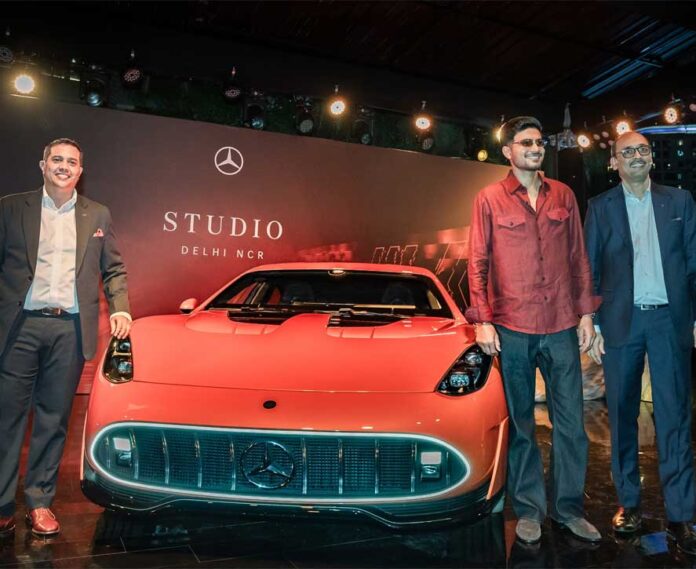
Mercedes-Benz India has inaugurated the country’s first Mercedes-Benz Studio in Gurugram, Delhi-NCR, making India one of just 14 markets globally to host the format.
Located at DLF One Horizon Centre, the Studio brings together automobiles, design, merchandise, food and lifestyle collaborations in an urban setting. For Mercedes-Benz, however, the new space represents more than another premium retail destination. It is an experiment in how a luxury automotive brand can engage customers at a time when the showroom is no longer the only place where consumers interact with a brand.
Speaking to reporters, Brendon Sissing, Vice President, Sales & Marketing, Mercedes-Benz India, said the format is intended to create a different kind of interaction with customers and aspirational buyers, away from the conventional dealership environment.
“This is not really a selling activation. It’s more of just connecting with our customers and aspirational customers that look at the brand in a desirable manner,” Sissing said.
The Gurugram Studio is the 14th such activation globally and the fourth in Asia, following Singapore, Seoul and Tokyo. Its launch in India also reflects the increasing importance of the market within Mercedes-Benz’s global business.
Beyond the Dealership
At first glance, the Studio could resemble another premium automotive retail outlet. It displays cars and is located within one of Gurugram’s prominent lifestyle destinations. However, Mercedes-Benz is deliberately positioning the space differently from a conventional dealership.
The Studio combines vehicles with a café, concept cars, e-bikes, merchandise and lifestyle collaborations, including a partnership with Adidas. The idea is to create an environment where visitors can spend time with the Mercedes-Benz brand without necessarily having an immediate intention to purchase a car.
“It’s really about doing something on a different level, doing something that’s out of the ordinary that you would find at our franchise shops anyway,” Sissing said.
That distinction is important because Mercedes-Benz does not currently see the Studio as the next stage of its retail network. Instead, the company is treating the Gurugram location as an experiment in taking the brand beyond traditional automotive spaces.
“This activation will not be indefinite. There’s a timeframe that we will be here,” Sissing said. “It’s also somewhat an experiment to see how it’s been received by customers, what kind of level of engagement and what kind of curiosity is built.”
The test comes as luxury carmakers increasingly compete not only on products but also on experiences. For Mercedes-Benz, the Studio is an opportunity to determine whether a physical lifestyle environment can create meaningful engagement with customers before they enter a conventional vehicle-buying cycle.
Two Different Experiments
The Studio’s arrival also comes at an interesting stage in Mercedes-Benz India’s retail strategy.
Since 2021, the company has operated its Retail of the Future model, under which customers purchase vehicles directly from Mercedes-Benz India rather than negotiating separate prices with individual dealer partners.
The change represented a significant departure from India’s traditional automotive retail structure, where customers often compare prices and discounts across dealerships before making a purchase.
Sissing said October will mark five years since Mercedes-Benz introduced the model.
“Consumers still want to go and shop around and get the best deal,” he said. “The philosophy we run is really about giving consumers the credibility, that peace of mind that you’re getting the best deal and it’s coming directly from Mercedes-Benz India.”
The model has fundamentally changed the way Mercedes-Benz dealerships compete.
Under a conventional retail structure, dealers can use discounts and pricing to attract customers. With Mercedes-Benz’s direct retail model, much of that differentiation is removed from the transaction itself. Customers purchase the vehicle from Mercedes-Benz India, while franchise partners increasingly compete through service quality and the broader ownership experience.
“How the franchise partners differentiate between themselves is that X-factor on service,” Sissing said. “How they show up on their commitment to serve you as a customer.”
For Mercedes-Benz, this represents a broader shift in the role of its retail partners. The direct retail model does not eliminate dealerships; instead, it changes what they compete on.
Rather than primarily competing on discounts, dealers have to differentiate themselves through responsiveness, service quality and their ability to retain customers throughout the ownership journey.
That also puts greater pressure on Mercedes-Benz and its retail partners to ensure that a consistent buying process translates into a compelling ownership experience. While price consistency can reduce the uncertainty associated with negotiating across dealerships, customers may expect the overall experience to justify the absence of dealer-led price competition.
The Studio, however, is not an extension of the direct retail model.
“Studio is a different activity,” Sissing clarified. “This is more lifestyle, connecting at a different pace.”
In that sense, the two initiatives target different stages of the customer relationship. The Retail of the Future model changes the transaction, while the Studio is designed to influence the relationship around that transaction.
Luxury Beyond the Car
The strategy comes at a time when luxury automotive brands are competing in a market where the vehicle itself is becoming only one part of the brand proposition.
New EV companies are establishing direct relationships with customers, technology is changing how vehicles are researched and purchased, and premium brands are increasingly competing for the attention of affluent consumers across lifestyle and digital channels.
Mercedes-Benz’s response is to broaden the definition of a brand touchpoint.
The Studio is open to visitors who may not currently be considering a Mercedes-Benz vehicle. Its success, therefore, is unlikely to be measured solely through bookings or immediate sales. Customer engagement, curiosity and the ability to create a stronger connection with the brand will also be important indicators.
“The core of what we’re trying to do here is about the experience,” Sissing said.
The choice of Gurugram reflects that objective. According to Sissing, Delhi-NCR offered the combination of lifestyle positioning, footfall and proximity to Mercedes-Benz’s existing retail network that the company was looking for.
Mercedes-Benz already has other brand activations in Mumbai, including at NMACC, making Gurugram a natural location for this particular format.
For now, however, the company has not committed to rolling out Mercedes-Benz Studios across India.
The Gurugram location will first serve as a test case.
And that may be the most interesting part of the experiment. Mercedes-Benz is not simply testing another showroom concept; it is testing whether a luxury automotive brand can remain part of a customer’s lifestyle even when that customer is not actively shopping for a car.
If the format succeeds, the lessons from Gurugram could influence how Mercedes-Benz thinks about the role of physical retail—and the meaning of a luxury brand experience—in India.