
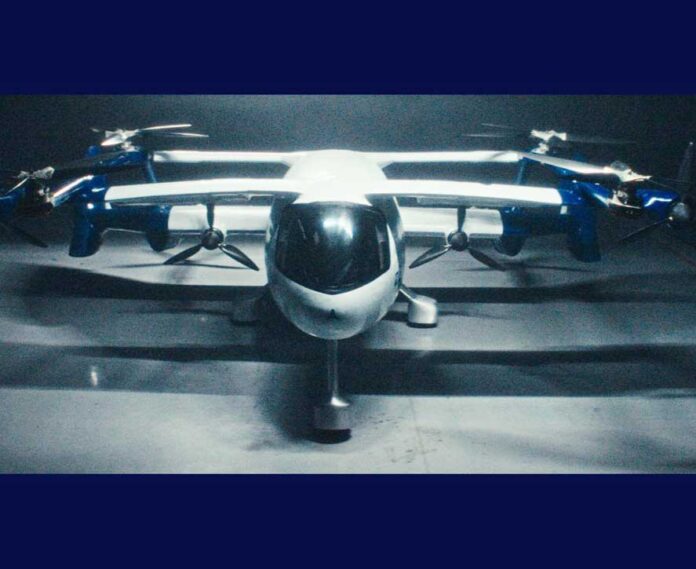
India has marked a major milestone in the future of urban air mobility with the unveiling of its first full-scale electric vertical take-off and landing (eVTOL) aircraft prototype by Chennai-based startup The ePlane Company. Incubated at IIT Madras, the company introduced the prototype, named PT-01, at its newly inaugurated 60,000 sq. ft. manufacturing facility on the IIT Madras Discovery Campus.
The PT-01 prototype represents the culmination of nearly five years of research and development involving computational modelling and progressively larger flying demonstrators. According to The Times of India, the aircraft will initially undergo unmanned test flights before advancing to piloted trials as part of its certification programme. The company is targeting commercial operations by 2028, with air ambulance services expected to be the first use case, followed by airport transfers and urban passenger transport.
Electric vertical take-off and landing aircraft are widely regarded as the next generation of short-distance urban transportation. Unlike conventional aircraft that require runways, eVTOLs can take off and land vertically before transitioning to forward flight. Powered by electric motors and batteries, they are expected to deliver quieter operations, lower emissions, and reduced operating costs compared to conventional helicopters.
The ePlane Company’s prototype has been designed to integrate with existing urban infrastructure rather than requiring dedicated new facilities. Built using a carbon-fibre composite structure, the aircraft weighs approximately 2.2 tonnes, features an 8-metre wingspan, and offers an operational range of around 110 km. Its compact footprint enables operations from spaces roughly half the size of a basketball court, allowing many existing hospital helipads and rooftop landing areas to be used with minimal modifications.
The PT-01 will initially conduct unmanned flights to validate its flight control and safety systems before carrying pilots. The aircraft has been engineered with six independent lift rotors and four forward propellers, allowing it to continue operating even if one propulsion unit fails by redistributing thrust across the remaining motors.
Unlike several competing eVTOL designs that rely on tilting rotors, the aircraft incorporates the company’s patented Synergistic Lift technology, combining fixed wings with dedicated lift and cruise propellers to enhance efficiency and operational safety.
Ground testing of the prototype is scheduled to begin early next year, followed by certification-compliant flight testing in the second quarter of 2027, subject to regulatory approvals. Commercial certification is expected to take an additional two to three years.
According to The Times of India, The ePlane Company has raised USD 21.5 million from investors, including Speciale Invest, Antares Ventures, and Micelio Mobility, and has already secured commitments for more than 800 aircraft, with a significant share of the initial demand coming from emergency medical service providers.