As electric vehicles move beyond early adopters in India, automakers are facing a new challenge: building dealer networks that can not only sell EVs, but also explain, service and support the technology throughout the ownership journey.
India’s electric passenger-vehicle market is entering a phase where selling the car may be only the beginning. As EV adoption expands beyond early adopters, the dealership is increasingly becoming an important part of the ownership experience—and the relationship between automakers and dealers is being tested in new ways.
Electric passenger-vehicle registrations rose 50% year on year to 30,325 units in August, taking EV penetration to 7.4%, according to Vahan data. While the numbers point to growing consumer acceptance, they also highlight the need for a retail and service ecosystem capable of supporting a rapidly expanding EV customer base.
For a conventional car buyer, questions around ownership are often relatively familiar. EVs introduce a different set of considerations. How often should the battery be charged? What does long-term ownership cost? How should battery health be maintained? What happens when a software-related issue occurs? And, perhaps most importantly, where can the vehicle be serviced by technicians trained to handle high-voltage systems and increasingly software-defined vehicles?
These questions are not just relevant to customers. They have become increasingly important for dealers as well.
Supporting EV customers requires investment in technician training, specialised equipment, charging infrastructure and customer education. At the same time, dealers need a business model that makes these investments commercially viable. This puts greater emphasis on the relationship between an automaker and its retail partners, particularly as the industry moves from selling a new technology to supporting it at scale.
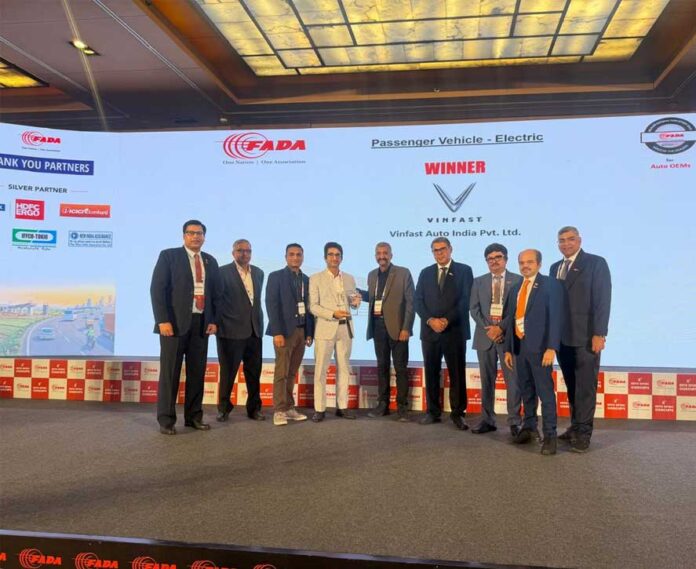
FADA’s 2025 Dealer Satisfaction Study provides an interesting lens into this changing relationship. The study surveyed more than 1,800 dealer principals representing nearly 5,000 outlets. After-sales service emerged as the most important factor influencing dealer satisfaction, followed by business viability and policy. Inventory, margins and training costs also remained among the concerns shaping the dealer experience.
Against this broader backdrop, the study offers a particularly interesting signal for India’s emerging EV market.
VinFast ranked No. 1 among electric passenger-vehicle OEMs in dealer satisfaction. The significance of the finding, however, lies less in what it says about the vehicles themselves and more in what it indicates about the automaker-dealer relationship.
Dealer satisfaction is ultimately a measure of how retail partners experience their engagement with an OEM. In an EV market where technology, service requirements and customer expectations are still evolving, that relationship could become an increasingly important competitive differentiator.
For automakers, the challenge is therefore no longer simply to build an attractive EV and put it in showrooms. They also need to give dealers the tools, training, economics and technical support required to confidently take customers through the entire ownership journey.
That could become particularly important as EVs move further into the mainstream. Early adopters may be willing to navigate unfamiliar charging routines, new maintenance practices or emerging service networks. The next wave of buyers may expect the industry to have already figured those things out.
And that is where the dealership could matter more than ever.
India’s EV boom is creating a new kind of partnership between automakers and dealers—one in which the strength of the relationship may be just as important as the strength of the product. As adoption accelerates, the companies that can build confident, capable and commercially sustainable dealer networks may be better positioned to turn EV interest into lasting customer trust.
That relationship becomes especially important when an EV maker is trying to build a network at the same time as it builds a customer base. VinFast recently opened its 60th dealership in Patna, a 3S facility bringing sales, after-sales service and customer support together. The company plans to reach 75 dealerships across more than 60 cities by the end of 2026, with the network extending into tier-2 and tier-3 markets. It has also signed with multiple Indian banks to support inventory financing, a crucial part of the dealer equation as new outlets require dealers to put more capital behind a growing stock of vehicles.
The push beyond India’s biggest cities also points to the next challenge for EV adoption: making ownership feel accessible wherever the buyer lives. The next wave of buyers will come from cities where the nearest service centre may be more important than another 20 kilometres of claimed range. A familiar local face can sometimes do more for confidence than another feature on a specification sheet.
Building that network, however, is not simply a matter of putting up more signs and opening more showrooms. As EVs spread into more cities, dealers have to become comfortable selling a technology that many of their customers are still learning about themselves. That means training sales teams, preparing technicians and making sure the service operation can keep pace with the sales operation.
The result is a “same same but different” kind of relationship between an automaker and its dealers, where the satisfaction of that relationship can bear fruit for both sides. A dealer that feels supported has more reason to invest in training, service capacity and inventory, while an OEM with a well-supported network has a better chance of reaching customers beyond the biggest cities. Coming back to the example of VinFast, it has built a nationwide dealer network in less than two years in India and is now among the country’s top five EV automakers. Its No. 1 ranking in FADA’s latest study does not explain that growth on its own, but it offers a useful indication of how the company’s relationship with its dealers may be supporting the expansion.