
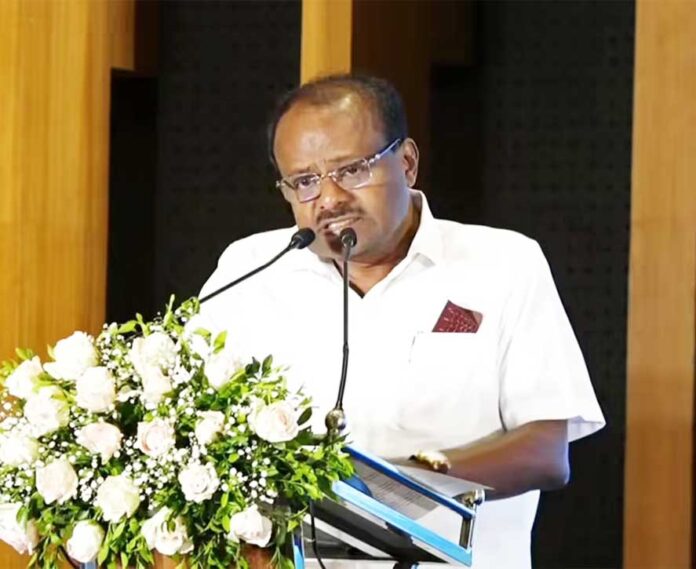
The government has approved 4,874 electric vehicle chargers under the PM e-Drive scheme with an investment of ₹503.86 crore, Union Minister for Heavy Industries and Steel H. D. Kumaraswamy announced during a conference in Bengaluru. The approvals are part of the Centre’s broader initiative to strengthen EV charging infrastructure and accelerate electric mobility adoption across India.
Among the approved proposals, Karnataka has received clearance for 1,243 EV charging stations under the scheme. The sanctioned projects also include proposals from public sector oil companies such as HPCL, Indian Oil Corporation, and BPCL, along with multiple states including Rajasthan, Andhra Pradesh, Uttar Pradesh, Gujarat, Kerala, Telangana, Karnataka, and Tamil Nadu.
The announcement was made during the Ministry of Heavy Industries conference themed “Enabling Nationwide EV Charging Infrastructure under PM E-DRIVE Scheme.” Kumaraswamy stated that ₹2,000 crore has been allocated specifically for charging infrastructure under the larger PM e-Drive scheme, which has a total outlay of ₹10,900 crore. He emphasized that a robust charging network is essential for accelerating EV adoption across two-wheelers, three-wheelers, buses, trucks, and passenger vehicles.
The minister also revealed that the government is developing a unified EV charging platform named Unified Bharat eCharge. The platform aims to allow users to locate charging stations, access networks, and make payments through a single application, similar to the convenience offered by UPI in digital payments. The Ministry of Heavy Industries is working closely with the Ministry of Power, state governments, and industry stakeholders to ensure charging infrastructure standardisation, grid readiness, and digital integration.
Highlighting the government’s focus on domestic manufacturing, Kumaraswamy pointed to several production-linked incentive (PLI) schemes supporting the EV ecosystem. These include the ₹18,100 crore PLI scheme for advanced chemistry cell manufacturing, the ₹25,938 crore PLI-Auto scheme for EVs, hydrogen-powered vehicles, and auto components, as well as the recently launched ₹7,280 crore initiative for rare earth permanent magnets aimed at boosting self-reliance.
According to the minister, India’s automotive industry contributes over 7% to the country’s GDP and nearly half of manufacturing GDP. He also acknowledged the role of oil marketing companies and private charging operators in expanding India’s EV charging ecosystem. Under the FAME-II scheme, 8,932 EV chargers have already been installed with government support worth ₹873.5 crore, including 721 chargers in Karnataka.
Kumaraswamy added that Bengaluru has emerged as one of India’s leading EV charging hubs and urged other states to fast-track charging infrastructure deployment as the country works towards reducing fossil fuel dependence and strengthening energy security.