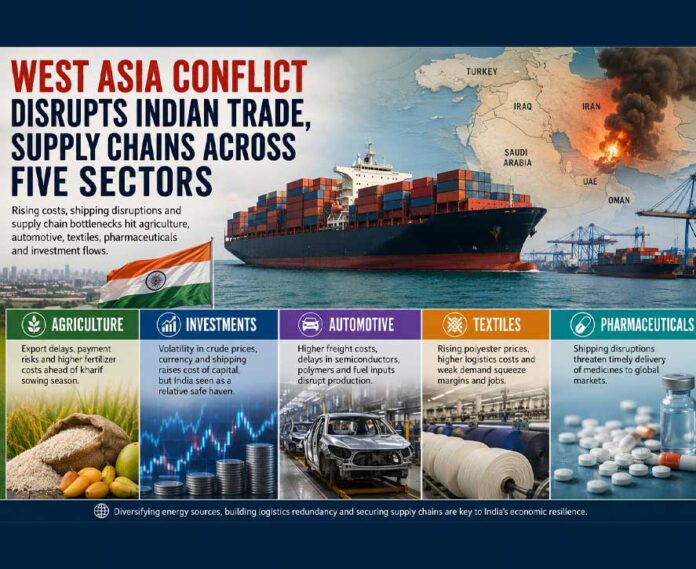
The ongoing conflict in West Asia is beginning to ripple through India’s economy, disrupting supply chains, increasing logistics costs, and creating uncertainty across key export-oriented industries, according to a new sectoral analysis by Primus Partners. The New Delhi-based consultancy says the impact extends well beyond rising crude oil prices, affecting trade routes, industrial supply chains, and investment flows simultaneously.
The report examines the implications for five major sectors — agriculture, investments, automotive, textiles, and pharmaceuticals — highlighting how the crisis is exposing structural weaknesses in India’s energy dependence, import concentration, and export exposure, while also presenting selective long-term opportunities.
Agriculture Faces Export and Input Cost Pressures
India’s agricultural exports to Gulf nations are witnessing shipment delays, payment-related uncertainties, and weakening buyer confidence. Key export commodities such as basmati rice, mangoes, and bananas are among the worst affected, given the Gulf region’s importance as a longstanding market for Indian produce.
At the same time, rising global urea prices are increasing input costs for farmers ahead of the kharif sowing season, when fertilizer demand typically peaks. A prolonged rise in fertilizer costs could influence cropping decisions and squeeze farm-level profitability, especially for small and marginal farmers with limited financial flexibility.
Investment Climate Turns Volatile, but India Gains Relative Advantage
Higher crude oil prices, widening sovereign spreads, currency volatility, and shipping disruptions are collectively driving up the global cost of capital and prompting investors to reassess commitments across markets.
Despite the uncertainty, the report suggests India may benefit from its relatively stable macroeconomic position compared to other regions facing heightened geopolitical risks. Manufacturing, infrastructure, and technology are identified as sectors likely to attract stronger investor interest, provided policy continuity and regulatory efficiency remain intact.
Automotive Sector Hit by Supply Chain Disruptions
India’s automotive industry is grappling with longer shipping timelines, rising freight costs, and shortages of critical inputs such as semiconductors, polymers, and fuel-linked materials — many of which are sourced from or routed through West Asia.
The disruptions are increasing production costs and creating uncertainty in manufacturing schedules at a time when the industry is already navigating the global shift toward electric mobility. The report notes that the crisis could accelerate efforts to localize component manufacturing and diversify sourcing strategies to reduce dependence on imported fuel-related inputs.
Textile Industry Under Mounting Pressure
The textile sector, one of India’s largest employment generators, is also facing significant strain. Rising polyester prices — closely linked to crude oil — are compressing margins, while logistics costs, delayed payments, and weaker demand from Gulf-linked markets are adding further pressure.
According to the analysis, the crisis reinforces longstanding structural challenges for the industry, including heavy dependence on a limited set of export markets and vulnerability to raw material price fluctuations. The report recommends market diversification, improved access to working capital, and stronger raw material security measures as critical long-term responses.
Pharmaceutical Supply Chains at Risk
The pharmaceutical sector carries some of the broadest implications from the ongoing disruption. As one of the world’s largest producers of generic medicines and vaccines, India plays a critical role in supplying affordable healthcare products to countries across Africa, Southeast Asia, and other developing regions.
The report warns that prolonged shipping disruptions along key maritime routes could delay deliveries of time-sensitive medicines and create bottlenecks in global pharmaceutical supply chains. Beyond commercial losses, such disruptions could impact healthcare access in countries with limited alternative sources of supply.
Strategic Importance of West Asia for India
West Asia remains central to India’s external economic relations. The region supplies a significant share of India’s crude oil imports — with the country importing nearly 85% of its oil requirements — while also serving as a major export destination for agricultural goods, pharmaceuticals, and manufactured products.
In addition, the Indian diaspora in Gulf countries contributes substantially to remittance inflows, a key source of foreign exchange for the country.
The report notes that disruptions to Gulf shipping routes and the Suez Canal corridor are increasing transit times and freight costs for Indian businesses. Since much of India’s trade with Europe and parts of Africa moves through the region, geopolitical instability in West Asia has become a structural economic concern rather than a temporary disruption.
According to Primus Partners, strengthening resilience against such crises will require India to diversify energy sources, build logistics redundancy, secure raw material supply chains, and maintain a stable regulatory environment capable of attracting long-term investments.