
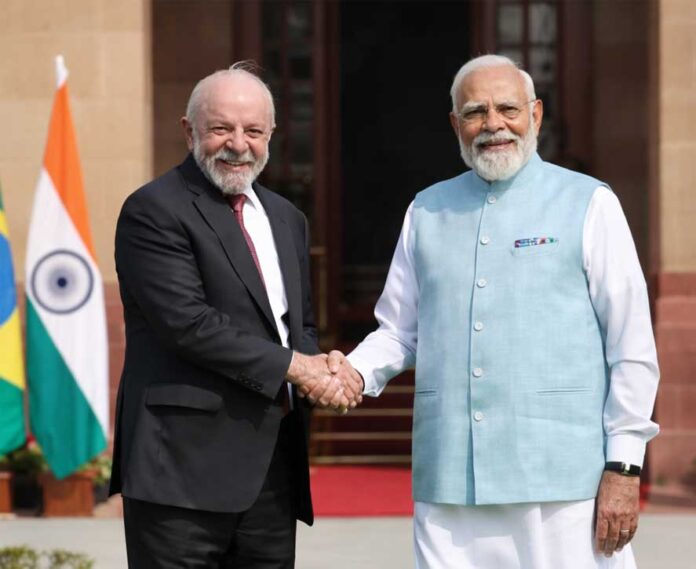
Brazil and India have signed a memorandum of understanding aimed at deepening cooperation in rare earth elements and critical minerals, marking an important step toward diversifying trade partnerships and strengthening collaboration between two leading Global South economies. The non-binding agreement establishes a framework for reciprocal investment, joint exploration, mining development, and the application of artificial intelligence technologies across the sector.
Brazil, which holds the world’s second-largest reserves of rare earth minerals, plays a significant role in global supply chains supporting products such as smartphones, electric vehicles, solar panels, and jet engines. Speaking after the signing, Brazilian President Luiz Inácio Lula da Silva emphasised that expanding cooperation in renewable energy and critical minerals forms the foundation of a forward-looking partnership between the two nations.
Beyond minerals, both countries also agreed to advance legal and institutional cooperation across entrepreneurship, healthcare, scientific research, and education. Lula arrived in India earlier in the week for a state visit aimed at strengthening bilateral ties and enhancing engagement within the BRICS grouping of developing economies, of which both nations are founding members. During the visit, he also participated in a summit focused on artificial intelligence.
Indian Prime Minister Narendra Modi, who travelled to Brazil in July last year, has been actively pursuing deeper economic and strategic cooperation with Brasília. Lula’s current visit marks his second state visit to India and included one of the largest delegations he has taken abroad, comprising 11 cabinet ministers and a sizeable group of business leaders — a move he described as a reflection of Brazil’s commitment to strengthening relations.
Analysts view the rare earths agreement as part of a broader effort by both countries to increase strategic autonomy amid shifting global dynamics. According to Oliver Stuenkel, a professor at the Getulio Vargas Foundation, diversification of partnerships has become increasingly important as geopolitical uncertainty grows.
Brazil’s push for diversified alliances gained momentum following tensions with the United States last year, when former US President Donald Trump imposed steep tariffs on Brazilian exports during legal proceedings involving his ally, former Brazilian President Jair Bolsonaro. Although most tariffs were later lifted, the episode reinforced Brasília’s desire to broaden its economic partnerships.
International relations expert Roberto Goulart Menezes of the University of Brasília noted that the dispute accelerated Brazil’s reassessment of rare earth minerals, elevating them from purely commercial commodities to assets of growing geopolitical importance.
Lula is also expected to visit his counterpart in Washington, D.C. in the coming months, with observers suggesting that the India agreement could serve as a strategic pilot framework ahead of negotiations with larger and more asymmetrical economic partners.