
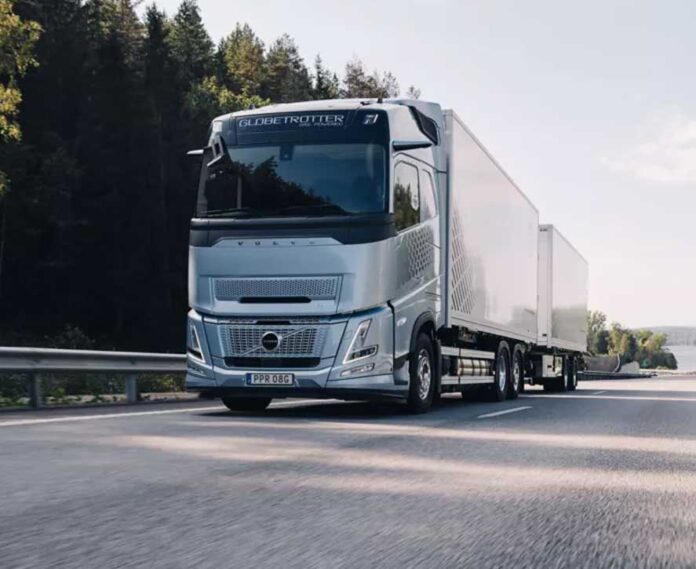
Volvo Trucks has achieved a significant milestone with more than 10,000 gas-powered trucks delivered worldwide since introducing the technology in 2018, reflecting growing industry adoption of alternative fuels aimed at reducing carbon emissions.
Demand for gas-powered trucks has accelerated as transport operators across multiple regions increasingly turn to cleaner energy solutions that offer substantial CO₂ emission reductions while maintaining operational efficiency. The company recorded its strongest-ever sales performance for gas-powered trucks in 2025, supported by an expanding product portfolio as well as favourable fuel availability and operating costs in several markets.
Volvo’s gas engines are offered in the heavy-duty Volvo FM, FH, and FH Aero ranges, and can effortlessly run on conventional LNG (Liquified Natural Gas) or bio-LNG, a non-fossil gas derived from organic waste replacing LNG.
“Volvo’s gas engine technology is a leading solution in terms of power, torque, engine response, and fuel efficiency, and our customers also appreciate the strong performance, drivability, and overall comfort of our gas-powered trucks,” says Jan Hjelmgren, Head of Product Management at Volvo Trucks. “We see substantial potential for gas-powered trucks as an important step on the journey toward zero-emission transport.”
Volvo’s gas-powered trucks can travel up to 1,000 kilometers on a single tank, making them well suited for long-haul and regional distribution, as well as construction operations. They are a practical alternative to other low-emission solutions at a time when transport operators and freight buyers are seeking more sustainable options.
In several countries, there is already a well-developed network of gas filling stations and rapidly expanding access to bio-LNG. Some examples are Germany, Norway, Finland, and Sweden where all gas filling stations now offer the fuel. This enables many users to achieve CO2 reductions of up to 100% (Well to Wheel). In markets where tax incentives and public support for renewable fuels and low emissions are available, bio-LNG becomes a highly cost-effective alternative.
Volvo’s advanced gas engine technology is derived from its highly successful D13 powertrain, delivering diesel-like performance while substantially cutting CO2 emissions.