
Introduction: Advancing the Future of Lighting and Display Technologies
The global shift toward energy-efficient solutions and enhanced visual experiences is significantly reshaping the lighting and display ecosystem, accelerating the adoption of LED and OLED technologies across multiple industries. From residential and commercial lighting applications to premium televisions, digital signage and advanced automotive dashboards, these solutions are redefining how illumination and visual content are delivered and experienced.
Known for their superior energy efficiency, design flexibility and high-performance capabilities, LED and OLED technologies are becoming essential components of modern infrastructure development, smart city initiatives and next-generation consumer electronics. As sustainability targets tighten and demand for immersive digital experiences continues to grow, the LED and OLED lighting products and displays market is entering a new phase of innovation-driven and sustainable expansion.
Market Overview: Growth Outlook and Revenue Potential
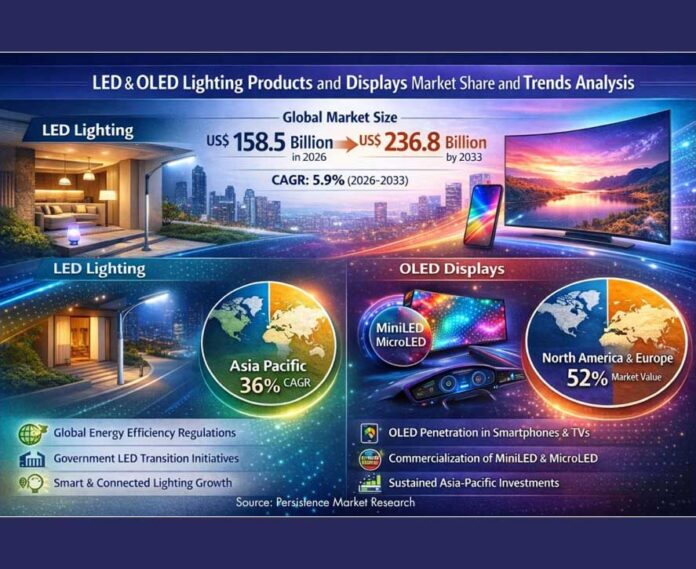
According to a recent analysis published by Persistence Market Research, the global LED and OLED lighting products and displays market is projected to reach approximately US$ 158.5 billion in 2026 and expand further to around US$ 236.8 billion by 2033. This trajectory reflects a compound annual growth rate of 5.9% during the forecast period from 2026 to 2033. The market’s expansion is being driven less by short-term demand spikes and more by structural forces such as tightening energy-efficiency regulations, large-scale LED transition programs supported by governments, and the continuous replacement of traditional lighting with smart, connected systems.
In the display segment, rising adoption of OLED panels in premium smartphones, televisions, and automotive infotainment systems is supporting value growth. At the same time, the commercialization of MiniLED and MicroLED technologies is raising performance benchmarks in brightness, power efficiency, and design flexibility. Ongoing investments in Asia-Pacific manufacturing ecosystems, combined with global decarbonization commitments, are also strengthening supply stability and long-term demand visibility across lighting and display applications.
Why Are LED and OLED Technologies Replacing Traditional Lighting and Display Systems?
LED and OLED technologies are rapidly replacing conventional lighting and display systems primarily because of their superior efficiency, durability, and design versatility. LEDs consume significantly less electricity than incandescent or fluorescent bulbs while offering longer lifespans and lower maintenance costs, making them ideal for both residential and industrial use. OLED displays, on the other hand, deliver deeper contrast, faster refresh rates, and thinner form factors, enhancing visual quality in consumer electronics and automotive systems. Additionally, global sustainability goals and energy regulations encourage businesses and governments to adopt low-energy technologies. As smart homes, electric vehicles, and digital infrastructure expand, LED and OLED solutions are becoming essential components of future-ready environments.
Growth Drivers: Sustainability and Efficiency at the Core
One of the strongest drivers of the LED and OLED market is the global push toward energy efficiency and carbon reduction. Governments worldwide are implementing strict lighting efficiency standards, encouraging the phase-out of incandescent and halogen lamps. LED lighting, which can reduce energy consumption by up to 80% compared to traditional bulbs, has become the preferred replacement solution.
At the same time, corporate sustainability commitments are accelerating adoption across commercial buildings, retail environments, and industrial facilities. Businesses are investing in intelligent lighting systems that combine LEDs with sensors and automation software to optimize energy consumption and reduce operational costs. This convergence of environmental regulation and economic benefit is ensuring long-term, stable demand growth for LED solutions.
Display Segment Expansion: OLED and Emerging Technologies
While LED lighting dominates infrastructure and architectural applications, OLED technology is rapidly transforming the display market. OLED panels offer self-emissive pixels, enabling superior contrast, flexible form factors, and ultra-thin designs. These characteristics have made OLED the technology of choice in high-end smartphones, premium televisions, and advanced automotive dashboards.
Beyond OLED, MiniLED and MicroLED innovations are gaining momentum. MiniLED enhances LCD backlighting performance, enabling brighter screens and improved contrast ratios, while MicroLED represents the next frontier with self-emissive, ultra-efficient pixels that promise exceptional durability and brightness. Although MicroLED remains in early commercialization stages due to high production costs, ongoing investments and research are expected to accelerate its adoption in large-format displays and augmented reality devices.
Smart Lighting and Connected Infrastructure
The integration of LED lighting into smart infrastructure systems is another major growth catalyst. Smart LED systems can be connected to IoT networks, enabling remote control, adaptive brightness, predictive maintenance, and energy monitoring. Cities worldwide are deploying smart street lighting to reduce energy consumption while improving public safety through adaptive illumination.
In commercial spaces, intelligent LED systems are being integrated with building management platforms to optimize lighting based on occupancy and daylight availability. These developments are transforming lighting from a static utility into a dynamic, data-driven component of digital infrastructure.
Regional Trends: Manufacturing Strength and Market Demand
Asia-Pacific continues to dominate manufacturing and supply chains for LED and OLED technologies. Countries such as China, South Korea, and Japan have built extensive production ecosystems supported by government incentives, advanced semiconductor capabilities, and strong export demand. This regional concentration ensures cost efficiency and supply continuity for global markets.
Meanwhile, North America and Europe are driving demand through sustainability regulations, infrastructure modernization programs, and strong consumer adoption of premium electronics. Emerging economies are also contributing to growth as urbanization, rising incomes, and electrification initiatives expand demand for efficient lighting and modern display devices.
Challenges: Cost Pressures and Technological Complexity
Despite steady growth prospects, the market faces challenges related to cost structures and technological complexity. OLED displays, while visually superior, remain more expensive to manufacture than traditional LCDs, limiting their adoption in mid-range consumer devices. Similarly, MicroLED production requires advanced fabrication techniques that are still being refined to achieve scalable yields.
In the lighting segment, price competition among manufacturers can compress margins, especially in commoditized LED products. To remain competitive, companies must differentiate through innovation, smart integration capabilities, and energy optimization features rather than relying solely on hardware sales.
Future Outlook: Innovation and Sustainable Growth
Looking ahead, the LED and OLED lighting products and displays market is expected to evolve through continued technological innovation and integration with digital ecosystems. Flexible OLED panels, transparent displays, human-centric lighting systems, and AI-driven illumination controls are likely to reshape both consumer and industrial applications.
Additionally, as global decarbonization strategies intensify, efficient lighting technologies will play a crucial role in reducing electricity consumption across buildings, cities, and transportation networks. The combination of regulatory support, technological progress, and expanding application areas ensures that the market will continue its steady growth trajectory over the coming decade.
Conclusion: A Market Defined by Efficiency and Innovation
The LED and OLED lighting products and displays market represents a convergence of sustainability, digital transformation, and consumer demand for high-performance technologies. With projected growth from US$ 158.5 billion in 2026 to US$ 236.8 billion by 2033, the sector is positioned for long-term stability rather than short-lived expansion. As innovation continues to enhance efficiency, flexibility, and connectivity, LED and OLED solutions will remain fundamental to modern lighting systems and next-generation visual experiences worldwide.