
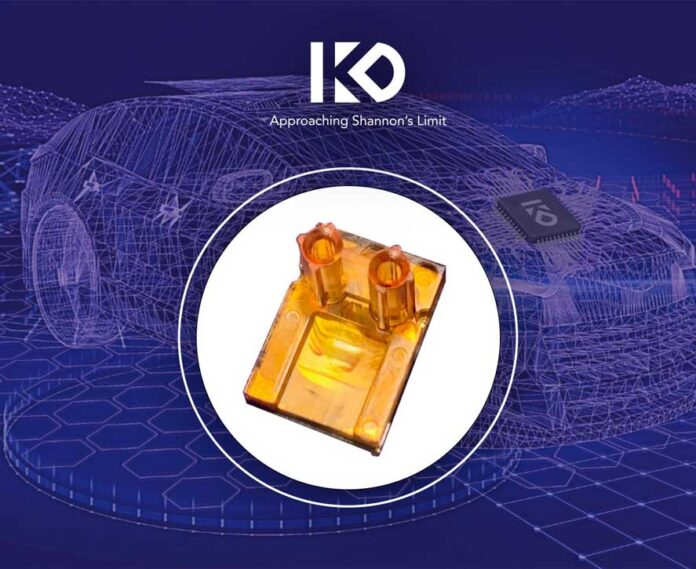
Semiconductor innovator KD has announced a strategic distribution partnership with Hitachi High-Tech Corporation, aimed at strengthening the availability of advanced optical multigigabit connectivity solutions across Japan’s automotive ecosystem. The agreement is designed to improve market access and customer engagement for KD’s integrated optoelectronic technologies, enabling automotive OEMs, Tier-1 suppliers, and ecosystem partners to evaluate and deploy next-generation in-vehicle networking solutions more efficiently.
Supporting the Evolution of Automotive Electronics
Commenting on the collaboration, Takahiro Sugihara, Head of Industrial & Social Infrastructure Business, highlighted the alignment between the two companies’ innovation goals. He emphasized that KD’s leadership in high-speed in-vehicle networking complements Hitachi High-Tech’s commitment to delivering advanced technologies and services that drive the future of automotive electronics and intelligent mobility.
From KD’s perspective, the partnership marks a significant step toward expanding its footprint in one of the world’s most technologically advanced automotive markets. Óscar Ciordia, Marketing and Sales Director at KD, noted that Japan’s strong ecosystem of OEMs and Tier-1 suppliers makes it a key region for optical networking adoption. He described the agreement as an important milestone that signals growing momentum for optical multigigabit connectivity within the Japanese automotive industry.
Spotlight on KD7251 Integrated Optoelectronics Platform
A central focus of the collaboration is KD’s KD7251 integrated optoelectronics device, engineered to support high-speed data transmission in demanding automotive environments. Designed for scalable and future-ready vehicle architectures, the solution addresses the growing bandwidth requirements of advanced driver assistance systems (ADAS), infotainment platforms, and emerging software-defined vehicle ecosystems.
The KD7251 integrates optical and electronic functionality into a single-chip design, enabling robust multigigabit communication while helping engineers manage electromagnetic interference (EMI), packaging constraints, and system complexity in zonal and centralized vehicle architectures.
Built around BASE-AU physical layer implementation and compliant with IEEE Std 802.3cz automotive optical communication standards, the ASIC supports multi-mode glass optical fibre (OM3) connectivity for reliable in-vehicle networking.
The single-chip solution features an on-chip optical interface supporting data rates of 2.5 Gb/s, 5 Gb/s, and 10 Gb/s. It also includes integrated bridging capabilities, allowing direct connectivity with MIPI-based sensors such as cameras and radar (CSI-2), displays (DSI-2), and AI processors through PCIe interfaces. This functionality simplifies system integration while enabling automakers to build high-performance, future-proof vehicle platforms.